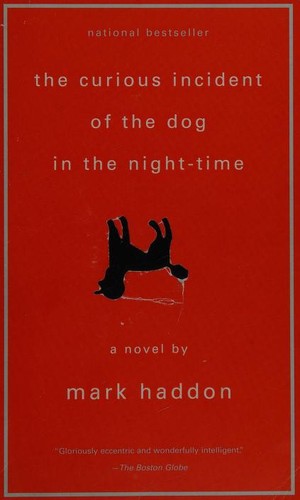
Talk to The Curious Incident of the Dog in the Night-Time like its author wrote you back.
Get the ideas that fit your life — not generic summaries.
- Chat with the book
- Audiobook-style main ideas
- Adapts to your life and goals
- Helps you take action
The Curious Incident of the Dog in the Night-Time, in detail
Christopher John Francis Boone is fifteen years old, knows all the prime numbers up to 7,057, and has decided to investigate who killed his neighbor's dog with a garden fork. The resulting detective story takes him — and the reader — on an increasingly high-stakes journey that begins in the quiet streets of Swindon and ends with Christopher alone on a train to London, doing something that terrifies him in ways that no math problem ever could.
What makes the novel unusual is its narrator. Christopher tells the story in a voice that is logical, literal, precise, and consistently missing the emotional register that most narrators use. Mark Haddon never labels Christopher's condition in the text — the novel's original paperback edition did use "Asperger's" on the jacket but the word never appears inside — and the effect is that the reader gradually understands Christopher through the way he sees the world rather than through any diagnostic category. What looks at first like an eccentric detective story reveals itself as a novel about what it means to live in a mind that processes the world differently from most people around you.
The formal invention is real. Christopher's chapters are numbered in prime numbers (2, 3, 5, 7, 11...). He includes maps, diagrams, and mathematical proofs in his narrative. He cannot read faces or metaphors or the social signals that most people absorb unconsciously. Haddon uses these constraints to create a narrator who is both highly reliable about physical facts and entirely unreliable about what those facts mean emotionally — a gap that becomes devastating when the truth about his family begins to emerge.
The book is short and reads fast, which can make it feel like a modest achievement on the page. It isn't. The craft involved in sustaining Christopher's voice for 220 pages without condescension, sentimentality, or easy resolution is considerable. It works as a young adult novel, as a mystery, and as a fairly serious literary experiment in restricted perspective. Readers who find Christopher's voice tedious early will not enjoy it; readers who surrender to the logic will find something that stays with them.
The big ideas
- 1.
Restricting narration to a single, highly specific perspective — one that cannot perceive or report emotional context — forces readers to do interpretive work that is unusually active and rewarding.
- 2.
Christopher is not a stereotype of neurodivergence; he is a fully specific person, and the novel is careful to show both what his way of thinking enables and what it costs him.
- 3.
The mystery structure is a delivery mechanism — the real discovery is not who killed the dog but what Christopher's parents have been hiding, which is a more ordinary and more devastating kind of crime.
