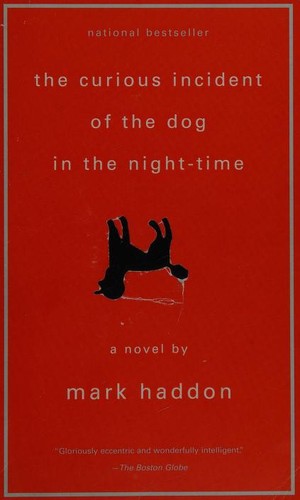
The Curious Incident of the Dog in the Night-Time by Mark Haddon is a 2003 contemporary fiction book about neurodivergence and perception, truth and trust, family breakdown. Restricting narration to a single, highly specific perspective — one that cannot perceive or report emotional context — forces readers to do interpretive work that is unusually active and rewarding.
Summary
Christopher John Francis Boone is fifteen years old, knows all the prime numbers up to 7,057, and has decided to investigate who killed his neighbor's dog with a garden fork. The resulting detective story takes him — and the reader — on an increasingly high-stakes journey that begins in the quiet streets of Swindon and ends with Christopher alone on a train to London, doing something that terrifies him in ways that no math problem ever could.
What makes the novel unusual is its narrator. Christopher tells the story in a voice that is logical, literal, precise, and consistently missing the emotional register that most narrators use. Mark Haddon never labels Christopher's condition in the text — the novel's original paperback edition did use "Asperger's" on the jacket but the word never appears inside — and the effect is that the reader gradually understands Christopher through the way he sees the world rather than through any diagnostic category. What looks at first like an eccentric detective story reveals itself as a novel about what it means to live in a mind that processes the world differently from most people around you.
The formal invention is real. Christopher's chapters are numbered in prime numbers (2, 3, 5, 7, 11...). He includes maps, diagrams, and mathematical proofs in his narrative. He cannot read faces or metaphors or the social signals that most people absorb unconsciously. Haddon uses these constraints to create a narrator who is both highly reliable about physical facts and entirely unreliable about what those facts mean emotionally — a gap that becomes devastating when the truth about his family begins to emerge.
The book is short and reads fast, which can make it feel like a modest achievement on the page. It isn't. The craft involved in sustaining Christopher's voice for 220 pages without condescension, sentimentality, or easy resolution is considerable. It works as a young adult novel, as a mystery, and as a fairly serious literary experiment in restricted perspective. Readers who find Christopher's voice tedious early will not enjoy it; readers who surrender to the logic will find something that stays with them.
Talk to The Curious Incident of the Dog in the Night-Time like its author wrote you back.
Get the ideas that fit your life — not generic summaries.
- Chat with the book
- Audiobook-style main ideas
- Adapts to your life and goals
- Helps you take action
Key takeaways
- 1.
Restricting narration to a single, highly specific perspective — one that cannot perceive or report emotional context — forces readers to do interpretive work that is unusually active and rewarding.
- 2.
Christopher is not a stereotype of neurodivergence; he is a fully specific person, and the novel is careful to show both what his way of thinking enables and what it costs him.
- 3.
The mystery structure is a delivery mechanism — the real discovery is not who killed the dog but what Christopher's parents have been hiding, which is a more ordinary and more devastating kind of crime.
- 4.
The chapter-numbering in primes is not a gimmick; it establishes the world Christopher inhabits before he says a single word about himself.
- 5.
Christopher's inability to lie — and his corresponding inability to trust people who do — becomes the moral center of the novel.
- 6.
The novel performs a kind of empathy training: by the end you understand something about a mode of perception that most fiction ignores.
- 7.
Haddon's restraint is the novel's distinguishing quality. He never explains Christopher, never condescends to him, and never converts his differences into pathos.
- 8.
The ending is deliberately incomplete — Christopher reaches a goal that is both an achievement and a beginning, not a resolution.
Discussion questions
Use these on your own, with a book club, or as chat starters in Superbook. Book club version, ready to copy or print →
- 1.
Haddon deliberately avoided labeling Christopher's condition in the text. Does that choice help you engage with him as a specific person, or does it make the novel harder to interpret?
- 2.
Christopher cannot lie and finds lying physically distressing. Does that make him more or less trustworthy as a narrator than most fiction narrators?
- 3.
The real mystery — what his parents concealed — is much more mundane than a murder. Was that revelation as affecting as you expected, or more so?
- 4.
Christopher's father is both the person who harms him most and the person who genuinely loves him. How does the novel ask you to hold that?
- 5.
The novel is sometimes taught in schools alongside books about autism or Asperger's syndrome. Does teaching it that way help or limit what the book actually does?
- 6.
Christopher's logic-driven narration occasionally produces comedy. Is that comedy affectionate, problematic, or both?
- 7.
The chapter numbers are primes. Did you notice while reading, and if so, did it change anything for you?
- 8.
Christopher undertakes a journey that terrifies him to reach a goal most teenagers would find trivial. What does that courage cost him, and does the novel honor it adequately?
- 9.
How does this novel compare to a-wrinkle-in-time or the-outsiders as a coming-of-age story about a character who doesn't fit?
- 10.
Several adult characters in the novel are well-intentioned and still harmful. Which one felt most honestly drawn?
- 11.
The book ends with Christopher having accomplished something important and planning something bigger. Is that an earned ending or an evasion?
- 12.
If Christopher told this story at fifty rather than fifteen, what would change?
Themes
Frequently asked questions
-
Is The Curious Incident of the Dog in the Night-Time worth reading as an adult?
Yes. It's marketed as both YA and adult fiction, and it rewards adult readers for reasons different from why it works for younger ones. The formal experimentation and the portrait of family dysfunction have more resonance with an adult frame of reference.
-
Is Christopher autistic?
Haddon has said he did minimal research on autism or Asperger's while writing and was deliberately vague. The word doesn't appear in the novel. Whether Christopher is 'on the spectrum' is less interesting than the specific character Haddon created — and conflating the two can reduce a richly specific person to a diagnostic category.
-
Is the book appropriate for children?
The recommended age range is typically twelve and up. It contains some strong language and deals with parental infidelity and family breakdown in ways that are honest rather than sanitized. Most teenage readers handle it easily.
-
Is there a movie of The Curious Incident?
No feature film has been made. The stage adaptation by Simon Stephens, which debuted at the National Theatre in London in 2012, is the major adaptation — it toured internationally and ran on Broadway. The production is considered exceptional and very faithful to the book's spirit.
-
Who shouldn't read this book?
Readers who find first-person narration with strong limitations frustrating — unreliable, emotionally flat, or exhaustingly constrained — will struggle. The novel asks you to stay inside a perspective that cannot give you the interpretive guidance most narrators provide.
Similar books
A Wrinkle in Time
Madeleine L'Engle
The Outsiders: Eight Unconventional CEOs and Their Radically Rational Blueprint for Success
William N. Thorndike
Educated: A Memoir
Tara Westover
Normal People
Sally Rooney
