Philosophy · Book club
The Daily Stoic book club questions
Here are 12 book club questions for The Daily Stoic by Ryan Holiday and Stephen Hanselman, ordered to open easily and end somewhere worth arguing about. Copy them, print them, or bring them up one at a time.
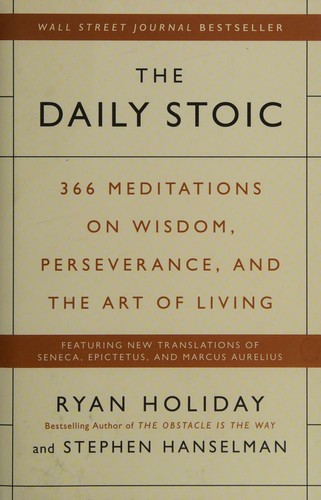
The Daily Stoic is a 366-entry collection of meditations drawn from the Stoic philosophers — Marcus Aurelius, Epictetus, Seneca, and lesser-known figures like Cato and Zeno.
Ryan Holiday and Stephen Hanselman · 2016 · 5h 0m
Full summary and key takeaways →The 12 questions
- 1.
Pick one of the three themes — perception, action, will — that you think you most need to develop. What does weakness there look like in your day-to-day life?
- 2.
The Stoics distinguish between preferred indifferents (health, money, reputation) and genuine goods (virtue, wisdom). Does that distinction change how you evaluate a recent decision?
- 3.
Holiday uses memento mori as a lens throughout the book. Is that idea clarifying or paralyzing for you? What does it change, if anything, about how you're spending your time?
- 4.
The obstacle is the way is one of Holiday's signature frames. Think of a current obstacle. What opportunity, if any, does it contain?
- 5.
Marcus Aurelius wrote for himself, not for an audience. Does the private nature of Meditations change how you read the passages Holiday includes?
- 6.
Epictetus was enslaved and later became one of the most influential philosophers of the ancient world. How does his biography affect the weight you give his ideas?
- 7.
The format assumes daily practice. How does reading philosophy in small doses over a long time differ from reading a book straight through? Which have you actually done?
- 8.
Negative visualization asks you to imagine losing what you have. What happens when you apply it to something you currently take for granted?
- 9.
The Stoics were skeptical of strong emotion, especially anger and grief. Where does that skepticism feel like wisdom to you, and where does it feel like denial?
- 10.
Holiday argues Stoicism is practical, not abstract. What's one Stoic idea from the book you've already applied or could apply this week?
- 11.
The book is structured as a year of reading. What would change if you actually read it that way rather than all at once?
- 12.
Several entries deal with how to treat people who wrong you. Does the Stoic prescription — respond with reason, not reaction — feel realistic or too demanding?
How to run the discussion
- Pick six to eight, not all of them. An hour of real discussion covers fewer questions than anyone expects, and racing the list is what makes a book club feel like homework.
- Open with what people noticed, not what they concluded. Asking for a verdict first hardens opinions before anyone has heard each other.
- Let the disagreement run. The questions below that split a room are the ones worth the time; the ones everyone answers the same way can be skipped.
- Ask the quiet person a specific question. A direct, narrow question is far easier to answer than an open invitation to contribute.
Themes worth steering toward
If the conversation stalls, these are the threads that usually restart it.
Common questions
What are good book club questions for The Daily Stoic?
Here are 12 book club questions for The Daily Stoic by Ryan Holiday and Stephen Hanselman, ordered to open easily and end somewhere worth arguing about. The strongest openers ask what each reader noticed rather than what they concluded, and the discussion usually turns on stoicism, resilience, self-discipline.
How long should a book club discussion of The Daily Stoic last?
Most groups run 60 to 90 minutes of actual discussion. That is roughly six to eight questions, not all of them, so pick the ones that suit your group rather than working down the list in order.
What are the main themes in The Daily Stoic?
Stoicism, Resilience, Self-discipline, Mortality, Virtue. Those are the threads most likely to divide a room, which makes them the useful places to steer a discussion that has gone quiet.
Picking the next one? See books like The Daily Stoic or questions for other book club picks.
