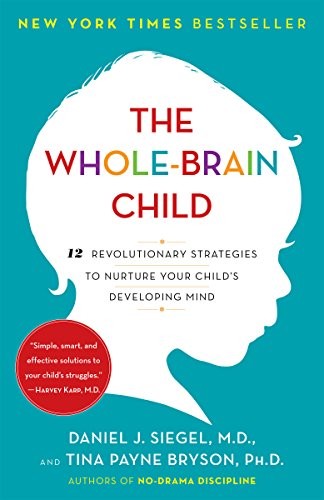
Talk to The Whole-Brain Child: 12 Revolutionary Strategies to Nurture Your Child's Developing Mind like its author wrote you back.
Get the ideas that fit your life — not generic summaries.
- Chat with the book
- Audiobook-style main ideas
- Adapts to your life and goals
- Helps you take action
What it argues
Daniel Siegel and Tina Payne Bryson's premise is that much of what frustrates parents — tantrums, defiance, emotional meltdowns — is best understood not as bad behavior but as immature brain function. The book translates neuroscience into practical parenting guidance, specifically around the idea that the left and right hemispheres of a child's brain, and the upstairs and downstairs regions, are not yet integrated. When integration fails, the child loses access to reasoning and is governed by reactive, emotional, survival-oriented circuits. The parent's job is not to punish these moments but to use them as opportunities to build the neural connections that make integration more reliable over time.
The left hemisphere handles logic, language, and sequence; the right handles emotion, imagery, and the body. In early childhood the right dominates. When a child is overwhelmed, the left brain goes offline and the child cannot be reasoned with — a fact most parents learn the hard way. Siegel and Bryson's first strategy is "connect and redirect": first connect emotionally and sensorially with the child's right-brain experience, then redirect to left-brain reasoning once the storm passes. Trying to reason with an emotionally overwhelmed child is neurologically futile, and insisting on it escalates rather than resolves the situation.
What it gets right
- 1.
Children's emotional meltdowns are often failures of brain integration, not willful misbehavior. The left brain's language and reasoning go offline when the right brain or downstairs brain is overwhelmed.
- 2.
Connect before you redirect. When a child is emotionally overwhelmed, trying to reason with them first is neurologically futile. Connect emotionally, then redirect once the storm passes.
- 3.
The prefrontal cortex — responsible for impulse control, empathy, and deliberate choice — is under construction through the mid-twenties. Punishing its absence doesn't accelerate its development.
What it covers
Who wrote it
Daniel J. Siegel is a clinical professor of psychiatry at the UCLA School of Medicine and the founding co-director of the Mindful Awareness Research Center. He developed the interpersonal neurobiology framework that underlies The Whole-Brain Child and has written extensively on attachment, development, and the neuroscience of experience. Tina Payne Bryson is a pediatric and adolescent psychotherapist and the founder of The Center for Connection in Pasadena. Together they also wrote No Drama Discipline and The Yes Brain.
