The Whole-Brain Child: 12 Revolutionary Strategies to Nurture Your Child's Developing Mind by Daniel J. Siegel and Tina Payne Bryson is a 2011 psychology book about child development, parenting, neuroscience. Children's emotional meltdowns are often failures of brain integration, not willful misbehavior. The left brain's language and reasoning go offline when the right brain or downstairs brain is overwhelmed.
Summary
Daniel Siegel and Tina Payne Bryson's premise is that much of what frustrates parents — tantrums, defiance, emotional meltdowns — is best understood not as bad behavior but as immature brain function. The book translates neuroscience into practical parenting guidance, specifically around the idea that the left and right hemispheres of a child's brain, and the upstairs and downstairs regions, are not yet integrated. When integration fails, the child loses access to reasoning and is governed by reactive, emotional, survival-oriented circuits. The parent's job is not to punish these moments but to use them as opportunities to build the neural connections that make integration more reliable over time.
The left hemisphere handles logic, language, and sequence; the right handles emotion, imagery, and the body. In early childhood the right dominates. When a child is overwhelmed, the left brain goes offline and the child cannot be reasoned with — a fact most parents learn the hard way. Siegel and Bryson's first strategy is "connect and redirect": first connect emotionally and sensorially with the child's right-brain experience, then redirect to left-brain reasoning once the storm passes. Trying to reason with an emotionally overwhelmed child is neurologically futile, and insisting on it escalates rather than resolves the situation.
The upstairs brain — the prefrontal cortex and its associated structures — handles deliberate decision-making, empathy, impulse control, and moral reasoning. It is under construction through the mid-twenties. The downstairs brain — the brainstem and limbic system — handles survival responses, basic drives, and emotion. When the downstairs brain floods with threat or emotional activation, the upstairs brain goes offline ("flipping the lid," in Siegel's memorable phrase). Parents who respond to downstairs-brain behavior with punishment are punishing the absence of a developmental capacity the child doesn't yet have.
The book offers twelve concrete strategies grouped under four categories: left-right integration, upstairs-downstairs integration, memory integration, and social integration. Each strategy comes with simple language parents can use, illustrations, and brief explanations of the underlying neuroscience. The writing is accessible and the examples are drawn from recognizable parenting situations. The book does not address severe behavioral or developmental disorders, and its strategies presuppose a degree of parental regulation and time that not all parents have. But as an introduction to applying neuroscience to everyday parenting, it is unusually practical.
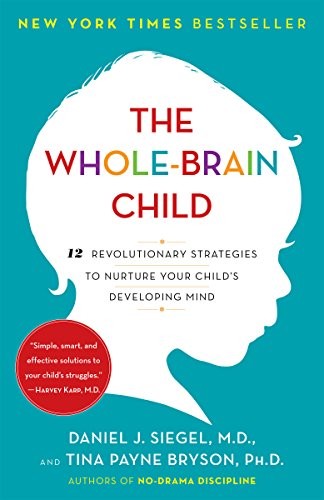
Talk to The Whole-Brain Child: 12 Revolutionary Strategies to Nurture Your Child's Developing Mind like its author wrote you back.
Get the ideas that fit your life — not generic summaries.
- Chat with the book
- Audiobook-style main ideas
- Adapts to your life and goals
- Helps you take action
Key takeaways
- 1.
Children's emotional meltdowns are often failures of brain integration, not willful misbehavior. The left brain's language and reasoning go offline when the right brain or downstairs brain is overwhelmed.
- 2.
Connect before you redirect. When a child is emotionally overwhelmed, trying to reason with them first is neurologically futile. Connect emotionally, then redirect once the storm passes.
- 3.
The prefrontal cortex — responsible for impulse control, empathy, and deliberate choice — is under construction through the mid-twenties. Punishing its absence doesn't accelerate its development.
- 4.
'Flipping the lid' is what happens when the downstairs brain takes over: the upstairs brain goes offline, and the child or adult loses access to reasoning, planning, and social sensitivity.
- 5.
Narrative integration — helping a child make sense of frightening or confusing experiences by retelling them — uses left-brain language to integrate right-brain emotional memory.
- 6.
Siegel and Bryson distinguish 'survive or thrive' — the state in which parents manage behavior reactively — from the deliberate use of difficult moments as opportunities to build brain integration.
- 7.
The brain is shaped by experience. Each time a parent connects with a child's emotional state and then guides them to regulation, the child builds neural pathways that make future regulation more accessible.
- 8.
Integration — of left and right, upstairs and downstairs, implicit and explicit memory — is the neurological correlate of emotional and behavioral health. Parenting practices that support integration build the architecture of resilience.
Discussion questions
Use these on your own, with a book club, or as chat starters in Superbook.
- 1.
Siegel and Bryson say that during an emotional meltdown, reasoning with a child is neurologically futile. Think of a time when someone tried to reason with you when you were emotionally overwhelmed. What would have helped instead?
- 2.
The concept of 'flipping the lid' applies to adults as well as children. When does your own upstairs brain go offline, and what triggers it?
- 3.
The book asks parents to see meltdowns as teaching opportunities rather than discipline problems. What does it take to make that shift in the moment, and what makes it hard?
- 4.
The authors distinguish between discipline that punishes behavior and discipline that builds brain capacity. How were you disciplined as a child, and how does that affect how you respond to children now?
- 5.
The left brain handles language and narrative; the right handles emotion and sensation. What does it mean in practice to connect with a child's right-brain experience before engaging their left brain?
- 6.
Siegel and Bryson argue that retelling a frightening experience in narrative form helps integrate it neurologically. Have you experienced something like this — a story that helped you make sense of something difficult?
- 7.
The book assumes parents have the capacity to stay regulated themselves in order to help a child regulate. What are the conditions under which that capacity fails, and what happens then?
- 8.
Which of the twelve strategies seems most immediately useful to you, and which seems hardest to implement in real circumstances?
- 9.
The book addresses early childhood primarily. How might the framework — upstairs/downstairs, left/right — apply to your interactions with adolescents or adults?
- 10.
Siegel and Bryson argue that brain integration is built in relationships. What does that suggest about children who lack consistent, regulated caregiving?
- 11.
The book does not address severe behavioral or developmental disorders. What are the limits of applying this framework to children whose neurological challenges are more significant?
- 12.
What aspect of your own upbringing do you now understand differently through the lens of brain development and integration?
Themes
Frequently asked questions
-
Is The Whole-Brain Child evidence-based?
The book is grounded in well-established neuroscience of child development, including research on prefrontal cortex maturation, hemispheric lateralization, and attachment. The specific application to parenting strategies is extrapolated from that research rather than independently validated in randomized trials, which is typical of parenting books drawing on neuroscience.
-
Is this book useful if my children are teenagers?
Yes, with adjustments. The upstairs-downstairs framework applies directly to adolescents, whose prefrontal cortex is still developing. The specific strategies are weighted toward early childhood, but the underlying principles about connecting before redirecting and supporting integration translate across ages.
-
How long does it take to read?
Around four hours at average pace. The chapters are short, the illustrations helpful, and the strategies are organized so you can return to specific sections as relevant situations arise. Most parents read it quickly and then use it as a reference.
-
What is the most practical takeaway?
Connect before you redirect. When a child is emotionally overwhelmed, acknowledge their emotional state before moving to explanation or consequence. This is the single behavioral change that the authors return to most consistently, and it is both neurologically justified and practically available to most parents.
-
Who should read this book?
Parents of young and school-age children who want a neuroscience-grounded framework for understanding emotional meltdowns, defiance, and developmental challenges. Also useful for teachers, therapists, and early childhood educators. Less useful as a guide to serious behavioral or developmental disorders.
Similar books

Mindset: The New Psychology of Success
Carol S. Dweck
Emotional Intelligence
Daniel Goleman
How Emotions Are Made: The Secret Life of the Brain
Lisa Feldman Barrett
Daring Greatly
Brené Brown
