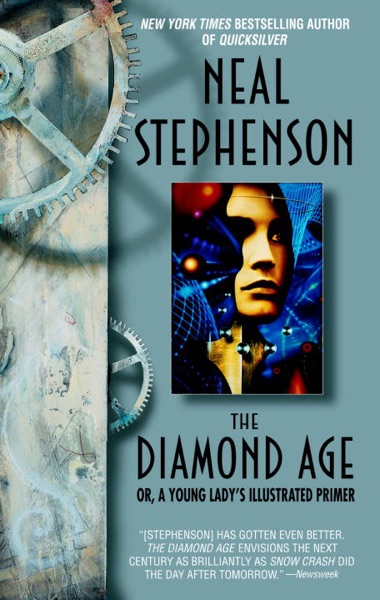
Talk to The Diamond Age like its author wrote you back.
Get the ideas that fit your life — not generic summaries.
- Chat with the book
- Audiobook-style main ideas
- Adapts to your life and goals
- Helps you take action
The Diamond Age, in detail
The Diamond Age, or A Young Lady's Illustrated Primer is a 1995 science fiction novel set in a near-future world where nanotechnology has solved most material scarcity but failed to eliminate inequality. Stephenson imagines a society organized around neo-Victorian "phyles" — voluntary cultural tribes defined by shared values rather than ethnicity or geography. The rich live in enclaves with powerful defenses and abundant matter compilers that fabricate almost anything from raw feedstock. The poor live in the Feed margins, dependent on centralized infrastructure they cannot control or understand.
The novel's engine is a piece of illegal technology: an interactive book called A Young Lady's Illustrated Primer, engineered by the brilliant Dr. John Percival Hackworth for a neo-Victorian lord who wants to give his daughter every cognitive advantage. The book is stolen, and a copy ends up in the hands of Nell, a young girl living in poverty on the outer edges of a Shanghai-like enclave. The Primer becomes Nell's tutor, companion, and surrogate parent — adapting its stories to her circumstances, teaching her not just facts but the capacity to think, question, and act.
The central argument the novel makes — through narrative rather than lecture — is that education is not information delivery. The Primer works because it responds to Nell as an individual and because a real human actor, a "ractor" named Miranda, breathes life into it for hours each night without knowing who the child is. The book raises the question of whether that human presence is irreplaceable, or whether a sufficiently sophisticated interactive system could substitute for it. The Chinese government thinks it can, and builds millions of Primers for the orphaned girls of Shanghai — a project that produces a different outcome than they expect.
Stephenson is a dense, allusive writer. The Diamond Age takes more work to follow than Snow Crash; it has more characters, a more fragmented structure, and an ending that leaves much unresolved. The payoff is a novel that takes ideas seriously — about education, about what culture is for, about whether technology can distribute cognitive advantage or whether the human element is always the bottleneck.
The big ideas
- 1.
Nanotechnology in the novel solves material scarcity for some while leaving others dependent on centralized infrastructure — abundance and inequality coexist.
- 2.
The most powerful thing the Illustrated Primer does is not teach content but teach the capacity to learn, question, and improvise.
- 3.
Stephenson argues through narrative that education requires a human element — the ractors animating the Primer are as essential as the AI.
