Talk to The Divide like its author wrote you back.
Get the ideas that fit your life — not generic summaries.
- Chat with the book
- Audiobook-style main ideas
- Adapts to your life and goals
- Helps you take action
What it argues
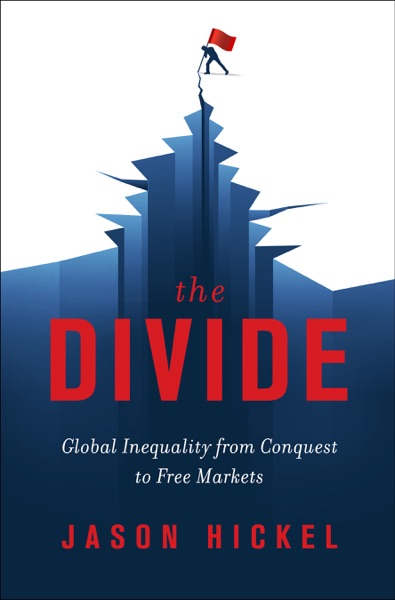
The Divide is Jason Hickel's argument that global poverty is not a natural condition that development has failed to fully remedy, but a product of policies — colonial extraction, debt regimes, trade rules, and structural adjustment — that wealthy countries have imposed on poor ones. Hickel, an economic anthropologist, mounts a systematic challenge to the dominant narrative of development economics, which holds that the world is getting steadily better and that the existing global economic architecture, despite its imperfections, is generally delivering progress.
His case proceeds in two parts. The first reconstructs how the divide between rich and poor countries was created. Colonialism did not merely slow development in what is now called the Global South; it actively dismantled existing industries, extracted wealth, and installed governance structures designed to serve metropolitan interests. The debt crisis of the 1980s continued this dynamic: loans came with structural adjustment conditions requiring privatization, deregulation, and austerity that often made poor countries poorer. Trade rules negotiated through the WTO and bilateral agreements systematically favor rich-country exports and restrict poor-country options.
What it gets right
- 1.
The global divide between rich and poor countries was not a natural starting point that development is trying to close — it was actively created through colonialism and continues to be maintained through debt, trade rules, and financial flows.
- 2.
More wealth leaves poor countries through debt repayment, profit repatriation, and illicit financial flows than enters through aid — the net flow of money is from poor countries to rich ones, not the reverse.
- 3.
The $1.90-a-day poverty line used in official statistics is set below the level at which people can meet basic nutritional needs in many countries. Using more realistic lines, poverty reduction in recent decades looks significantly less dramatic.
What it covers
Who wrote it
Jason Hickel is an economic anthropologist and author who has taught at the London School of Economics, Goldsmiths University of London, and the Institute for Environmental Science and Technology in Barcelona. His work focuses on global inequality, development economics, and ecological economics. He is the author of several books including Less Is More, which argues for degrowth as a response to ecological crisis, and has written for outlets including The Guardian, Al Jazeera, and Foreign Policy. He is a prominent critic of mainstream development economics and the measurement frameworks used to assess global poverty.
