Science · Book club
The Double Helix book club questions
Here are 12 book club questions for The Double Helix by James D. Watson, ordered to open easily and end somewhere worth arguing about. Copy them, print them, or bring them up one at a time.
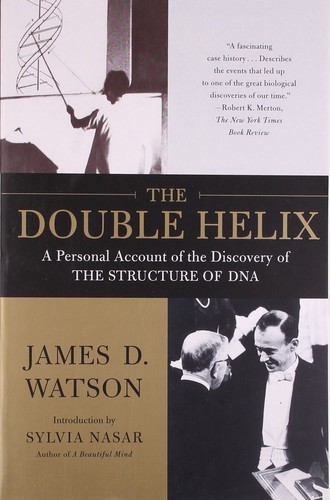
The Double Helix is James Watson's account of the race to determine the structure of DNA, which he and Francis Crick solved in 1953 at Cambridge.
James D. Watson · 1968 · 4h 0m
Full summary and key takeaways →The 12 questions
- 1.
Watson was remarkably candid about his ambitions and the competitive atmosphere of science. Does that candor make the book more trustworthy or less?
- 2.
Rosalind Franklin's X-ray data was shared without her knowledge. How do you evaluate that ethically, given that it led to one of the most important discoveries in biology?
- 3.
Franklin died in 1958 before the Nobel Prize was awarded in 1962. Nobel Prizes are not awarded posthumously. Does that matter, or is credit always distributed imperfectly in collaborative science?
- 4.
The double helix was solved by model-building rather than experiment. What does that suggest about what counts as scientific method?
- 5.
Watson describes being motivated largely by ambition and competitive drive. Is that kind of motivation compatible with good science, or does it distort it?
- 6.
The book paints a picture of science as a club with informal norms, gossip networks, and social hierarchies. Does that picture match your expectations?
- 7.
Watson's account of Franklin is widely criticized as unfair. Why do you think he wrote it the way he did, and what does that tell us about how scientists construct their own histories?
- 8.
The discovery of the double helix immediately suggested the mechanism of genetic replication. How often do major scientific discoveries resolve not just the question being asked but several other questions simultaneously?
- 9.
Watson is dismissive of Franklin's personality while relying on her work. How should we read scientific memoirs written by one of the principal actors?
- 10.
What would the history of molecular biology look like if Watson and Crick had not seen Franklin's Photo 51?
- 11.
The book was controversial when published. Should scientists have the right to publish personal accounts of discoveries that implicate colleagues who may see things differently?
- 12.
How does knowing the outcome — DNA's structure is now taught in every high school — change how you read the tension and uncertainty Watson describes?
How to run the discussion
- Pick six to eight, not all of them. An hour of real discussion covers fewer questions than anyone expects, and racing the list is what makes a book club feel like homework.
- Open with what people noticed, not what they concluded. Asking for a verdict first hardens opinions before anyone has heard each other.
- Let the disagreement run. The questions below that split a room are the ones worth the time; the ones everyone answers the same way can be skipped.
- Ask the quiet person a specific question. A direct, narrow question is far easier to answer than an open invitation to contribute.
Themes worth steering toward
If the conversation stalls, these are the threads that usually restart it.
Common questions
What are good book club questions for The Double Helix?
Here are 12 book club questions for The Double Helix by James D. Watson, ordered to open easily and end somewhere worth arguing about. The strongest openers ask what each reader noticed rather than what they concluded, and the discussion usually turns on dna, scientific competition, discovery.
How long should a book club discussion of The Double Helix last?
Most groups run 60 to 90 minutes of actual discussion. That is roughly six to eight questions, not all of them, so pick the ones that suit your group rather than working down the list in order.
What are the main themes in The Double Helix?
DNA, Scientific competition, Discovery, Molecular biology, Ambition. Those are the threads most likely to divide a room, which makes them the useful places to steer a discussion that has gone quiet.
Picking the next one? See books like The Double Helix or questions for other book club picks.
