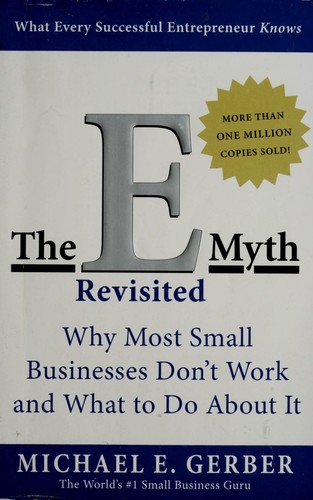
The E-Myth Revisited by Michael E. Gerber is a 1995 business book about entrepreneurship, systems thinking, small business. The entrepreneurial myth: most small business owners are Technicians who started a business without understanding what running one actually requires.
Summary
The E-Myth Revisited is Michael Gerber's diagnosis of why most small businesses fail — not because their owners lack technical skill, but because they confuse being good at a craft with knowing how to run a business. The "entrepreneurial myth" is the dangerous assumption that someone who understands the work of a business can successfully run one. A skilled baker who opens a bakery is not running a business; she's bought herself a job.
Gerber introduces three personalities that every business owner must balance: the Entrepreneur, who lives in the future and sees possibility; the Manager, who lives in the past and craves order; and the Technician, who lives in the present and loves doing the work. Most small business owners are overwhelmingly Technicians who were seized by an "entrepreneurial seizure" — a moment of false confidence that led them to strike out on their own without the systems or mindset that running a business actually requires.
The core prescription is to build your business as if you were franchising it: create documented systems, processes, and standards for every function so the business runs consistently without depending on any single person. Gerber uses the McDonald's model not as a symbol of mediocrity but as an example of a turnkey operation — a business that works because its systems are designed to produce a predictable result regardless of who fills the roles. The lesson is not to copy McDonald's, but to build the same kind of operational clarity into your own company.
The book is framed as an extended conversation with a struggling small business owner named Sarah, which makes the advice feel grounded rather than theoretical. Gerber's tone is evangelical at times, and some of the franchising metaphors feel strained for businesses that can't or wouldn't want to scale that way. But the central insight — that working on your business rather than just in it is the real job of an entrepreneur — remains one of the most clarifying ideas in small business literature.
Talk to The E-Myth Revisited like its author wrote you back.
Get the ideas that fit your life — not generic summaries.
- Chat with the book
- Audiobook-style main ideas
- Adapts to your life and goals
- Helps you take action
Key takeaways
- 1.
The entrepreneurial myth: most small business owners are Technicians who started a business without understanding what running one actually requires.
- 2.
Every owner carries three personalities — Entrepreneur, Manager, and Technician — and the balance between them shapes whether the business can grow or stays trapped.
- 3.
Build your business as if you plan to franchise it: documented systems and processes create consistency that doesn't depend on heroic individual effort.
- 4.
The Technician's impulse is to do the work. The business owner's job is to design a system that does the work, then hire people to operate it.
- 5.
Most small businesses fail during the adolescent phase, when the owner can no longer personally do everything and hasn't built systems to delegate reliably.
- 6.
A business that cannot run without you is not a business — it's a job. The goal is a company that works even when you're not there.
- 7.
The franchise prototype is both the model and the discipline: document every process as if you were preparing the operations manual for someone else to run it.
- 8.
Customer experience must be designed intentionally. If you don't specify what it should be, every employee will invent their own version.
Discussion questions
Use these on your own, with a book club, or as chat starters in Superbook. Book club version, ready to copy or print →
- 1.
Gerber argues most business owners are Technicians at heart. Which of the three personalities dominates how you currently spend your time?
- 2.
What specific processes in your business (or a business you know) are locked in someone's head rather than documented anywhere?
- 3.
Think of a business that consistently delivers a predictable experience. What systems are behind that consistency you normally don't see?
- 4.
Gerber says the fatal assumption is that technical skill in the work qualifies you to run the business. Where have you seen this play out badly?
- 5.
What would you have to change about how you work today if your goal was that the business ran equally well without you?
- 6.
The book draws a sharp line between working in your business and working on it. In a typical week, which one takes up more of your time?
- 7.
If you were to build a franchise prototype of your current role or business, which five processes would be the hardest to document and why?
- 8.
Gerber says the adolescent phase of a business is when owners hit a wall because they can no longer do everything themselves. What signs warn you that phase is approaching?
- 9.
How does the franchising mindset apply to a service business or professional practice where the work is highly personalized?
- 10.
What's one system in your life outside of work — a morning routine, a meal plan, a filing system — that already runs without much conscious effort? What made it stick?
- 11.
Gerber frames the ideal business as one that delivers a consistent customer experience regardless of who is executing. What are the tradeoffs of that model?
- 12.
Is there a business you interact with regularly that clearly hasn't built Gerber's systems? What is the customer experience like as a result?
Themes
Frequently asked questions
-
Is The E-Myth Revisited worth reading?
Yes, especially for first-time business owners or anyone who has discovered that owning a business feels more like a demanding job than freedom. The core insight about building systems is genuinely useful and the framing of the three personalities clarifies a confusion many owners feel but can't name.
-
How long does it take to read The E-Myth Revisited?
Most readers finish it in four to five hours. The conversational narrative format makes it fast. Chapters are short and the central idea is introduced early, with the rest building on it through examples and application.
-
What is the main point of The E-Myth Revisited?
That technical skill at a craft does not prepare you to run a business, and that the solution is to build systems — the franchise prototype — so the business can operate consistently without depending on any single person's expertise or effort.
-
Who should read The E-Myth Revisited?
Small business owners, especially service providers, tradespeople, and consultants who feel overwhelmed and trapped in their own company. Also useful for anyone advising or investing in small businesses who wants to understand why so many plateau or fail.
-
Does The E-Myth apply to startups and tech companies?
The systems-thinking framework applies broadly, but the franchising metaphor fits traditional small businesses better than high-growth tech startups. For the startup context, books like The Lean Startup or Traction address similar operational discipline with more relevant examples.