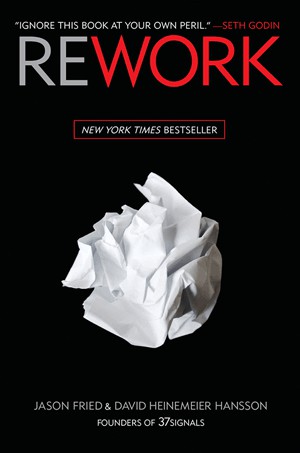
Rework by Jason Fried and David Heinemeier Hansson is a 2010 business book about entrepreneurship, startups, productivity. Planning is guessing. Long-range plans create false certainty and lock you into decisions before you have the information needed to make them well.
Summary
Rework is Jason Fried and David Heinemeier Hansson's deliberately provocative argument against most conventional wisdom about building a business. Fried and Hansson co-founded Basecamp, a project management software company that has been profitable since its earliest years without taking venture capital, without a sales team, and without following the growth-at-all-costs playbook of the technology industry. Rework is a collection of short, punchy essays drawn from their operating philosophy.
The book challenges assumptions that most business people take as given. Planning is guessing — plans for beyond a few weeks are usually wrong, and the time spent on them would be better invested in doing. Working more hours is not more productive — it is the enemy of clear thinking, good work, and sustainability. Meetings are toxic — they interrupt focused work, produce vague outcomes, and signal a culture that values appearance over result. The conventional business virtues — growth, headcount, market share — are metrics that often obscure rather than measure whether a company is actually working.
Their prescriptions are equally direct. Start making something, not planning to make something. Sell a by-product of what you already do. Build less, build something narrower, and make that thing extraordinary. Hire only when the pain of not hiring outweighs the complexity of adding a person. Ignore the competition and focus on your customers. Do less marketing and be more interesting.
Rework is best read as a corrective to the venture-funded startup mythology rather than as a universal business guide. Fried and Hansson are writing from a specific context — a bootstrapped software company with a subscription model and strong opinions about work culture — and some of their prescriptions are precisely wrong for companies in different situations. The book's value is in the force of its argument against the ideas it targets, not in the universality of its alternatives.
Talk to Rework like its author wrote you back.
Get the ideas that fit your life — not generic summaries.
- Chat with the book
- Audiobook-style main ideas
- Adapts to your life and goals
- Helps you take action
Key takeaways
- 1.
Planning is guessing. Long-range plans create false certainty and lock you into decisions before you have the information needed to make them well.
- 2.
Working more hours is the enemy of good work. Tiredness produces worse decisions, not more output. The best work often comes from constraints on time, not expansions of it.
- 3.
Meetings are usually more expensive than they appear — they interrupt multiple people simultaneously and produce less than the sum of the individual work time they consume.
- 4.
Start with a smaller scope. Make half a product, not a half-baked product. A smaller, deeply useful product beats a larger, mediocre one in every market.
- 5.
Ignore the competition. Obsessing over competitors leads you to react rather than create. Focus on what your customers need.
- 6.
Hire when the pain of not hiring is real, not when growth benchmarks say you should add headcount. Every hire makes the company more complex.
- 7.
Teaching what you know publicly is marketing. Writing about what you do, sharing problems you've solved, and explaining your thinking builds an audience that trusts you before they become customers.
- 8.
Say no by default. Every feature added creates maintenance cost, complexity, and the risk of a worse product. Good products say no to almost everything.
Discussion questions
Use these on your own, with a book club, or as chat starters in Superbook. Book club version, ready to copy or print →
- 1.
Fried and Hansson argue planning is guessing. When does planning add genuine value, and when does it create false certainty that crowds out adaptation?
- 2.
They say working more hours degrades quality. Have you seen this in your own experience? What conditions make long hours productive versus counterproductive?
- 3.
Meetings as described in Rework are a symptom of cultural dysfunction. What would a culture look like that used meetings only when no other option would work?
- 4.
Make half a product rather than a half-baked product. What have you seen shipped that should have been scoped down further? What would the focused version have looked like?
- 5.
The bootstrapped Basecamp model is fundamentally different from the venture-funded startup model. What types of businesses are suited to each, and how do you know which you're building?
- 6.
Fried and Hansson say to ignore the competition. When is that actually good advice, and when would ignoring the competition be strategically dangerous?
- 7.
Their advice on hiring — wait until the pain is real — is controversial. What's the cost of under-hiring, and how do you calibrate when the cost is high enough to justify the complexity of adding someone?
- 8.
Rework advocates teaching publicly as marketing. What are the limits of that strategy — what kinds of businesses does it not work for?
- 9.
Say no by default to features and scope. What organizational pressures make it hard to say no, and how have you seen companies resist or succumb to them?
- 10.
How much of Rework's advice is specific to software companies, and how much transfers to other industries?
- 11.
The book is deliberately short and structured as a collection of essays rather than a sustained argument. What is gained and lost by that format?
Themes
Frequently asked questions
-
Is Rework worth reading?
Yes, especially if you feel pressured to grow headcount, raise investment, or follow the standard startup playbook. It is a useful corrective. At under three hours, the time cost is low. Take the prescriptions as provocations rather than universal rules.
-
How long does Rework take to read?
About two to three hours. The chapters are extremely short — most are a page or two — and designed to be read in any order. It is more a manifesto of short essays than a linear argument.
-
Is Rework anti-growth?
It's anti-growth-for-its-own-sake. Fried and Hansson are not arguing against revenue or customers — they built a successful, profitable company. They're arguing against adding headcount, raising capital, and scaling operations before the core product is genuinely good.
-
Does Rework apply to large companies?
Many of its prescriptions — fewer meetings, scope discipline, ignoring the competition — apply broadly. Others — bootstrapping, avoiding investment — are irrelevant or impossible for most large enterprises. Read it as a mindset corrective rather than an operational manual.
-
What is the relationship between Rework, Remote, and It Doesn't Have to Be Crazy at Work?
All three books share the same contrarian voice and Basecamp-as-case-study foundation. Rework is the broadest; Remote focuses on distributed work; It Doesn't Have to Be Crazy at Work focuses on sustainable work culture. They can be read independently.
Similar books
The E-Myth Revisited
Michael E. Gerber
Scaling Up: How a Few Companies Make It...and Why the Rest Don't
Verne Harnish

The Everything Store: Jeff Bezos and the Age of Amazon
Brad Stone
Zero to One: Notes on Startups, or How to Build the Future
Peter Thiel
Rework vs.
Deciding between two books? Rework vs The 4-Hour Workweek .
