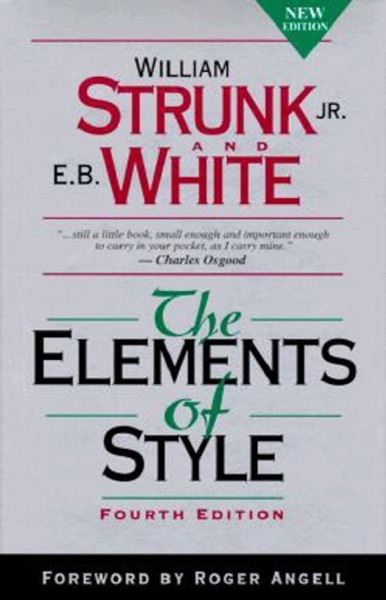
Talk to The Elements of Style like its author wrote you back.
Get the ideas that fit your life — not generic summaries.
- Chat with the book
- Audiobook-style main ideas
- Adapts to your life and goals
- Helps you take action
The Elements of Style, in detail
The Elements of Style is a short book about writing English clearly and without waste. William Strunk Jr. originally wrote it as a class handout at Cornell in 1919. E.B. White, who had been Strunk's student, revised and expanded it for publication in 1959 at the request of Macmillan, adding a final chapter on style. The resulting 85-page book has never gone out of print and has sold more copies than almost any other book about writing in English.
The book is organized into five sections. The first covers basic rules of grammar and usage: form the possessive singular of nouns by adding apostrophe-s; use active voice; put statements in positive form; omit needless words. These rules are stated bluntly and without lengthy justification. Strunk's manner is imperious and occasionally amusing in its confidence. His most quoted line — "Omit needless words" — is followed by the elaboration: "Vigorous writing is concise. A sentence should contain no unnecessary words, a paragraph no unnecessary sentences, for the same reason that a drawing should have no unnecessary lines and a machine no unnecessary parts."
White's contribution is the final chapter on style, which is more nuanced and personal than Strunk's rules. Style, White argues, is not decoration added to clear writing — it is the writer's self, revealed on the page. It cannot be directly taught. But it can be cultivated by reading writers who have it, by placing yourself in the background, and by committing fully to whatever you are trying to say. White lists twenty-one stylistic reminders, some of which are directives ("Prefer the standard to the offbeat") and some of which are more like postures ("Do not affect a breezy manner").
The book is not without critics. Its rules have been called too prescriptive, occasionally inconsistent, and sometimes simply wrong by contemporary linguists. The passive voice prohibition, for instance, is applied far more broadly than Strunk probably intended and has generated decades of earnest misapplication. But as an introduction to intentional prose — to the discipline of rereading your own sentences and asking what they are actually doing — it remains useful in a way that more comprehensive and more current writing guides do not quite match.
The big ideas
- 1.
Omit needless words. Every word in a sentence should earn its place. The discipline of cutting reveals whether you actually understood what you were trying to say.
- 2.
Prefer the active voice. Active constructions are clearer, more direct, and more energetic than passive ones. Use passive only when the agent is unknown or unimportant.
- 3.
Put the emphatic word at the end of the sentence. English readers are conditioned to expect the main point last. A sentence that buries its emphasis in the middle loses force.
