The Elements of Style by Strunk & White is a 1959 self-help book about writing, clarity, style. Omit needless words. Every word in a sentence should earn its place. The discipline of cutting reveals whether you actually understood what you were trying to say.
Summary
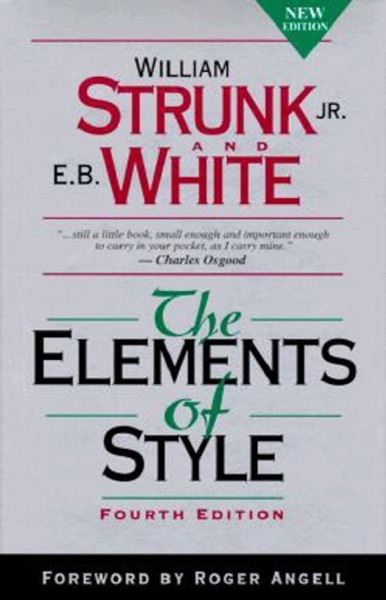
The Elements of Style is a short book about writing English clearly and without waste. William Strunk Jr. originally wrote it as a class handout at Cornell in 1919. E.B. White, who had been Strunk's student, revised and expanded it for publication in 1959 at the request of Macmillan, adding a final chapter on style. The resulting 85-page book has never gone out of print and has sold more copies than almost any other book about writing in English.
The book is organized into five sections. The first covers basic rules of grammar and usage: form the possessive singular of nouns by adding apostrophe-s; use active voice; put statements in positive form; omit needless words. These rules are stated bluntly and without lengthy justification. Strunk's manner is imperious and occasionally amusing in its confidence. His most quoted line — "Omit needless words" — is followed by the elaboration: "Vigorous writing is concise. A sentence should contain no unnecessary words, a paragraph no unnecessary sentences, for the same reason that a drawing should have no unnecessary lines and a machine no unnecessary parts."
White's contribution is the final chapter on style, which is more nuanced and personal than Strunk's rules. Style, White argues, is not decoration added to clear writing — it is the writer's self, revealed on the page. It cannot be directly taught. But it can be cultivated by reading writers who have it, by placing yourself in the background, and by committing fully to whatever you are trying to say. White lists twenty-one stylistic reminders, some of which are directives ("Prefer the standard to the offbeat") and some of which are more like postures ("Do not affect a breezy manner").
The book is not without critics. Its rules have been called too prescriptive, occasionally inconsistent, and sometimes simply wrong by contemporary linguists. The passive voice prohibition, for instance, is applied far more broadly than Strunk probably intended and has generated decades of earnest misapplication. But as an introduction to intentional prose — to the discipline of rereading your own sentences and asking what they are actually doing — it remains useful in a way that more comprehensive and more current writing guides do not quite match.
Talk to The Elements of Style like its author wrote you back.
Get the ideas that fit your life — not generic summaries.
- Chat with the book
- Audiobook-style main ideas
- Adapts to your life and goals
- Helps you take action
Key takeaways
- 1.
Omit needless words. Every word in a sentence should earn its place. The discipline of cutting reveals whether you actually understood what you were trying to say.
- 2.
Prefer the active voice. Active constructions are clearer, more direct, and more energetic than passive ones. Use passive only when the agent is unknown or unimportant.
- 3.
Put the emphatic word at the end of the sentence. English readers are conditioned to expect the main point last. A sentence that buries its emphasis in the middle loses force.
- 4.
Use definite, specific, concrete language. Abstract writing hides unclear thinking. Concrete words force you to have thought through what you mean.
- 5.
Do not overwrite. The reader's attention is a finite resource. Sentences that strain for effect or accumulate modifiers tend to accomplish less than simpler ones.
- 6.
Style is not decoration — it is self. White argues that a writer's style is their identity on the page, and that it develops through reading widely, writing honestly, and placing the reader's interest ahead of your own performance.
- 7.
Revise, revise, revise. Most of Strunk's rules are more useful as revision criteria than as compositional rules. Read your sentences as a stranger would.
Discussion questions
Use these on your own, with a book club, or as chat starters in Superbook. Book club version, ready to copy or print →
- 1.
Strunk's most famous rule is 'omit needless words.' Read a paragraph of your own recent writing. How many words could be cut without loss of meaning?
- 2.
The passive voice prohibition is probably the book's most misunderstood rule. Can you identify a sentence where the passive is genuinely the better choice, and one where Strunk's preference for active is clearly right?
- 3.
White argues that style reveals the writer's self. What does that mean practically? Can you identify a writer whose style you recognize as distinctly theirs?
- 4.
The book was written about American prose in the mid-twentieth century. Are its rules as applicable to digital writing — email, Slack, social media — as to formal prose?
- 5.
Strunk states rules categorically and without extensive justification. Is that pedagogy effective, or does it produce rule-following without understanding?
- 6.
The book's critics argue it is too prescriptive and that many of its rules reflect mid-century American preferences more than universal truths about good writing. Which rules feel most prescriptive to you?
- 7.
White says a writer should 'prefer the standard to the offbeat.' Is that good advice for writers trying to develop a distinctive voice, or does it produce conformity?
- 8.
What is the difference between clarity and simplicity? Can writing be clear without being simple?
- 9.
The book has 85 pages and covers the subject in roughly two hours. What does its own brevity model — and does it live up to its own advice?
- 10.
If you were to add one rule to The Elements of Style for the writing challenges of the present decade — digital communication, global audiences, AI-assisted drafting — what would it be?
- 11.
The book treats good writing as primarily a matter of craft, not inspiration. Is that framing limiting or liberating for people who struggle to write?
Themes
Frequently asked questions
-
Is The Elements of Style still worth reading?
Yes, as a short, direct encounter with the discipline of intentional prose. Its rules require critical interpretation rather than literal application, but the core disciplines — cut the unnecessary, prefer the concrete, put the important word last — remain useful for writers at any level.
-
How long does The Elements of Style take to read?
About ninety minutes to two hours for the main text. Many readers go slowly and stop to apply the rules as they read. As a reference, specific sections can be re-read in minutes.
-
Is the book too prescriptive?
Some rules are, particularly the passive voice prohibition and a few usage preferences that reflect mid-century American standards more than timeless principles. Steven Pinker's The Sense of Style (2014) is a useful companion that applies modern linguistics to similar problems with more nuance.
-
Should professional writers read it?
Professional writers who were trained in it know its rules well enough to break them intelligently. Professionals who haven't read it often find their instincts about concision and structure already match Strunk's prescriptions. The book is most useful to people who are beginning to think seriously about their own prose.
-
What is the single most valuable rule in the book?
Omit needless words. It is the most mechanical of the rules and therefore the easiest to apply: take a sentence you've written, cut every word that does no work, and read what remains. If it is clearer, the rule was right. If not, the word earned its place.