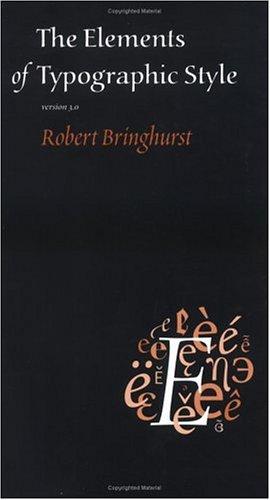
Talk to The Elements of Typographic Style like its author wrote you back.
Get the ideas that fit your life — not generic summaries.
- Chat with the book
- Audiobook-style main ideas
- Adapts to your life and goals
- Helps you take action
What it argues
The Elements of Typographic Style is Robert Bringhurst's comprehensive treatment of typography as both craft and art. First published in 1992 and updated through several editions, it is widely considered the closest thing typography has to a canonical reference — Bringhurst himself calls it a book about "the marriage of language and form." The title is a nod to Strunk and White, but where that book is thin and prescriptive, Bringhurst's is capacious and historical.
The book operates on multiple levels simultaneously. At the most practical level, it is a manual: rules for choosing and sizing typefaces, setting line lengths, managing spacing, handling punctuation, working with multiple scripts, and organizing a page. These rules are specific and often opinionated. Bringhurst gives exact guidance — a line length of roughly 66 characters is comfortable to read; a type-to-leading ratio of 1:1.2 is a starting point; certain typefaces are historically suited to certain functions. The reader who needs to make actual typographic decisions has a reliable reference.
What it gets right
- 1.
Typography exists to serve the text, not to draw attention to itself. The best typographic work is invisible: it transmits language without friction.
- 2.
A comfortable line length for reading is roughly 45–75 characters, with 66 as a classical target. Lines that are too long or too short both degrade reading.
- 3.
Leading (line spacing) should typically be set at 120% of the type size as a baseline; text that is wide, light, or dense in word count benefits from more.
What it covers
Who wrote it
Robert Bringhurst is a Canadian poet, typographer, and scholar of indigenous oral literature. He has published more than twenty books of poetry as well as A Story as Sharp as a Knife, a major study of Haida oral narrative, and The Tree of Meaning, on language and ecology. He designed type for several decades before The Elements of Typographic Style became the standard reference in the field. Bringhurst received the Alcuin Society's award for excellence in book design and holds honorary doctorates from several Canadian universities. He lives in British Columbia.
