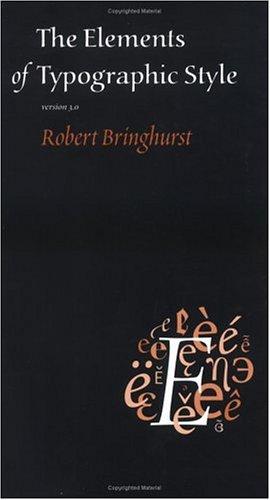
The Elements of Typographic Style by Robert Bringhurst is a 1992 science book about typography, design, craft. Typography exists to serve the text, not to draw attention to itself. The best typographic work is invisible: it transmits language without friction.
Summary
The Elements of Typographic Style is Robert Bringhurst's comprehensive treatment of typography as both craft and art. First published in 1992 and updated through several editions, it is widely considered the closest thing typography has to a canonical reference — Bringhurst himself calls it a book about "the marriage of language and form." The title is a nod to Strunk and White, but where that book is thin and prescriptive, Bringhurst's is capacious and historical.
The book operates on multiple levels simultaneously. At the most practical level, it is a manual: rules for choosing and sizing typefaces, setting line lengths, managing spacing, handling punctuation, working with multiple scripts, and organizing a page. These rules are specific and often opinionated. Bringhurst gives exact guidance — a line length of roughly 66 characters is comfortable to read; a type-to-leading ratio of 1:1.2 is a starting point; certain typefaces are historically suited to certain functions. The reader who needs to make actual typographic decisions has a reliable reference.
At a deeper level, the book is a meditation on how letters connect to meaning. Bringhurst is also a poet and a scholar of indigenous oral literature, and this shapes his argument: typography exists to serve the text, not to express the designer. Good typographic design is audible — it gives the reader rhythm, pause, and breath. Bad typographic design is noise that interferes with transmission. This orientation makes the book unusual among design manuals, which tend toward celebration of effect rather than discipline of service.
The third layer is historical. Bringhurst traces major typefaces and typographic traditions from the fifteenth century to the present, embedding the practical rules in the reasons those rules exist — the physical constraints of metal type, the evolution of the roman alphabet, the relationship between writing and printing across cultures. Readers who work primarily with screen typography or digital tools will find some chapters less directly applicable, but the historical grounding changes how you see every typeface you use.
Talk to The Elements of Typographic Style like its author wrote you back.
Get the ideas that fit your life — not generic summaries.
- Chat with the book
- Audiobook-style main ideas
- Adapts to your life and goals
- Helps you take action
Key takeaways
- 1.
Typography exists to serve the text, not to draw attention to itself. The best typographic work is invisible: it transmits language without friction.
- 2.
A comfortable line length for reading is roughly 45–75 characters, with 66 as a classical target. Lines that are too long or too short both degrade reading.
- 3.
Leading (line spacing) should typically be set at 120% of the type size as a baseline; text that is wide, light, or dense in word count benefits from more.
- 4.
Typeface selection is not arbitrary. Faces evolved for specific contexts — old-style faces for long text, display faces for headlines — and misusing them shows.
- 5.
Punctuation is part of the typographic system, not an afterthought. The em dash, the en dash, quotation marks, and diacritics each have precise functions.
- 6.
Historical knowledge protects against fashion. Understanding why a typeface was made the way it was makes it possible to use it intelligently rather than decoratively.
- 7.
The page has a rhythm. Vertical spacing, margin proportions, and the baseline grid are not cosmetic; they are what make a long document comfortable to read.
- 8.
Typography is a form of service. The designer's ego is irrelevant; what matters is whether the reader receives the author's meaning clearly and with appropriate feeling.
Discussion questions
Use these on your own, with a book club, or as chat starters in Superbook. Book club version, ready to copy or print →
- 1.
Bringhurst says good typography is invisible. Have you ever read something where the typography was so good you forgot about it — or so bad you couldn't ignore it?
- 2.
He argues typography is a form of service to the text. Does that hierarchy feel right to you, or is there a case that design can legitimately transform or comment on content?
- 3.
The book is written in a precise, authoritative voice. Does that tone help you trust the material, or does it make the subject feel more forbidding than it needs to?
- 4.
Bringhurst draws extensively on historical precedent. How much does knowing why a rule exists change how you follow it?
- 5.
He gives specific numerical recommendations — line lengths, ratios, spacing. Are you comfortable working with that level of specificity, or do you prefer principles that allow more judgment?
- 6.
The book was first published before web typography matured. How well do you think its rules transfer to screen reading and responsive layout?
- 7.
He makes a case for using only a few typefaces well rather than many indifferently. How does that apply to the design work in your own life or field?
- 8.
Bringhurst is also a poet, and his voice here is sometimes more like literary criticism than technical instruction. Does that context change how you read his prescriptions?
- 9.
Typography is one of the few design disciplines where almost everyone has an opinion but few people have studied it. What assumptions about type did you bring in that the book challenged?
- 10.
He treats punctuation as part of the typographic system with precise functions. What punctuation do you consistently misuse or ignore the conventions of?
- 11.
The book is itself a demonstration of its principles. What did you notice about how it is typeset that reflects what Bringhurst is arguing?
Themes
Frequently asked questions
-
Is The Elements of Typographic Style for beginners or professionals?
It serves both, but in different ways. Beginners will find it comprehensive and occasionally overwhelming; professionals use it as a reference they return to for specific questions. Most readers come back to it multiple times at different stages of their work.
-
Is the book still relevant for screen and web typography?
Largely yes. The principles about line length, spacing, type selection, and rhythm transfer directly to screen work. Some chapters on paper and print are less directly applicable, but the reasoning behind the rules matters more than the specific medium.
-
How long does it take to read?
Roughly six hours if you read it straight through, but this isn't really a straight-through book. Most readers use it in combination: reading some sections deeply and returning to others as reference when a specific question arises.
-
What typeface does Bringhurst recommend for book text?
He does not prescribe a single face, but he writes admiringly of old-style text faces — Garamond, Bembo, Palatino — and provides detailed historical context for major typefaces. The emphasis is on matching face to purpose rather than declaring a universal winner.
-
Who calls this book the typographer's bible?
That reputation spread through design schools and professional practice from the 1990s onward, helped by endorsements from designers including Hermann Zapf. The comparison is apt: it's consulted more than read cover to cover, and practitioners argue about which parts to follow literally.