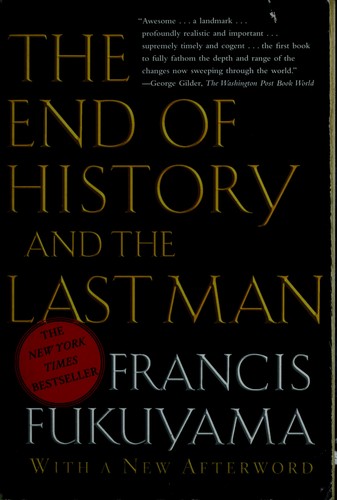
Talk to The End of History and the Last Man like its author wrote you back.
Get the ideas that fit your life — not generic summaries.
- Chat with the book
- Audiobook-style main ideas
- Adapts to your life and goals
- Helps you take action
What it argues
Francis Fukuyama's The End of History and the Last Man was published in 1992, following the collapse of the Soviet Union and the apparent triumph of liberal democracy as the world's dominant political model. The book expanded a 1989 essay that had already generated enormous controversy. Its central argument is that liberal democracy represents the final form of human political organization — not because all conflict has ended, but because no serious ideological alternative to it remains.
Fukuyama draws heavily on Hegel and Alexandre Kojève. He argues that history, understood as the struggle between competing ideological systems for recognition and legitimacy, has reached an endpoint. Fascism was defeated. Communism collapsed. No successor ideology capable of mounting a fundamental challenge to liberal democracy's claim to satisfy the human need for recognition — what Hegel called thymos — is visible on the horizon. The remaining conflicts would be struggles within the liberal democratic framework, not challenges to it.
What it gets right
- 1.
The 'end of history' does not mean the end of events but the end of ideological competition — no viable alternative to liberal democracy's claim to satisfy the human need for recognition remains in sight.
- 2.
Fukuyama's argument is Hegelian: history is the struggle for recognition, and liberal democracy is the political form that most adequately provides universal recognition to all citizens.
- 3.
The defeat of fascism and the collapse of communism left liberal democracy without a credible systemic rival — regional variants and religious alternatives exist, but none poses a fundamental ideological challenge.
What it covers
Who wrote it
Francis Fukuyama is an American political scientist and author, currently a senior fellow at the Freeman Spogli Institute for International Studies at Stanford University. He earned his doctorate from Harvard and previously held positions at the RAND Corporation, the Johns Hopkins School of Advanced International Studies, and Stanford's Hoover Institution. His other major works include Trust, The Origins of Political Order, Political Order and Political Decay, and Liberalism and Its Discontents. He remains one of the most widely read and debated political theorists writing in English.
