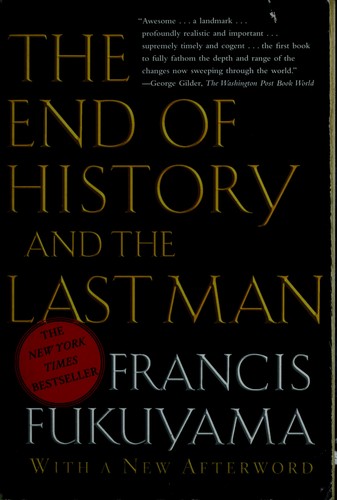
The End of History and the Last Man by Francis Fukuyama is a 1992 history book about liberal democracy, political philosophy, geopolitics. The 'end of history' does not mean the end of events but the end of ideological competition — no viable alternative to liberal democracy's claim to satisfy the human need for recognition remains in sight.
Summary
Francis Fukuyama's The End of History and the Last Man was published in 1992, following the collapse of the Soviet Union and the apparent triumph of liberal democracy as the world's dominant political model. The book expanded a 1989 essay that had already generated enormous controversy. Its central argument is that liberal democracy represents the final form of human political organization — not because all conflict has ended, but because no serious ideological alternative to it remains.
Fukuyama draws heavily on Hegel and Alexandre Kojève. He argues that history, understood as the struggle between competing ideological systems for recognition and legitimacy, has reached an endpoint. Fascism was defeated. Communism collapsed. No successor ideology capable of mounting a fundamental challenge to liberal democracy's claim to satisfy the human need for recognition — what Hegel called thymos — is visible on the horizon. The remaining conflicts would be struggles within the liberal democratic framework, not challenges to it.
The second half of the book grapples with the "last man" problem, drawn from Nietzsche. Fukuyama worries that liberal democracy, by satisfying material needs and granting universal recognition, produces a human type that is complacent, undistinguished, and incapable of greatness — Nietzsche's last man, comfortable but spiritless. This creates a tension at the heart of the liberal democratic project: its success may contain the seeds of a kind of spiritual malaise that drives some people to seek deeper struggles.
The book was savaged by critics almost immediately, misread by many as a claim that history in the narrow sense — wars, elections, crises — was over. Fukuyama always denied this. The more serious debate concerns whether his Hegelian framework is the right tool, whether Islam or Chinese authoritarianism constitute genuine ideological alternatives, and whether the "last man" problem accurately describes the political psychology of liberal societies. The book has aged in interesting ways — less obviously wrong than its critics claimed in the 1990s, but more complicated than its defenders claimed after the Cold War's end.
Talk to The End of History and the Last Man like its author wrote you back.
Get the ideas that fit your life — not generic summaries.
- Chat with the book
- Audiobook-style main ideas
- Adapts to your life and goals
- Helps you take action
Key takeaways
- 1.
The 'end of history' does not mean the end of events but the end of ideological competition — no viable alternative to liberal democracy's claim to satisfy the human need for recognition remains in sight.
- 2.
Fukuyama's argument is Hegelian: history is the struggle for recognition, and liberal democracy is the political form that most adequately provides universal recognition to all citizens.
- 3.
The defeat of fascism and the collapse of communism left liberal democracy without a credible systemic rival — regional variants and religious alternatives exist, but none poses a fundamental ideological challenge.
- 4.
The 'last man' problem: liberal democracy's success creates the conditions for a comfortable, recognition-satisfied human type that may lack the drive and spirit needed for genuine greatness or self-transcendence.
- 5.
Thymos — the part of the soul that seeks recognition and dignity — is the driver of political struggle. Understanding it is essential for understanding why purely material satisfaction does not end political conflict.
- 6.
Nationalism and religion can generate intense political energy but do not constitute coherent alternative political ideologies with a plausible theory of governance to replace liberal democracy.
- 7.
The spread of liberal democracy is connected to economic development, but the relationship is not automatic — the conditions that produce stable democratic institutions are historically specific and not easily transferred.
- 8.
Fukuyama anticipated the 'last man' problem would produce periodic challenges — people who seek struggle and meaning beyond consumer society — which helps explain religious extremism and nationalist revivals.
Discussion questions
Use these on your own, with a book club, or as chat starters in Superbook. Book club version, ready to copy or print →
- 1.
Fukuyama claims no serious ideological alternative to liberal democracy remains. Does authoritarian capitalism — particularly the Chinese model — qualify as such an alternative? Why or why not?
- 2.
His argument rests on the Hegelian idea that history is driven by the struggle for recognition. Do you find that a more or less persuasive account of political motivation than economic interest?
- 3.
How should we read the book in light of the events of the past twenty years: the 2008 financial crisis, the rise of populist nationalism, Brexit, and the increasing authoritarianism of previously democratizing states?
- 4.
The 'last man' problem is Fukuyama's most uncomfortable idea. Do you see evidence in your own society that successful liberal democracy produces a kind of spiritless complacency he worried about?
- 5.
Fukuyama was widely mocked after 9/11 for claiming that ideological conflict was over. Is that criticism fair, or was it based on a misreading of his actual argument?
- 6.
He distinguishes between the end of ideological history and the continuation of conventional history. Is that distinction coherent? Can you separate the two cleanly?
- 7.
Which parts of the Hegelian framework — the struggle for recognition, thymos, the progressive unfolding of freedom — do you find most and least useful as political analysis tools?
- 8.
Fukuyama's 2022 book argues that the liberal international order is more fragile than he thought in 1992. Does that represent a fundamental revision of his thesis or just an adjustment?
- 9.
The book treats liberal democracy partly as a universal aspiration. How does that assumption hold up in societies where liberal democratic values were not generated internally but imported or imposed?
- 10.
What would a genuine ideological alternative to liberal democracy actually look like? What would it have to offer that liberalism cannot?
- 11.
How does Fukuyama's argument interact with Huntington's Clash of Civilizations thesis? Are they fundamentally incompatible, or do they describe different levels of analysis?
- 12.
Which is more prescient about the early twenty-first century — Fukuyama's optimism about liberal democracy's dominance or Huntington's pessimism about civilizational conflict?
Themes
Frequently asked questions
-
Was Fukuyama wrong about the end of history?
Partly. His specific claim — that no serious ideological alternative to liberal democracy's theory of recognition exists — is still defensible. What he underestimated was the fragility of liberal democratic institutions from within, through populist nationalism and institutional decay rather than external ideological challenge.
-
How long is The End of History and the Last Man?
Roughly 400 pages, or about 10 hours at average reading pace. The first half is the main historical argument; the second half, on the last man problem, is philosophically denser and rewards slower reading.
-
What does Fukuyama actually mean by the end of history?
He means the end of ideological history — the competition between fundamentally different theories of legitimate political organization. He does not mean the end of events, wars, or crises. The confusion between these two senses accounts for most of the misreadings.
-
Who should read The End of History?
Readers interested in political philosophy, the post-Cold War international order, or the intellectual origins of current debates about liberal democracy. It repays careful reading rather than the summary version that circulates in political debates.
-
How does The End of History relate to Fukuyama's later work?
His two-volume series on political order (2011, 2014) develops the institutional side of what makes liberal democracy stable, partly as a response to critics who found the 1992 book insufficiently attentive to the conditions required for democracy to take root and survive.