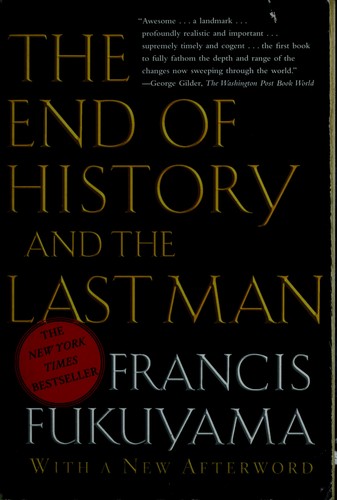
Talk to The End of History and the Last Man like its author wrote you back.
Get the ideas that fit your life — not generic summaries.
- Chat with the book
- Audiobook-style main ideas
- Adapts to your life and goals
- Helps you take action
The End of History and the Last Man, in detail
Francis Fukuyama's The End of History and the Last Man was published in 1992, following the collapse of the Soviet Union and the apparent triumph of liberal democracy as the world's dominant political model. The book expanded a 1989 essay that had already generated enormous controversy. Its central argument is that liberal democracy represents the final form of human political organization — not because all conflict has ended, but because no serious ideological alternative to it remains.
Fukuyama draws heavily on Hegel and Alexandre Kojève. He argues that history, understood as the struggle between competing ideological systems for recognition and legitimacy, has reached an endpoint. Fascism was defeated. Communism collapsed. No successor ideology capable of mounting a fundamental challenge to liberal democracy's claim to satisfy the human need for recognition — what Hegel called thymos — is visible on the horizon. The remaining conflicts would be struggles within the liberal democratic framework, not challenges to it.
The second half of the book grapples with the "last man" problem, drawn from Nietzsche. Fukuyama worries that liberal democracy, by satisfying material needs and granting universal recognition, produces a human type that is complacent, undistinguished, and incapable of greatness — Nietzsche's last man, comfortable but spiritless. This creates a tension at the heart of the liberal democratic project: its success may contain the seeds of a kind of spiritual malaise that drives some people to seek deeper struggles.
The book was savaged by critics almost immediately, misread by many as a claim that history in the narrow sense — wars, elections, crises — was over. Fukuyama always denied this. The more serious debate concerns whether his Hegelian framework is the right tool, whether Islam or Chinese authoritarianism constitute genuine ideological alternatives, and whether the "last man" problem accurately describes the political psychology of liberal societies. The book has aged in interesting ways — less obviously wrong than its critics claimed in the 1990s, but more complicated than its defenders claimed after the Cold War's end.
The big ideas
- 1.
The 'end of history' does not mean the end of events but the end of ideological competition — no viable alternative to liberal democracy's claim to satisfy the human need for recognition remains in sight.
- 2.
Fukuyama's argument is Hegelian: history is the struggle for recognition, and liberal democracy is the political form that most adequately provides universal recognition to all citizens.
- 3.
The defeat of fascism and the collapse of communism left liberal democracy without a credible systemic rival — regional variants and religious alternatives exist, but none poses a fundamental ideological challenge.
