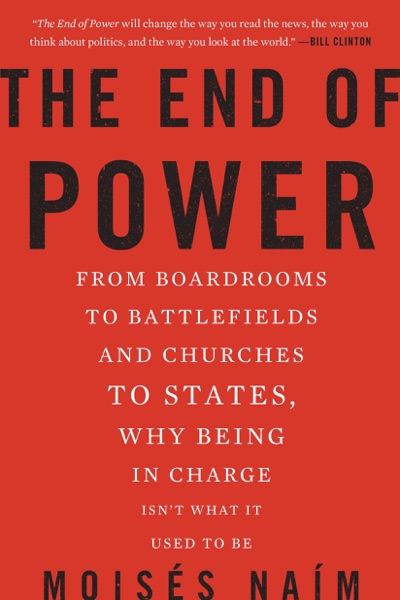
Talk to The End of Power like its author wrote you back.
Get the ideas that fit your life — not generic summaries.
- Chat with the book
- Audiobook-style main ideas
- Adapts to your life and goals
- Helps you take action
What it argues
The End of Power is Moisés Naím's argument that power — the ability to make others do what you want — is becoming easier to acquire, harder to consolidate, and faster to lose. Naím, a former Venezuelan cabinet minister and longtime editor of Foreign Policy, draws on a career of watching institutions from the inside to build a case that is empirically grounded but genuinely counterintuitive.
The book's central thesis is that three revolutions are simultaneously undermining the ability of any actor — state, corporation, military, church, political party — to hold power over time. The More revolution: there are more people, more countries, more organizations, more information, more weapons, all competing for influence. The Mobility revolution: people, capital, and ideas move more freely, making it harder to control populations or markets through geographic position. The Mentality revolution: expectations have changed. People are less willing to accept authority they haven't chosen, less deferential to institutions simply because they exist.
What it gets right
- 1.
Power is becoming easier to get, harder to use, and quicker to lose. The main beneficiaries are challengers, disrupters, and non-state actors.
- 2.
Three revolutions are driving the shift: More (scale and complexity), Mobility (movement of people and capital), and Mentality (changed expectations of authority).
- 3.
Nation-states are losing relative power to corporations, NGOs, terrorist organizations, criminal networks, and other non-state actors simultaneously.
What it covers
Who wrote it
Moisés Naím is a Venezuelan-American author, journalist, and political analyst. He served as Venezuela's minister of trade and industry from 1989 to 1990 and as executive director of the World Bank. He was editor in chief of Foreign Policy magazine from 1996 to 2010, during which time it became one of the most influential foreign-affairs publications in the world. He is a distinguished fellow at the Carnegie Endowment for International Peace. The End of Power, published in 2013, became an international bestseller and was named by Mark Zuckerberg as one of his most influential books.
