Talk to The End of Power like its author wrote you back.
Get the ideas that fit your life — not generic summaries.
- Chat with the book
- Audiobook-style main ideas
- Adapts to your life and goals
- Helps you take action
The End of Power, in detail
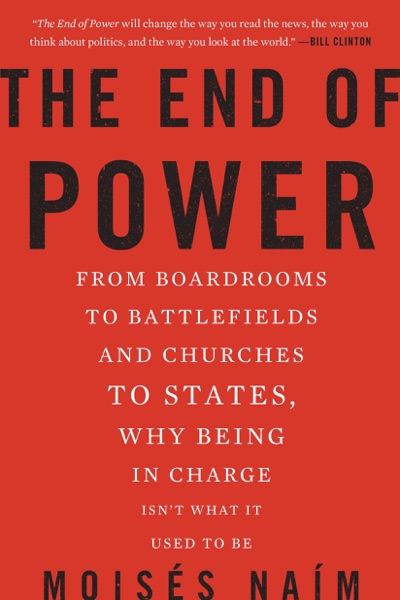
The End of Power is Moisés Naím's argument that power — the ability to make others do what you want — is becoming easier to acquire, harder to consolidate, and faster to lose. Naím, a former Venezuelan cabinet minister and longtime editor of Foreign Policy, draws on a career of watching institutions from the inside to build a case that is empirically grounded but genuinely counterintuitive.
The book's central thesis is that three revolutions are simultaneously undermining the ability of any actor — state, corporation, military, church, political party — to hold power over time. The More revolution: there are more people, more countries, more organizations, more information, more weapons, all competing for influence. The Mobility revolution: people, capital, and ideas move more freely, making it harder to control populations or markets through geographic position. The Mentality revolution: expectations have changed. People are less willing to accept authority they haven't chosen, less deferential to institutions simply because they exist.
Naím illustrates the thesis across domains: geopolitics (no major power can simply impose its will), corporations (market leaders lose position faster), the Catholic Church (attendance and authority declining despite institutional scale), political parties (fragmentation, the rise of insurgent candidates), warfare (non-state actors challenging nation-states). In each domain, the pattern is the same: incumbents find it harder to consolidate advantages, challengers find it easier to break in.
The book is careful not to frame this as straightforwardly good news. Decentralized power creates space for new actors, but it also creates space for fragmentation, gridlock, and the inability to solve collective-action problems that require sustained institutional commitment. Democracy may look more participatory while actually becoming harder to govern. Naím closes with a genuine concern that the decay of power could undermine the coordination needed to address climate change, nuclear proliferation, and other threats that require stable institutions to manage.
The big ideas
- 1.
Power is becoming easier to get, harder to use, and quicker to lose. The main beneficiaries are challengers, disrupters, and non-state actors.
- 2.
Three revolutions are driving the shift: More (scale and complexity), Mobility (movement of people and capital), and Mentality (changed expectations of authority).
- 3.
Nation-states are losing relative power to corporations, NGOs, terrorist organizations, criminal networks, and other non-state actors simultaneously.
