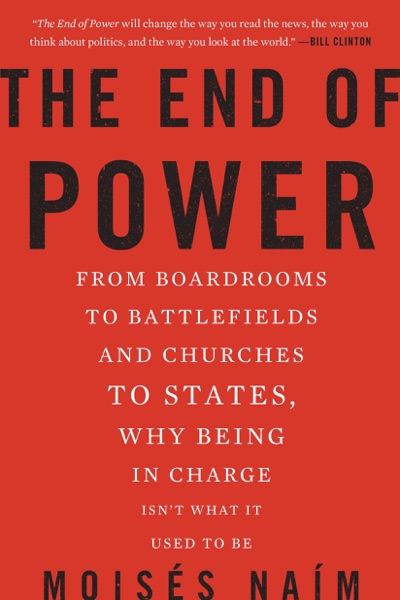
The End of Power by Moisés Naím is a 2013 politics book about power and authority, political fragmentation, institutions. Power is becoming easier to get, harder to use, and quicker to lose. The main beneficiaries are challengers, disrupters, and non-state actors.
Summary
The End of Power is Moisés Naím's argument that power — the ability to make others do what you want — is becoming easier to acquire, harder to consolidate, and faster to lose. Naím, a former Venezuelan cabinet minister and longtime editor of Foreign Policy, draws on a career of watching institutions from the inside to build a case that is empirically grounded but genuinely counterintuitive.
The book's central thesis is that three revolutions are simultaneously undermining the ability of any actor — state, corporation, military, church, political party — to hold power over time. The More revolution: there are more people, more countries, more organizations, more information, more weapons, all competing for influence. The Mobility revolution: people, capital, and ideas move more freely, making it harder to control populations or markets through geographic position. The Mentality revolution: expectations have changed. People are less willing to accept authority they haven't chosen, less deferential to institutions simply because they exist.
Naím illustrates the thesis across domains: geopolitics (no major power can simply impose its will), corporations (market leaders lose position faster), the Catholic Church (attendance and authority declining despite institutional scale), political parties (fragmentation, the rise of insurgent candidates), warfare (non-state actors challenging nation-states). In each domain, the pattern is the same: incumbents find it harder to consolidate advantages, challengers find it easier to break in.
The book is careful not to frame this as straightforwardly good news. Decentralized power creates space for new actors, but it also creates space for fragmentation, gridlock, and the inability to solve collective-action problems that require sustained institutional commitment. Democracy may look more participatory while actually becoming harder to govern. Naím closes with a genuine concern that the decay of power could undermine the coordination needed to address climate change, nuclear proliferation, and other threats that require stable institutions to manage.
Talk to The End of Power like its author wrote you back.
Get the ideas that fit your life — not generic summaries.
- Chat with the book
- Audiobook-style main ideas
- Adapts to your life and goals
- Helps you take action
Key takeaways
- 1.
Power is becoming easier to get, harder to use, and quicker to lose. The main beneficiaries are challengers, disrupters, and non-state actors.
- 2.
Three revolutions are driving the shift: More (scale and complexity), Mobility (movement of people and capital), and Mentality (changed expectations of authority).
- 3.
Nation-states are losing relative power to corporations, NGOs, terrorist organizations, criminal networks, and other non-state actors simultaneously.
- 4.
Market leaders in most industries hold their positions for shorter periods than they did twenty years ago. Size and incumbency are less durable advantages.
- 5.
The decay of power produces more veto players. It becomes easier for any actor to block a decision than to make one stick — producing gridlock in democratic systems.
- 6.
Religious institutions, political parties, and universities are all experiencing the same pattern: declining loyalty and authority despite continuing institutional scale.
- 7.
The same forces that democratize power also complicate governance. Fragmentation makes it harder to act on problems that require sustained, coordinated institutional response.
- 8.
Naím argues that understanding the decay of power is prerequisite to addressing it. Nostalgia for concentrated power is not the answer — designing for the new landscape is.
Discussion questions
Use these on your own, with a book club, or as chat starters in Superbook. Book club version, ready to copy or print →
- 1.
Naím published this in 2013. Do the ten years since feel like confirmation of his thesis, a partial refutation, or something more complicated?
- 2.
He argues that power is decaying across politics, business, religion, and warfare simultaneously. Is that one phenomenon or several different ones that happen to share a surface pattern?
- 3.
The book is careful to say that the decay of power is not simply good. What collective-action problems do you think are most endangered by the fragmentation he describes?
- 4.
Naím identifies three revolutions: More, Mobility, Mentality. Which of the three do you think is most important, and why?
- 5.
How does the rise of AI and large-scale digital platforms fit into his framework? Do they concentrate power again, or accelerate its decay?
- 6.
He argues that incumbents in most industries hold positions for shorter periods. Is that consistent with what you observe in your own field?
- 7.
The Mentality revolution — declining deference to authority — has both progressive and regressive expressions. How do you distinguish between healthy skepticism of institutions and corrosive rejection of expertise?
- 8.
Naím was a Venezuelan cabinet minister. Does his own national experience of institutional breakdown shape the argument in ways worth noting?
- 9.
If veto players multiply and it becomes harder to make decisions stick, what institutions or mechanisms do you think still manage to act effectively? What makes them different?
- 10.
The book ends with concern about global governance problems requiring sustained institutional commitment. Has that concern been borne out in climate, nuclear, or health governance since 2013?
- 11.
Naím frames the decay of power as a structural trend, not a moral judgment. Is that framing persuasive, or does the argument have a normative direction?
- 12.
What should individuals, organizations, and governments be doing differently given the landscape he describes? Does the book answer that question adequately?
Themes
Frequently asked questions
-
What is The End of Power about?
Moisés Naím's argument that power is becoming easier to acquire, harder to use, and faster to lose — across politics, business, religion, and warfare — driven by three simultaneous revolutions in scale, mobility, and expectations.
-
Is The End of Power still relevant?
Yes. The structural forces Naím identified in 2013 have if anything become more pronounced. Some specific predictions have been complicated by events — the rise of authoritarian consolidation in some states — but the overall framework for analyzing power dynamics holds up well.
-
What are the three revolutions in The End of Power?
The More revolution (scale, complexity, more actors competing for influence), the Mobility revolution (freer movement of people, capital, and ideas), and the Mentality revolution (declining deference to established authority).
-
Who should read The End of Power?
Anyone interested in geopolitics, institutional design, or the dynamics of organizational power. It's useful for executives, policymakers, journalists, and anyone trying to understand why large organizations seem to find governance harder than they used to.
-
Is the decay of power good or bad according to Naím?
Both. It creates more opportunity for challengers and disrupters, and it reflects genuine gains in human freedom and mobility. But it also makes it harder to address collective-action problems — climate, nuclear weapons, pandemic response — that require sustained institutional commitment.
Similar books
Why Nations Fail: The Origins of Power, Prosperity, and Poverty
Daron Acemoglu and James A. Robinson
How Democracies Die
Steven Levitsky and Daniel Ziblatt

On Tyranny: Twenty Lessons from the Twentieth Century
Timothy Snyder
Sapiens: A Brief History of Humankind
Yuval Noah Harari
