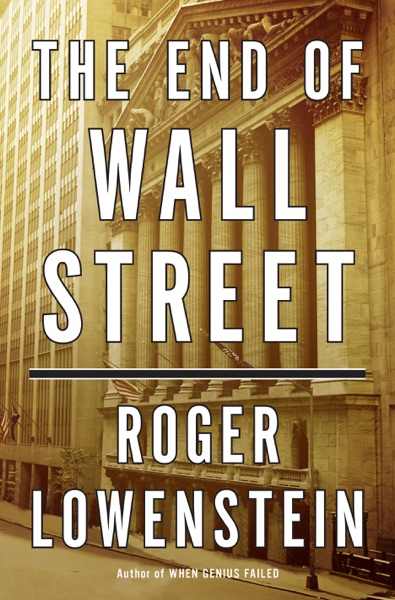
Talk to The End of Wall Street like its author wrote you back.
Get the ideas that fit your life — not generic summaries.
- Chat with the book
- Audiobook-style main ideas
- Adapts to your life and goals
- Helps you take action
The End of Wall Street, in detail
The End of Wall Street is Roger Lowenstein's account of the 2008 financial crisis, from the early signs of trouble in the mortgage market through the collapse of Lehman Brothers, the government interventions, and the immediate aftermath. Lowenstein is among the most readable financial journalists working — his previous books include Buffett: The Making of an American Capitalist and When Genius Failed — and this book benefits from that track record: it is clear, well-organized, and properly angry without becoming polemical.
The book's central argument is that the crisis was caused by a combination of factors that were not individually exotic: regulators who had been philosophically committed to deregulation, banks that had loaded up on mortgage-backed securities because the models said the risk was low, rating agencies that gave investment-grade ratings to instruments that were, on examination, catastrophically leveraged, and a Federal Reserve under Alan Greenspan that treated financial innovation as presumptively benign. Lowenstein traces how these factors reinforced each other through the housing bubble years.
The narrative moves between institutional behavior and individual stories with the skill Lowenstein developed in When Genius Failed. He profiles figures including Hank Paulson, Ben Bernanke, and Tim Geithner in the crisis period, showing the genuine uncertainty they faced as institutions that had seemed foundational revealed themselves to be fragile. The Lehman decision — to let it fail rather than arrange a rescue — is covered in detail, and Lowenstein is skeptical of the official account that Lehman could not be saved.
The book is less comprehensive on the mortgage origination side of the story than other accounts, including Michael Lewis's The Big Short. Lowenstein is stronger on the institutional and regulatory failures in Washington than on the specific mechanics of how bad mortgages were packaged and sold upstream. The two books complement each other. What The End of Wall Street does best is make the case that this was not primarily a story of individual greed but of systems — regulatory, financial, political — that failed together, and that the reforms adopted in the aftermath were insufficient to prevent the same failure modes from recurring.
The big ideas
- 1.
The crisis was not caused by unusual individual greed but by systems — regulatory frameworks, rating models, incentive structures — that systematically mispriced risk.
- 2.
The philosophy of deregulation, dominant in Washington for two decades before 2008, prevented regulators from intervening even when specific risks were visible.
- 3.
Rating agencies gave investment-grade ratings to mortgage-backed securities based on models that assumed national housing prices could not fall simultaneously, which they then did.
