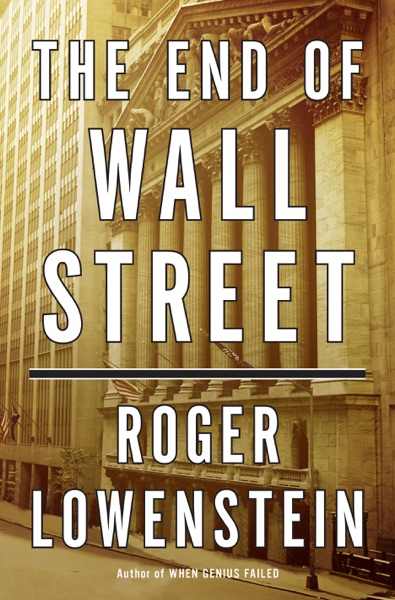
The End of Wall Street by Roger Lowenstein is a 2010 economics book about financial crisis, risk, banking. The crisis was not caused by unusual individual greed but by systems — regulatory frameworks, rating models, incentive structures — that systematically mispriced risk.
Summary
The End of Wall Street is Roger Lowenstein's account of the 2008 financial crisis, from the early signs of trouble in the mortgage market through the collapse of Lehman Brothers, the government interventions, and the immediate aftermath. Lowenstein is among the most readable financial journalists working — his previous books include Buffett: The Making of an American Capitalist and When Genius Failed — and this book benefits from that track record: it is clear, well-organized, and properly angry without becoming polemical.
The book's central argument is that the crisis was caused by a combination of factors that were not individually exotic: regulators who had been philosophically committed to deregulation, banks that had loaded up on mortgage-backed securities because the models said the risk was low, rating agencies that gave investment-grade ratings to instruments that were, on examination, catastrophically leveraged, and a Federal Reserve under Alan Greenspan that treated financial innovation as presumptively benign. Lowenstein traces how these factors reinforced each other through the housing bubble years.
The narrative moves between institutional behavior and individual stories with the skill Lowenstein developed in When Genius Failed. He profiles figures including Hank Paulson, Ben Bernanke, and Tim Geithner in the crisis period, showing the genuine uncertainty they faced as institutions that had seemed foundational revealed themselves to be fragile. The Lehman decision — to let it fail rather than arrange a rescue — is covered in detail, and Lowenstein is skeptical of the official account that Lehman could not be saved.
The book is less comprehensive on the mortgage origination side of the story than other accounts, including Michael Lewis's The Big Short. Lowenstein is stronger on the institutional and regulatory failures in Washington than on the specific mechanics of how bad mortgages were packaged and sold upstream. The two books complement each other. What The End of Wall Street does best is make the case that this was not primarily a story of individual greed but of systems — regulatory, financial, political — that failed together, and that the reforms adopted in the aftermath were insufficient to prevent the same failure modes from recurring.
Talk to The End of Wall Street like its author wrote you back.
Get the ideas that fit your life — not generic summaries.
- Chat with the book
- Audiobook-style main ideas
- Adapts to your life and goals
- Helps you take action
Key takeaways
- 1.
The crisis was not caused by unusual individual greed but by systems — regulatory frameworks, rating models, incentive structures — that systematically mispriced risk.
- 2.
The philosophy of deregulation, dominant in Washington for two decades before 2008, prevented regulators from intervening even when specific risks were visible.
- 3.
Rating agencies gave investment-grade ratings to mortgage-backed securities based on models that assumed national housing prices could not fall simultaneously, which they then did.
- 4.
The Federal Reserve's long-held belief that asset price inflation was not its concern — that it could clean up after bubbles rather than preventing them — contributed directly to the crisis.
- 5.
The decision to let Lehman fail was more consequential than the government initially admitted, and Lowenstein suggests it could have been handled differently.
- 6.
The bailout of AIG protected the counterparties to AIG's credit default swaps — mostly Goldman Sachs and other large banks — at one hundred cents on the dollar, a decision that has never been adequately explained.
- 7.
Bank capital requirements before 2008 allowed investment banks to be leveraged at 30:1 or more. At those ratios, a small decline in asset values eliminated all equity.
- 8.
The reforms adopted after the crisis — Dodd-Frank, increased capital requirements — addressed some failure modes but preserved the fundamental architecture that allowed the crisis to develop.
Discussion questions
Use these on your own, with a book club, or as chat starters in Superbook. Book club version, ready to copy or print →
- 1.
Lowenstein argues the crisis was a systems failure, not primarily a story of individual greed. Does that distinction matter for how we think about accountability and reform?
- 2.
Rating agencies gave triple-A ratings to instruments that were, on examination, catastrophically risky. How should we think about the credibility of ratings agencies today?
- 3.
The deregulation philosophy that dominated Washington before 2008 had intellectual roots in serious economic thinking. How do mainstream intellectual frameworks become dangerous in practice?
- 4.
Greenspan testified after the crisis that he had found a 'flaw' in his ideology — that self-interest would not automatically lead banks to manage their own risk prudently. Was that a surprising conclusion, in retrospect?
- 5.
The decision to let Lehman fail and rescue AIG, in the same week, was not publicly justified as a principled distinction. How should regulators explain decisions of this scale in real time?
- 6.
The bailout protected AIG's counterparties at full value. If you had been making the decision, what would you have done differently, and what would the consequences have been?
- 7.
Bank employees who created mortgage-backed securities were paid based on volume rather than long-term performance of the instruments. How do you design incentive structures that do not punish short-term prudence?
- 8.
The crisis was global because the instruments were distributed globally through financial networks. Does that make financial regulation inherently national or does it require international coordination?
- 9.
The reforms adopted in the aftermath — Dodd-Frank, stress tests, higher capital requirements — are often described as insufficient. What would sufficient reform have required, politically?
- 10.
The homeowners who lost their houses and the bank employees whose pension funds collapsed were not the people who designed the risky instruments. How should we think about distributing the consequences of systemic failures?
- 11.
Lowenstein is skeptical of the claim that Lehman could not be saved. What would it have taken, and does it matter now?
- 12.
The 2008 crisis is now fifteen years past. Have the changes made since then addressed the specific failure modes Lowenstein identifies, or have new ones emerged?
Themes
Frequently asked questions
-
How does The End of Wall Street compare to The Big Short?
The two are complementary. The Big Short is stronger on the mortgage origination side and more focused on the specific people who saw the crisis coming; The End of Wall Street is stronger on the regulatory and institutional failures in Washington. Read together they give a more complete picture than either alone.
-
How long is The End of Wall Street?
About 340 pages, roughly seven hours to read. Lowenstein writes clearly and the pacing is good for a financial book — the narrative sections around the Lehman collapse are fast.
-
Is prior knowledge of finance required?
No. Lowenstein explains financial instruments as they appear and does not assume familiarity with derivatives or credit default swaps. The book is more accessible than academic accounts of the crisis.
-
Who should read The End of Wall Street?
Anyone who wants to understand the 2008 financial crisis, particularly how regulatory and political failures contributed to it. It is more useful than most newspaper accounts as a complete narrative and more readable than academic treatments.
-
Is the book still relevant today?
Yes. The regulatory architecture that existed before 2008 was not entirely replaced, and the risk patterns Lowenstein describes — leverage, model dependency, regulatory capture — remain present in current financial markets.
Similar books
The Big Short: Inside the Doomsday Machine
Michael Lewis
When Genius Failed
Roger Lowenstein
Liar's Poker
Michael Lewis
Against the Gods: The Remarkable Story of Risk
Peter L. Bernstein
