Science · Book club
The Ends of the World: Volcanic Apocalypses, Lethal Oceans, and Our Quest to Understand Earth's Past Mass Extinctions book club questions
Here are 12 book club questions for The Ends of the World: Volcanic Apocalypses, Lethal Oceans, and Our Quest to Understand Earth's Past Mass Extinctions by Peter Brannen, ordered to open easily and end somewhere worth arguing about. Copy them, print them, or bring them up one at a time.
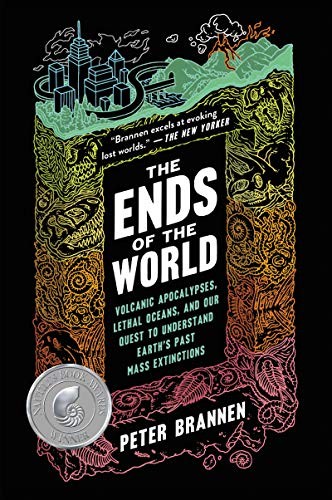
Peter Brannen is a science journalist who spent years reporting on paleontology and geology, and The Ends of the World is the result of that work: a deep history of the five major mass extinctions in Earth's past, told through visits to the scientists who decode them and the rock formations that preserve their evidence.
Peter Brannen · 2017 · 5h 40m
Full summary and key takeaways →The 12 questions
- 1.
Brannen draws an implicit comparison between the chemistry of past extinction events and current ocean acidification measurements. How explicit do you think that comparison should be in a book like this?
- 2.
Each mass extinction in the book has its own character and mechanism. Which one struck you as most surprising, and why?
- 3.
The end-Permian extinction killed more than 90 percent of marine species. What do you think would have to be true about the surviving 10 percent to explain why they made it?
- 4.
Deep time is genuinely difficult to feel rather than just know. Did the book change your intuitive sense of how long Earth's history is? What helped or didn't help?
- 5.
Brannen visits the actual rock formations that record each extinction. How does that field reporting approach change the book compared to a purely desk-researched account?
- 6.
The end-Cretaceous extinction is the best known. Did reading the chapters on the earlier extinctions change how you think about the asteroid impact event?
- 7.
Recovery from the end-Cretaceous extinction took roughly ten million years. What does that timescale suggest about what 'recovery' from a biodiversity crisis actually means?
- 8.
The volcanic CO2 that drove the end-Permian extinction was released over about 100,000 years. Current anthropogenic emissions are releasing a comparable amount of carbon much faster. How does that rate comparison affect your reading of the extinction mechanism?
- 9.
Brannen is careful about how explicitly he draws comparisons to the present. Do you think that restraint is appropriate, or does it allow readers to avoid an obvious implication?
- 10.
Which of the scientists Brannen profiles struck you as most memorable, and what does their specific area of research illuminate about how we understand deep time?
- 11.
The book describes mass extinctions as events that reset the evolutionary slate, creating opportunities for surviving lineages. How do you think about that framing in relation to current biodiversity loss?
- 12.
What did reading this book change about how you think about the geological present — the period of time in which human civilization exists?
How to run the discussion
- Pick six to eight, not all of them. An hour of real discussion covers fewer questions than anyone expects, and racing the list is what makes a book club feel like homework.
- Open with what people noticed, not what they concluded. Asking for a verdict first hardens opinions before anyone has heard each other.
- Let the disagreement run. The questions below that split a room are the ones worth the time; the ones everyone answers the same way can be skipped.
- Ask the quiet person a specific question. A direct, narrow question is far easier to answer than an open invitation to contribute.
Themes worth steering toward
If the conversation stalls, these are the threads that usually restart it.
Common questions
What are good book club questions for The Ends of the World: Volcanic Apocalypses, Lethal Oceans, and Our Quest to Understand Earth's Past Mass Extinctions?
Here are 12 book club questions for The Ends of the World: Volcanic Apocalypses, Lethal Oceans, and Our Quest to Understand Earth's Past Mass Extinctions by Peter Brannen, ordered to open easily and end somewhere worth arguing about. The strongest openers ask what each reader noticed rather than what they concluded, and the discussion usually turns on mass extinctions, deep time, earth history.
How long should a book club discussion of The Ends of the World: Volcanic Apocalypses, Lethal Oceans, and Our Quest to Understand Earth's Past Mass Extinctions last?
Most groups run 60 to 90 minutes of actual discussion. That is roughly six to eight questions, not all of them, so pick the ones that suit your group rather than working down the list in order.
What are the main themes in The Ends of the World: Volcanic Apocalypses, Lethal Oceans, and Our Quest to Understand Earth's Past Mass Extinctions?
Mass extinctions, Deep time, Earth history, Climate, Geology. Those are the threads most likely to divide a room, which makes them the useful places to steer a discussion that has gone quiet.
Picking the next one? See books like The Ends of the World: Volcanic Apocalypses, Lethal Oceans, and Our Quest to Understand Earth's Past Mass Extinctions or questions for other book club picks.
