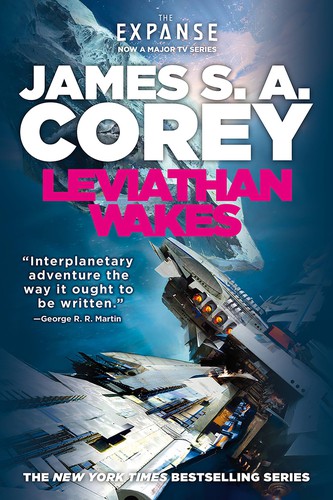
Talk to Leviathan Wakes like its author wrote you back.
Get the ideas that fit your life — not generic summaries.
- Chat with the book
- Audiobook-style main ideas
- Adapts to your life and goals
- Helps you take action
What it argues
Two hundred years from now, humanity has colonized Mars and the asteroid belt, and the political fault lines between Earth, Mars, and the Belters — the third-generation descendants of asteroid miners — are the dominant tension in the solar system. Into this pressure cooker come two storylines: Jim Holden, XO of an ice-hauler, witnesses an act of apparent aggression that could spark an interplanetary war; and Detective Miller, a burned-out Belter cop, is hired to find a missing girl from a wealthy Earth family. The two threads collide when whatever the missing girl found threatens not just the three factions but humanity's existence.
Leviathan Wakes is science fiction grounded in economics and political realism rather than idealism. The Belt isn't glamorous — it's a resource colony run on exploitation, where Belters die young, speak a creole dialect born of isolation, and have learned that Earth and Mars see them as labor, not people. The political worldbuilding is unusually thought-through: every faction has comprehensible interests, no one is purely villainous, and the horror that arrives from outside doesn't simplify those conflicts — it amplifies them.
What it gets right
- 1.
The Belt's political situation — a resource colony whose labor force has developed its own culture and grievances — is the novel's best worldbuilding, and it reflects recognizable historical dynamics more than most SF settings do.
- 2.
Holden's compulsive honesty is treated as both heroic and catastrophic. The novel is genuinely ambivalent about whether being right is the same as being useful.
- 3.
Miller's arc is a study in what happens when a person's sense of meaning has been hollowed out — his obsession with Julie Mao is unhealthy, and the book knows it.
What it covers
Who wrote it
James S.A. Corey is the pen name of Daniel Abraham and Ty Franck. Abraham is a New Mexico-based author of fantasy and science fiction with over twenty novels to his name; Franck was George R.R. Martin's assistant before co-writing The Expanse. The pair have written nine Expanse novels and a collection of novellas set in the same universe. The series was adapted into a television show that ran for six seasons, first on Syfy and later on Amazon Prime Video. Abraham and Franck have cited Kim Stanley Robinson and George R.R. Martin as influences.
