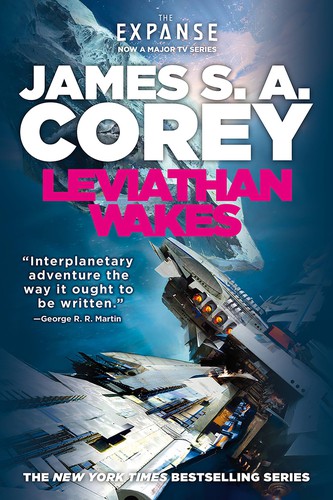
Leviathan Wakes by James S.A. Corey is a 2011 science fiction book about class and power, first contact, political survival. The Belt's political situation — a resource colony whose labor force has developed its own culture and grievances — is the novel's best worldbuilding, and it reflects recognizable historical dynamics more than most SF settings do.
Summary
Two hundred years from now, humanity has colonized Mars and the asteroid belt, and the political fault lines between Earth, Mars, and the Belters — the third-generation descendants of asteroid miners — are the dominant tension in the solar system. Into this pressure cooker come two storylines: Jim Holden, XO of an ice-hauler, witnesses an act of apparent aggression that could spark an interplanetary war; and Detective Miller, a burned-out Belter cop, is hired to find a missing girl from a wealthy Earth family. The two threads collide when whatever the missing girl found threatens not just the three factions but humanity's existence.
Leviathan Wakes is science fiction grounded in economics and political realism rather than idealism. The Belt isn't glamorous — it's a resource colony run on exploitation, where Belters die young, speak a creole dialect born of isolation, and have learned that Earth and Mars see them as labor, not people. The political worldbuilding is unusually thought-through: every faction has comprehensible interests, no one is purely villainous, and the horror that arrives from outside doesn't simplify those conflicts — it amplifies them.
James S.A. Corey is the pen name of authors Daniel Abraham and Ty Franck. Their collaboration produces a thriller pacing — the book moves — while maintaining the systemic scope that single-author science fiction sometimes sacrifices for character. Miller and Holden are distinct and complementary: Holden is an idealist who keeps telling the truth at the worst possible times; Miller is a pragmatist who has given up on everything except one case that doesn't make sense. Their friction is the engine.
This is the first book in a nine-novel series that was adapted into an acclaimed television series on Amazon Prime. It stands alone reasonably well, but the world is so well built that most readers continue. If you want hard-ish science fiction with genuine political intelligence, and you can commit to a long series, this is where to start.
Talk to Leviathan Wakes like its author wrote you back.
Get the ideas that fit your life — not generic summaries.
- Chat with the book
- Audiobook-style main ideas
- Adapts to your life and goals
- Helps you take action
Key takeaways
- 1.
The Belt's political situation — a resource colony whose labor force has developed its own culture and grievances — is the novel's best worldbuilding, and it reflects recognizable historical dynamics more than most SF settings do.
- 2.
Holden's compulsive honesty is treated as both heroic and catastrophic. The novel is genuinely ambivalent about whether being right is the same as being useful.
- 3.
Miller's arc is a study in what happens when a person's sense of meaning has been hollowed out — his obsession with Julie Mao is unhealthy, and the book knows it.
- 4.
The alien presence is introduced as a mystery and explained as a threat; Leviathan Wakes is careful not to anthropomorphize it, which makes it more disturbing.
- 5.
The book takes the economics of space colonization seriously in a way most science fiction doesn't: fuel, air, water, and food are scarce and political, not incidental details.
- 6.
Corey uses alternating POV chapters between Holden and Miller to create dramatic irony — the reader often knows things one character doesn't, which raises stakes without cheap manipulation.
- 7.
The horror elements in the Eros Station sections are genuinely disturbing. Leviathan Wakes isn't afraid to go dark in ways that space opera usually avoids.
- 8.
No faction is purely wrong. Earth, Mars, and the Belt each have comprehensible interests. The external threat doesn't unite humanity — it exposes how fractures deepen under pressure.
Discussion questions
Use these on your own, with a book club, or as chat starters in Superbook. Book club version, ready to copy or print →
- 1.
Holden keeps broadcasting information that makes things worse. Is he right to do it? Does the novel think he's a hero or a liability?
- 2.
Miller becomes obsessed with a woman he has never met. Is that portrayed sympathetically, or does the book ask us to see it as a red flag?
- 3.
The Belt is a resource colony — economically and culturally distinct, politically powerless. Which real-world historical parallels did you see most clearly?
- 4.
The alien protomolecule doesn't communicate and doesn't seem to notice human suffering. How does that affect what the book seems to say about first contact?
- 5.
Earth, Mars, and the Belt all have reasons to go to war with each other before the alien element arrives. Would they have anyway? Is the protomolecule a catalyst or a distraction from existing tensions?
- 6.
The Eros sequence is the most disturbing part of the novel. Was it effective horror, or did it feel like a tonal shift from what came before?
- 7.
Miller's solution at the end involves a kind of self-erasure. Was that earned? Does it feel like sacrifice or surrender?
- 8.
Holden assembles a found family aboard the Rocinante. Is the crew dynamic convincing, or does it feel like genre convenience?
- 9.
If Leviathan Wakes were written from a Martian or Earth POV rather than a Belter/Outer-planets one, how different would the politics look?
- 10.
The series runs to nine books. Does Leviathan Wakes stand alone, or does it feel like setup?
- 11.
How does the show adaptation compare to the book for those who've seen it? What does each version do better?
- 12.
The novel treats the alien threat as non-negotiable and incomprehensible. Is that a more honest first-contact scenario than fiction usually offers?
Themes
Frequently asked questions
-
Is Leviathan Wakes worth reading?
Yes, especially if you want science fiction that takes politics and economics seriously. It's one of the best-constructed space operas of the 2010s. The pacing is excellent and the worldbuilding rewards close attention.
-
Is it hard science fiction?
Harder than most space opera — no faster-than-light travel, realistic orbital mechanics, and genuine attention to what living in low gravity does to human bodies. But it's not Alastair Reynolds levels of rigor; the emphasis is on character and politics.
-
Do I need to read all nine books?
No. Leviathan Wakes has a satisfying enough arc on its own. But the world is well built enough that most readers continue. The series maintains quality through at least the fifth or sixth book.
-
Should I watch the TV show or read the book first?
Either works. The show is faithful and well-cast. The book has more Miller interiority and some political texture that the show streamlines. Reading first gives you more of the world; watching first makes the book faster.
-
Who shouldn't read Leviathan Wakes?
Readers who want a single-book story with full resolution. The Eros sequence is genuinely disturbing horror — if body horror is a hard stop for you, be aware that section exists.