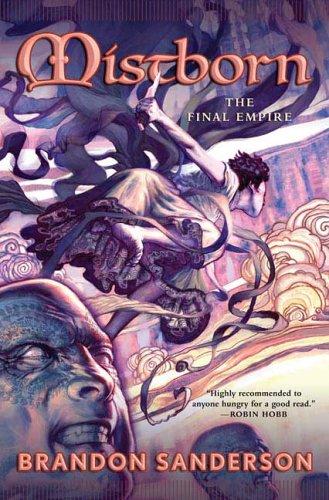
Talk to Mistborn: The Final Empire like its author wrote you back.
Get the ideas that fit your life — not generic summaries.
- Chat with the book
- Audiobook-style main ideas
- Adapts to your life and goals
- Helps you take action
Mistborn: The Final Empire, in detail
Mistborn: The Final Empire opens with a premise that inverts a thousand years of genre convention: the Dark Lord won. The Lord Ruler has ruled the ash-covered world for a millennium, the slave class — the skaa — are kept in near-total subjugation, and the nobility who serve the Lord Ruler maintain their position through brutal control over an economy of metals and fear. Into this world, Brandon Sanderson drops a classic heist plot: a crew of thieves and con artists, led by the charismatic and possibly unhinged Kelsier, plans to rob the empire and start a revolution.
The book's central relationship is between Kelsier — all fire and mission and cultivated legend — and Vin, a young skaa thief who discovers she has Allomantic powers: the ability to burn metals and use them to enhance senses, emotions, and physical ability. Vin is the reader's point of entry into the world, and Sanderson uses her to explore what it costs to trust when survival has always required isolation. The romance subplot that develops is present but handled lightly; the more interesting relationship is Vin's evolving understanding of Kelsier's plan and whether she believes in it.
Sanderson's signature is his magic systems, and Allomancy is among his best: specific, internally consistent, with clear rules and escalating applications that make action sequences feel like logic puzzles as much as spectacle. The "hard magic" approach — where rules govern powers precisely and readers can follow the reasoning — contrasts sharply with the vaguer supernatural of Tolkien or Jordan and gives the book a different texture. Plot mechanics and magic are woven tightly together; understanding the system is part of understanding the story.
The Final Empire is a propulsive, accessible read — the most common complaint is that it is almost too plotted, that character depth is traded for mechanism. That is a fair observation: Sanderson writes characters with clarity and function rather than ambiguity. But the book earns its ending, which recontextualizes much of what came before and lands harder than its heist-adventure framing suggested. For readers new to Sanderson, this is where to start. For readers who want morally complex, slow-burning character studies, it may not be the right tool.
The big ideas
- 1.
The premise — what if the hero of prophecy failed and the Dark Lord won — is not just a marketing hook; the book takes it seriously and builds a coherent oppressive world from that starting point.
- 2.
Allomancy is one of fantasy fiction's most satisfying hard magic systems: each metal has a specific effect, the rules are consistent, and mastery means puzzle-solving rather than escalating power fantasy.
- 3.
Vin's arc — from a girl who survives by trusting no one to someone capable of being changed by other people — is the emotional core of the book, even when the heist plot takes over.
