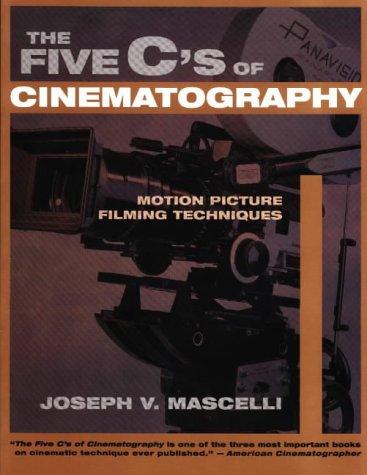
Talk to The Five C's of Cinematography like its author wrote you back.
Get the ideas that fit your life — not generic summaries.
- Chat with the book
- Audiobook-style main ideas
- Adapts to your life and goals
- Helps you take action
What it argues
The Five C's of Cinematography is the most widely used introductory text on film technique in American film schools, still in print more than sixty years after its first publication. Joseph Mascelli was a cinematographer and industry educator, not an auteur theorist, and the book reflects that practical orientation: it is concerned with how shots work, not with the meaning of cinema. The five C's are camera angles, continuity, cutting, close-ups, and composition. Each gets its own section, and the cumulative effect is a working grammar of how images convey information and create the experience of continuous space and time.
Camera angles occupy the first and most developed section. Mascelli covers the full vocabulary: high angles that reduce subjects, low angles that elevate them, Dutch tilts that create unease, over-the-shoulder shots that establish spatial relationships, point-of-view shots that create identification. The writing is descriptive rather than theoretical — for each type he explains what it does visually and gives production guidance. This is less a book about why you might make certain choices and more a book about what will happen when you do.
What it gets right
- 1.
The five C's — camera angles, continuity, cutting, close-ups, and composition — are the core vocabulary of cinematographic technique, each with learnable effects on viewer experience.
- 2.
Camera angle conveys psychological information: high angles diminish subjects, low angles aggrandize them, Dutch tilts create disorientation.
- 3.
The 180-degree rule preserves spatial continuity across cuts by keeping the camera on one side of an action axis. Crossing it creates apparent reversals of direction that confuse the viewer.
What it covers
Who wrote it
Joseph V. Mascelli (1918–1989) was an American cinematographer, director, and educator who worked primarily in industrial and educational films during the postwar era. He wrote The Five C's of Cinematography as a teaching text while working as an instructor, drawing on his production experience to systematize the technical conventions of professional filmmaking. The book was self-published through Cine/Graphic Publications in Los Angeles and has remained continuously in print, becoming a standard text at film schools across the United States and internationally.
