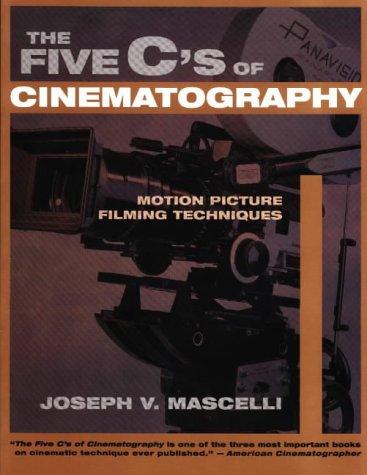
The Five C's of Cinematography by Joseph Mascelli is a 1965 science book about cinematography, visual storytelling, camera technique. The five C's — camera angles, continuity, cutting, close-ups, and composition — are the core vocabulary of cinematographic technique, each with learnable effects on viewer experience.
Summary
The Five C's of Cinematography is the most widely used introductory text on film technique in American film schools, still in print more than sixty years after its first publication. Joseph Mascelli was a cinematographer and industry educator, not an auteur theorist, and the book reflects that practical orientation: it is concerned with how shots work, not with the meaning of cinema. The five C's are camera angles, continuity, cutting, close-ups, and composition. Each gets its own section, and the cumulative effect is a working grammar of how images convey information and create the experience of continuous space and time.
Camera angles occupy the first and most developed section. Mascelli covers the full vocabulary: high angles that reduce subjects, low angles that elevate them, Dutch tilts that create unease, over-the-shoulder shots that establish spatial relationships, point-of-view shots that create identification. The writing is descriptive rather than theoretical — for each type he explains what it does visually and gives production guidance. This is less a book about why you might make certain choices and more a book about what will happen when you do.
The continuity chapters address the central technical problem of narrative filmmaking: creating the illusion of continuous action from discontinuous shots. Mascelli explains the 180-degree rule, screen direction, eyeline matching, and action matches. These rules were not invented arbitrarily — they encode what the eye expects based on how we track movement and space in real life. Understanding why they work makes it easier to decide when to break them deliberately.
The sections on cutting, close-ups, and composition are shorter but equally pragmatic. Cutting covers rhythm and pacing: where to cut within a scene, how cut length affects emotional tempo, when to hold and when to move. Close-ups are treated as emphatic punctuation — they isolate detail and force the viewer's attention. Composition draws on classical painting principles — rule of thirds, leading lines, framing within frame — and translates them into moving-image terms.
The book's limitation is its era. Published in 1965 and written primarily from the perspective of 35mm studio production, it does not address the handheld, verite, or digital camera aesthetics that transformed the medium in subsequent decades. But the fundamental grammar has not changed. Any filmmaker, photographer, or visual storyteller who does not already know why continuity editing works or what a low angle implies will find Mascelli as useful as any more recent text.
Talk to The Five C's of Cinematography like its author wrote you back.
Get the ideas that fit your life — not generic summaries.
- Chat with the book
- Audiobook-style main ideas
- Adapts to your life and goals
- Helps you take action
Key takeaways
- 1.
The five C's — camera angles, continuity, cutting, close-ups, and composition — are the core vocabulary of cinematographic technique, each with learnable effects on viewer experience.
- 2.
Camera angle conveys psychological information: high angles diminish subjects, low angles aggrandize them, Dutch tilts create disorientation.
- 3.
The 180-degree rule preserves spatial continuity across cuts by keeping the camera on one side of an action axis. Crossing it creates apparent reversals of direction that confuse the viewer.
- 4.
Screen direction — the apparent direction of movement within the frame — must be consistent across cuts to maintain the illusion of continuous space.
- 5.
Close-ups are emphatic punctuation, not just zoomed views. They force audience attention to a specific detail and carry strong emotional weight when used selectively.
- 6.
Composition principles from painting — rule of thirds, leading lines, foreground elements — apply directly to cinematography, but must account for motion and sequence, which still images do not require.
- 7.
Cutting rhythm affects perceived pace: short cuts feel urgent, long takes slow time down. Neither is inherently better; both serve specific dramatic functions.
Discussion questions
Use these on your own, with a book club, or as chat starters in Superbook. Book club version, ready to copy or print →
- 1.
Think of a scene from a film you admire. Can you identify which of Mascelli's five C's are most actively at work in it?
- 2.
The 180-degree rule is sometimes called the continuity system. Directors who break it — Godard, Eisenstein — do so for specific effects. What does violating the rule actually feel like in a scene you've seen?
- 3.
Mascelli treats filmmaking as a grammar with rules. Is that the right model? Or is film technique better understood as a set of conventions that can be learned and broken?
- 4.
He argues that close-ups lose their power if overused. Has overuse of close-ups in contemporary television and film changed how they affect you?
- 5.
The book says camera angle conveys psychological meaning automatically — viewers read low angles as powerful, high angles as powerless. How reliable is that effect across different cultures and audiences?
- 6.
Continuity editing is designed to be invisible. Why is the goal invisibility? Are there filmmaking traditions that deliberately make editing visible, and why?
- 7.
How do the compositional principles from this book apply to still photography, video, or even slide presentations?
- 8.
The book was published in 1965. How has digital acquisition, handheld camera work, and streaming changed the visual grammar Mascelli describes?
- 9.
What is the relationship between technical facility with these rules and personal visual style? Does knowing the grammar constrain or liberate?
- 10.
Mascelli focuses on how shots work rather than what they mean. What's missing from a purely technical account of visual storytelling?
- 11.
Think of a film where the cinematography itself feels like a character — where the camera work shapes the meaning rather than just recording it. What techniques make that possible?
- 12.
If you were teaching someone to shoot their first short film, which of the five C's would you start with?
Themes
Frequently asked questions
-
Is The Five C's of Cinematography still relevant for digital filmmakers?
Yes. The visual grammar Mascelli describes — how angles, continuity, cutting, close-ups, and composition shape viewer experience — operates the same way in digital formats. The production advice is dated, but the perceptual principles are not.
-
How long does it take to read this book?
Around four hours at a comfortable pace. The book is organized as a reference as much as a cover-to-cover read, and many filmmakers return to specific chapters when working through particular technical problems.
-
What does the book not cover?
Digital acquisition, handheld and documentary aesthetics, color grading, and the conventions that emerged from music video and television in the 1980s and 1990s. For a more contemporary companion, books by cinematographers like Roger Deakins or technical guides to modern camera systems fill those gaps.
-
Who should read this book?
Anyone who makes moving images — from feature cinematographers to video content creators — who wants a clear grounding in the basic grammar of visual storytelling. Also useful for writers, directors, and visual artists who want to understand how film constructs space and time.
-
What is the most important idea in the book?
The 180-degree rule and its underlying logic. Understanding why crossing the line creates apparent spatial reversal — and what the eye is actually doing when it tracks action across cuts — unlocks most of what the continuity system is trying to achieve.