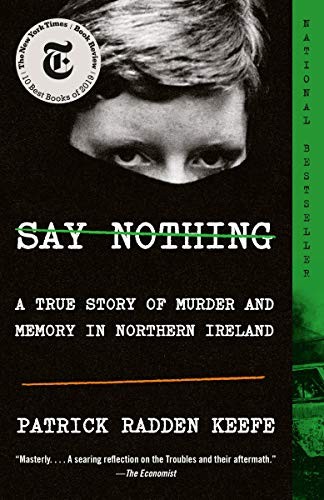
Say Nothing: A True Story of Murder and Memory in Northern Ireland by Patrick Radden Keefe is a 2018 history book about political violence, memory, identity. Jean McConville's murder illustrates how political violence abstracts individuals into symbols — her killing was ordered partly because of what she represented, not who she was.
Summary
Say Nothing opens with a scene that sets its register precisely: Jean McConville, a widowed mother of ten, is dragged from her Belfast flat by a gang of masked strangers in December 1972 and never seen alive again. Patrick Radden Keefe uses her abduction and murder as the spine of a narrative that expands outward to encompass the full arc of the Troubles — the three decades of sectarian violence in Northern Ireland that left more than three thousand people dead and a society still sorting through what it did and what it meant.
The book follows several figures whose lives intertwined with McConville's fate. Dolours Price and her sister Marian became IRA volunteers as teenagers, participated in bombings on the British mainland, and went on hunger strike in prison. Brendan Hughes, a commander known as "The Dark," led some of the IRA's most significant operations and later gave secret oral-history testimony that implicated his former comrades. Gerry Adams, the political leader who guided Sinn Féin toward the peace process, is present throughout — and the question of what he knew and what he ordered shadows the entire narrative. Keefe weaves these threads with precision, resisting the urge to collapse the characters into symbols.
Much of Say Nothing is built around the tension between truth and peace. The Good Friday Agreement of 1998 ended the killing but required that participants on all sides effectively shelve accountability. A Boston College oral-history project recorded testimonies from IRA and loyalist veterans under the promise of secrecy until death — a promise that broke down when British police subpoenaed the tapes. That legal battle, and the testimonies it eventually surfaced, forced survivors and perpetrators to confront what had happened in ways that the peace settlement had allowed them to avoid. Keefe is interested not just in the crimes themselves but in how societies decide what to remember, what to suppress, and what price those choices carry.
The result is a book that works simultaneously as a true-crime narrative, a political history, and a meditation on how individuals reconcile the violence they participated in with the ordinary lives they went on to live. It is not a neutral account — Keefe has evident sympathy for Jean McConville's children and a skeptical eye for the self-serving way some participants narrated their own pasts. But it is a fair one, and the fairness is what gives the book its weight. Readers with no prior knowledge of Northern Ireland will find it a lucid entry point; those who lived through the Troubles will find it a more uncomfortable one.
Talk to Say Nothing: A True Story of Murder and Memory in Northern Ireland like its author wrote you back.
Get the ideas that fit your life — not generic summaries.
- Chat with the book
- Audiobook-style main ideas
- Adapts to your life and goals
- Helps you take action
Key takeaways
- 1.
Jean McConville's murder illustrates how political violence abstracts individuals into symbols — her killing was ordered partly because of what she represented, not who she was.
- 2.
The Troubles were sustained not just by ideology but by community pressure, inherited identity, and a culture in which informing carried the ultimate social penalty.
- 3.
Dolours Price's trajectory — from idealistic volunteer to disillusioned prisoner to broken witness — tracks the psychological toll that political violence exacts on its perpetrators as well as its victims.
- 4.
The Good Friday Agreement achieved peace partly by deferring accountability. That tradeoff has costs that show up decades later, when survivors demand answers and participants still have reasons to stay silent.
- 5.
The Boston College Belfast Project shows how oral history can become evidence: a well-intentioned effort to preserve testimony was undone by the legal reality that researchers cannot promise confidentiality across jurisdictions.
- 6.
Gerry Adams's public denial of IRA membership, maintained for decades despite extensive contrary evidence, illustrates how political transformation sometimes requires a kind of collective fiction.
- 7.
Memory is not neutral. The people who participated in the violence reconstructed their roles in ways that protected their sense of self, and Keefe treats these reconstructions as data about how humans cope with atrocity.
- 8.
Societies emerging from conflict face a genuine dilemma: the full truth may destabilize the peace, but suppressing it leaves wounds that reopen in the next generation.
Discussion questions
Use these on your own, with a book club, or as chat starters in Superbook. Book club version, ready to copy or print →
- 1.
Keefe shows that Jean McConville's children spent decades searching for answers that the IRA's culture of silence withheld. What do victims' families owe, and what do perpetrators' communities owe them?
- 2.
The Boston College researchers believed their promise of confidentiality would hold. Was the project ethically defensible, given the foreseeable legal risks? What would you have done?
- 3.
Dolours Price believed she was fighting a just war. At what point, if any, do you think she stopped believing that — and what evidence in the book supports your reading?
- 4.
The peace process required participants to set aside justice for stability. Can you think of historical or contemporary situations where the same tradeoff was made, and do you think it was the right call?
- 5.
Gerry Adams maintained his denial of IRA membership long after it strained credibility. What does the book suggest about the relationship between political utility and personal honesty?
- 6.
Several characters in the book experienced the Troubles as inherited — born into Catholic or Protestant communities, shaped by family loyalties before they could choose. How much moral weight does that inherited context carry?
- 7.
Brendan Hughes gave his testimony to the oral history project knowing it would embarrass former comrades. Do you see his decision as an act of integrity, grievance, or something else?
- 8.
Jean McConville's children describe different ways of handling the absence of answers — some pursued justice, others tried to move on. Which approach do you understand better, and why?
- 9.
Keefe writes that the peace required a kind of collective forgetting. Is there a version of the Northern Ireland settlement you think would have been more honest without unraveling the peace?
- 10.
The book ends without full resolution. Several perpetrators died before testifying; others maintained silence. How did that open ending sit with you as a reader?
- 11.
Keefe is American writing about Irish history. Did you find that external perspective a strength — more distance, less grievance — or a limitation, missing things an insider would have caught?
- 12.
The title comes from the culture of omerta inside the IRA: say nothing, no matter what. How does that code function throughout the book, and who in the narrative eventually breaks it?
Themes
Frequently asked questions
-
What is Say Nothing about?
It centers on the 1972 abduction and murder of Jean McConville, a Belfast mother of ten, and traces the lives of the IRA members involved across the full arc of the Troubles. Keefe uses her case to examine political violence, memory, and the compromises that ended the conflict.
-
Is Say Nothing worth reading if you know nothing about Northern Ireland?
Yes. Keefe builds enough context that no prior knowledge is needed. Readers unfamiliar with the Troubles will find it a gripping entry point; the history emerges through the characters rather than being front-loaded as background.
-
How long does it take to read Say Nothing?
Roughly seven to seven and a half hours at average pace. At around 400 pages it reads quickly because of Keefe's narrative structure, but the subject matter rewards slowing down. Many readers find it hard to put down despite the weight of the material.
-
Is this a true crime book or a history book?
Both. Keefe builds the narrative around a specific crime and its investigation, but the frame expands to cover three decades of the Troubles and the political settlement that ended them. It reads like the best literary journalism: reported, sourced, and driven by character.
-
Who should read Say Nothing?
Anyone interested in how societies move from violence to peace without fully resolving the violence. It will resonate with readers of Erik Larson and David Grann, and with anyone drawn to the question of how individuals live with the things they did in political conflicts.
Similar books
Killers of the Flower Moon
David Grann
Empire of Pain: The Secret History of the Sackler Dynasty
Patrick Radden Keefe
Bad Blood: Secrets and Lies in a Silicon Valley Startup
John Carreyrou
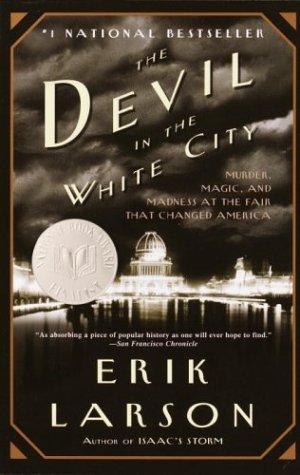
The Devil in the White City
Erik Larson
