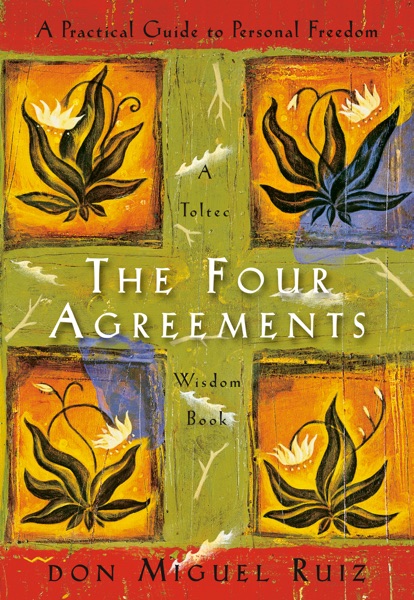
Talk to The Four Agreements like its author wrote you back.
Get the ideas that fit your life — not generic summaries.
- Chat with the book
- Audiobook-style main ideas
- Adapts to your life and goals
- Helps you take action
The Four Agreements, in detail
The Four Agreements is Don Miguel Ruiz's distillation of what he describes as ancient Toltec wisdom, repackaged as a practical guide to personal freedom. The book is brief, repetitive by design, and structured around four behavioral commitments that Ruiz argues can free people from the self-limiting agreements they made in childhood without realizing it. It has sold over ten million copies in the United States alone, making it one of the most successful self-help books of the late twentieth century, despite (or because of) its unusual combination of New Age spirituality and practical behavioral advice.
Ruiz's framework begins with the observation that every human being lives in a kind of dream — a collective hallucination of beliefs, norms, and judgments absorbed from family, school, religion, and culture during childhood, before the critical faculties are developed enough to evaluate them. Most of this domestication, as he calls it, is done through punishment and reward, and the result is an internal judge and an internal victim who spend most of their energy on self-criticism and the anxious management of others' opinions.
The four agreements are the antidote. The first, be impeccable with your word, is the most demanding: it means using language with integrity, avoiding gossip, not using words as weapons against yourself or others. The second, don't take anything personally, addresses the energy wasted in reacting to what other people say and do as if it were about you, when it is almost always about them. The third, don't make assumptions, targets the suffering caused by treating unverified inferences as facts. The fourth, always do your best, is the safety net: if the first three are too demanding today, doing your best today — which will vary — is enough.
The book has real limitations. The historical claim about Toltec origins is loosely sourced, and the framework is not as tightly argued as more academic treatments of the same territory. Some chapters feel padded. But the core ideas — particularly around taking things personally and the stories we tell ourselves about other people's behavior — have a clarity that makes them sticky. Readers who come to the book without expecting philosophical precision often find it more useful than its detractors allow.
The big ideas
- 1.
Every person lives inside a personal dream shaped by agreements made in childhood — beliefs about how the world works and how one should behave — most of which were never consciously chosen.
- 2.
Being impeccable with your word means using language with integrity and refusing to use it as a weapon against yourself or others; gossip and self-criticism are forms of verbal violence.
- 3.
Don't take anything personally: other people's words and actions reflect their own beliefs, fears, and wounds, not a verdict on your value. Reacting to them as personal attacks wastes energy on a fiction.
