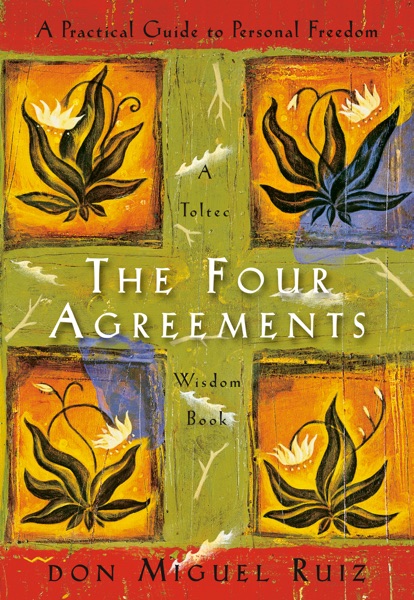
The Four Agreements by Don Miguel Ruiz is a 1997 self-help book about personal freedom, communication, self-awareness. Every person lives inside a personal dream shaped by agreements made in childhood — beliefs about how the world works and how one should behave — most of which were never consciously chosen.
Summary
The Four Agreements is Don Miguel Ruiz's distillation of what he describes as ancient Toltec wisdom, repackaged as a practical guide to personal freedom. The book is brief, repetitive by design, and structured around four behavioral commitments that Ruiz argues can free people from the self-limiting agreements they made in childhood without realizing it. It has sold over ten million copies in the United States alone, making it one of the most successful self-help books of the late twentieth century, despite (or because of) its unusual combination of New Age spirituality and practical behavioral advice.
Ruiz's framework begins with the observation that every human being lives in a kind of dream — a collective hallucination of beliefs, norms, and judgments absorbed from family, school, religion, and culture during childhood, before the critical faculties are developed enough to evaluate them. Most of this domestication, as he calls it, is done through punishment and reward, and the result is an internal judge and an internal victim who spend most of their energy on self-criticism and the anxious management of others' opinions.
The four agreements are the antidote. The first, be impeccable with your word, is the most demanding: it means using language with integrity, avoiding gossip, not using words as weapons against yourself or others. The second, don't take anything personally, addresses the energy wasted in reacting to what other people say and do as if it were about you, when it is almost always about them. The third, don't make assumptions, targets the suffering caused by treating unverified inferences as facts. The fourth, always do your best, is the safety net: if the first three are too demanding today, doing your best today — which will vary — is enough.
The book has real limitations. The historical claim about Toltec origins is loosely sourced, and the framework is not as tightly argued as more academic treatments of the same territory. Some chapters feel padded. But the core ideas — particularly around taking things personally and the stories we tell ourselves about other people's behavior — have a clarity that makes them sticky. Readers who come to the book without expecting philosophical precision often find it more useful than its detractors allow.
Talk to The Four Agreements like its author wrote you back.
Get the ideas that fit your life — not generic summaries.
- Chat with the book
- Audiobook-style main ideas
- Adapts to your life and goals
- Helps you take action
Key takeaways
- 1.
Every person lives inside a personal dream shaped by agreements made in childhood — beliefs about how the world works and how one should behave — most of which were never consciously chosen.
- 2.
Being impeccable with your word means using language with integrity and refusing to use it as a weapon against yourself or others; gossip and self-criticism are forms of verbal violence.
- 3.
Don't take anything personally: other people's words and actions reflect their own beliefs, fears, and wounds, not a verdict on your value. Reacting to them as personal attacks wastes energy on a fiction.
- 4.
Don't make assumptions: most interpersonal suffering comes from treating unverified guesses about other people's motives as facts. Ask rather than infer.
- 5.
Always do your best: the standard varies with circumstance — your best when exhausted is different from your best when rested — so the commitment is to effort, not outcome.
- 6.
The internal judge and internal victim are two sides of the same belief system; weakening the judge also weakens the victim, because both depend on the same set of agreements.
- 7.
Changing deeply held beliefs requires more than intellectual understanding; the agreements were created through repetition and must be challenged through consistent, repeated action.
- 8.
Much of the anxiety about other people's opinions comes from projecting one's own internal judgments outward — assuming others will condemn what you condemn in yourself.
Discussion questions
Use these on your own, with a book club, or as chat starters in Superbook. Book club version, ready to copy or print →
- 1.
Ruiz says the beliefs we live by were mostly established before we had the capacity to evaluate them. Which belief about yourself do you most want to have chosen consciously, rather than absorbed?
- 2.
Don't take anything personally is easy to agree with in principle. What is the hardest situation in your own life where you genuinely struggle not to take something personally?
- 3.
He distinguishes between words as tools of creation and words as weapons. Has there been a period in your life when you used language primarily as a weapon — against yourself or against others?
- 4.
Don't make assumptions asks you to seek clarification rather than infer. When in your life has an unasked question caused a problem that direct communication would have prevented?
- 5.
The fourth agreement — always do your best — seems like advice to lower your standards. How do you interpret it instead?
- 6.
Ruiz frames the socialization process as domestication through punishment and reward. Is that framing fair to parents and teachers, or does it assign them too much negative agency?
- 7.
The book sells a spiritual framework (Toltec wisdom) alongside practical advice. Does the spiritual framing add to the usefulness of the ideas or distract from them?
- 8.
Which of the four agreements would be the hardest for you to practice consistently, and why?
- 9.
The book has sold tens of millions of copies. Why do you think these particular ideas resonate so widely across different cultures and demographics?
- 10.
Ruiz says changing agreements requires sustained effort because they were created through repetition. What practice or routine have you used — or would you need to use — to actually change a deeply held belief about yourself?
- 11.
The internal judge is described as the voice that criticizes and evaluates. Is it possible to have a useful internal evaluator that isn't a judge in Ruiz's negative sense?
- 12.
The four agreements are simple to state but reportedly hard to live. Have you tried applying any of them over a sustained period? What happened?
Themes
Frequently asked questions
-
Is The Four Agreements worth reading for secular readers?
Yes, with adjusted expectations. The four commitments themselves — impeccable language, not taking things personally, not making assumptions, always doing your best — are practically useful regardless of the spiritual framework around them. Readers who find the Toltec mythology distracting can read past it without losing the core content.
-
How long is The Four Agreements?
Around 140 pages, roughly two to three hours of reading. It is deliberately simple and repetitive — Ruiz returns to the same ideas from different angles — which some readers find reinforcing and others find padded.
-
What does 'Toltec wisdom' mean in this context?
Ruiz presents it as a spiritual tradition from pre-Columbian Mexico, focused on personal mastery and freedom from conditioning. Scholars of Mesoamerican history note that his account of Toltec philosophy is loosely sourced and partly reconstructed. The book is better approached as personal philosophy than as historical anthropology.
-
Is the second agreement — don't take anything personally — realistic?
It's an asymptotic goal rather than a binary state. The useful version of the idea is: notice how often you react to things that are really about the other person, and practice creating a moment of pause before taking offense. No one achieves complete detachment, but the direction is useful.
-
Who should read this book?
People who struggle with self-criticism, oversensitivity to others' opinions, or patterns of assuming the worst about what others mean. It's also useful for anyone in a demanding interpersonal role — parents, teachers, managers — who needs frameworks for not letting others' behavior constantly land as personal attacks.
Similar books
The Power of Now
Eckhart Tolle
Man's Search for Meaning
Viktor E. Frankl
The Subtle Art of Not Giving a F*ck
Mark Manson
A New Earth: Awakening to Your Life's Purpose
Eckhart Tolle
