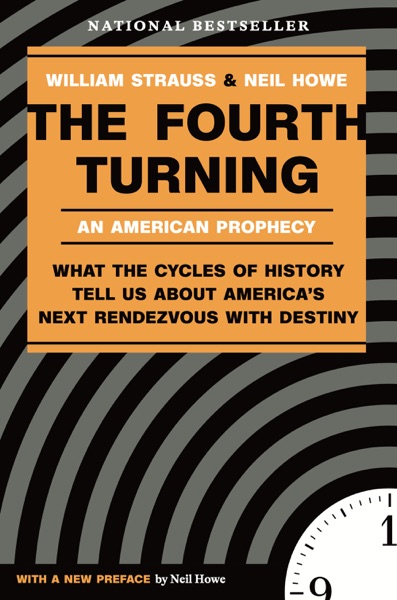
Talk to The Fourth Turning like its author wrote you back.
Get the ideas that fit your life — not generic summaries.
- Chat with the book
- Audiobook-style main ideas
- Adapts to your life and goals
- Helps you take action
What it argues
The Fourth Turning is William Strauss and Neil Howe's 1997 argument that Anglo-American history moves in recurring eighty-to-one-hundred-year cycles, each composed of four "turnings" corresponding to distinct social moods. The First Turning is a High — a period of institutional confidence and expanding order. The Second is an Awakening — a spiritual and cultural upheaval that challenges the prevailing order. The Third is an Unraveling — a time of individualism, institutional distrust, and cultural fragmentation. The Fourth is a Crisis — a period of severe collective danger that destroys the old order and regenerates social cohesion. Strauss and Howe argued in 1997 that the United States was entering a Fourth Turning that would peak sometime around 2020 to 2030.
The book's central claim is that these cycles are driven by generational biology. Each turning lasts roughly twenty years — the length of a generation — and each generation is shaped by the turning during which its formative years fall. This creates a repeating four-type pattern: Prophets (born during a High), Nomads (born during an Awakening), Heroes (born during an Unraveling), and Artists (born during a Crisis). The Baby Boomers are Prophets; Generation X are Nomads; Millennials are Heroes. Each archetype carries characteristic values, behaviors, and social roles that, the authors argue, recur across cycles.
What it gets right
- 1.
History, in the Strauss-Howe model, cycles through four turnings — High, Awakening, Unraveling, and Crisis — each lasting roughly twenty years, driven by generational succession.
- 2.
Each generation is shaped by the social mood of its formative era and inherits a characteristic archetype: Prophet, Nomad, Hero, or Artist, cycling in order.
- 3.
Fourth Turnings are periods of genuine collective crisis — comparable to the Civil War or World War II — that destroy old institutions and create conditions for a new social order.
What it covers
Who wrote it
William Strauss (1947–2007) was an American author, playwright, and political satirist. Neil Howe is an American historian, economist, and demographer. Together they developed the Strauss-Howe generational theory, which they introduced in Generations (1991) before elaborating it in The Fourth Turning (1997). Howe has continued to develop and apply the framework as a consultant to government and corporate clients. Their work has been cited by politicians and investors across the political spectrum and gained a new wave of readers after the 2008 financial crisis and the political turbulence of the 2010s.
