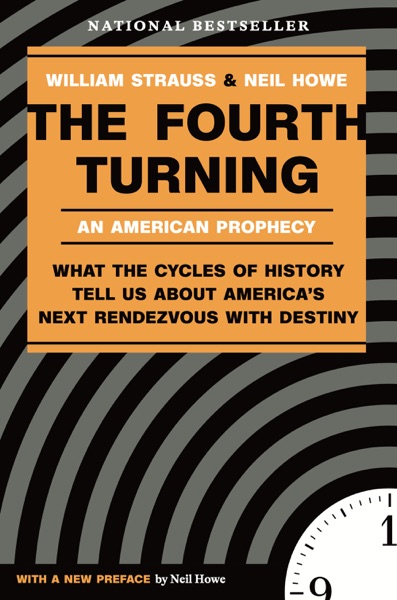
The Fourth Turning by William Strauss & Neil Howe is a 1997 history book about historical cycles, generational theory, social change. History, in the Strauss-Howe model, cycles through four turnings — High, Awakening, Unraveling, and Crisis — each lasting roughly twenty years, driven by generational succession.
Summary
The Fourth Turning is William Strauss and Neil Howe's 1997 argument that Anglo-American history moves in recurring eighty-to-one-hundred-year cycles, each composed of four "turnings" corresponding to distinct social moods. The First Turning is a High — a period of institutional confidence and expanding order. The Second is an Awakening — a spiritual and cultural upheaval that challenges the prevailing order. The Third is an Unraveling — a time of individualism, institutional distrust, and cultural fragmentation. The Fourth is a Crisis — a period of severe collective danger that destroys the old order and regenerates social cohesion. Strauss and Howe argued in 1997 that the United States was entering a Fourth Turning that would peak sometime around 2020 to 2030.
The book's central claim is that these cycles are driven by generational biology. Each turning lasts roughly twenty years — the length of a generation — and each generation is shaped by the turning during which its formative years fall. This creates a repeating four-type pattern: Prophets (born during a High), Nomads (born during an Awakening), Heroes (born during an Unraveling), and Artists (born during a Crisis). The Baby Boomers are Prophets; Generation X are Nomads; Millennials are Heroes. Each archetype carries characteristic values, behaviors, and social roles that, the authors argue, recur across cycles.
Strauss and Howe trace this pattern through major Anglo-American historical cycles: the crisis of the colonial era culminating in the Revolutionary War, the Civil War era crisis, and the Depression and World War II crisis. Each followed the same four-phase structure, and each Fourth Turning featured a defining external catalyst, a "regeneracy" of civic unity, and a climax that destroyed the old order and created conditions for a new High.
The theory is ambitious and the pattern-fitting is impressive, but it has clear limits. History is messier than a model of neat twenty-year phases, and the authors must do some squeezing to make centuries of events fit. The framework also has difficulty accounting for non-Anglo societies and applies most cleanly to periods of genuine military crisis. But as a lens for understanding generational dynamics and long-wave social change, it remains genuinely provocative and has accumulated a large readership decades after publication — in part because events since 1997 have done little to disprove the core prediction.
Talk to The Fourth Turning like its author wrote you back.
Get the ideas that fit your life — not generic summaries.
- Chat with the book
- Audiobook-style main ideas
- Adapts to your life and goals
- Helps you take action
Key takeaways
- 1.
History, in the Strauss-Howe model, cycles through four turnings — High, Awakening, Unraveling, and Crisis — each lasting roughly twenty years, driven by generational succession.
- 2.
Each generation is shaped by the social mood of its formative era and inherits a characteristic archetype: Prophet, Nomad, Hero, or Artist, cycling in order.
- 3.
Fourth Turnings are periods of genuine collective crisis — comparable to the Civil War or World War II — that destroy old institutions and create conditions for a new social order.
- 4.
The book predicted in 1997 that a Fourth Turning would arrive around 2005 to 2008 and peak around 2020 to 2030, driven by fiscal, social, or military crisis.
- 5.
Millennials as Hero-archetype are predicted to be the civic generation that coalesces to resolve the Fourth Turning crisis — much as the GI Generation did in World War II.
- 6.
The institutional trust and civic confidence characteristic of a First Turning (a High) can only be rebuilt after a genuine Fourth Turning has cleared the old order.
- 7.
Generational conflict is partly an archetype conflict, not just an age conflict. Prophets and Heroes have historically been in tension, just as Nomads and Artists have.
- 8.
The theory does not predict which crisis will trigger the Fourth Turning, only that some severe collective danger will arrive on schedule and demand a collective response.
Discussion questions
Use these on your own, with a book club, or as chat starters in Superbook. Book club version, ready to copy or print →
- 1.
The book predicted a Fourth Turning crisis peaking around 2020. Which events since 1997 look most like confirmation of the model, and which fit least well?
- 2.
Strauss and Howe argue that generational character is shaped by the social mood of formative years, not just by individual experience. To what extent does your own generation's character match their archetype?
- 3.
The model implies that history is cyclical and that individual agency is constrained by generational position. How do you reconcile that with your own sense of historical possibility?
- 4.
The book's Anglo-American focus is explicit. Does the framework export to other societies? If not, what does that limit tell us about its underlying claims?
- 5.
Fourth Turnings, in the model, are characterized by a 'regeneracy' — a moment when civic unity reforms around a shared crisis. Can you identify anything in recent history that looks like a genuine regeneracy?
- 6.
Prophets, the generation shaped during a High, are characterized as idealistic and moralistic — driving Awakenings later in life. Does that description fit your understanding of the Baby Boom generation?
- 7.
The model predicts that Millennials will play the Hero role — subordinating individual ambition to collective survival during the Crisis. Does that seem plausible given what you know of that generation?
- 8.
The book was written in 1997 and the authors acknowledge their predictions could be wrong. How should we calibrate our confidence in theories that make long-range historical predictions?
- 9.
Strauss and Howe argue that institutional trust can only be rebuilt after a Crisis forces collective sacrifice. Is there an alternative path to civic renewal that doesn't require catastrophe?
- 10.
The framework treats generations as relatively homogeneous. How much variation within generations undermines the predictive value of generational archetypes?
- 11.
Critics argue the authors are pattern-matching and that the historical cycles are an artifact of how they frame the data. How would you distinguish a genuine historical cycle from sophisticated confirmation bias?
- 12.
If the Fourth Turning model is broadly correct, what does it imply about the decisions you should be making in the next decade — personally, professionally, or politically?
Themes
Frequently asked questions
-
Is The Fourth Turning worth reading?
Yes, with appropriate skepticism. The framework is intellectually stimulating and the historical evidence is marshaled impressively. Treat it as a useful lens for thinking about long-wave social change rather than a literal predictive model. Its value is heuristic, not scientific.
-
How did The Fourth Turning predict the future?
The book predicted in 1997 that a major crisis would begin around 2005–2008 and peak around 2020–2030. The 2008 financial crisis, the polarization of the 2010s, and the COVID-19 pandemic have given the model a significant body of readers who see those events as confirmation.
-
What is a 'turning' in the Strauss-Howe model?
A turning is a twenty-year phase defined by a distinct social mood. The four turnings are the High (institutional confidence), the Awakening (cultural upheaval), the Unraveling (fragmentation), and the Crisis (collective danger and regeneration). They cycle continuously.
-
Is this a liberal or conservative book?
Neither, though it has been adopted by readers across the political spectrum. The model predicts crisis and civic renewal regardless of which ideology wins. It has been cited by figures ranging from Steve Bannon on the right to progressive policy analysts on the left.
-
What are the main criticisms of the theory?
The primary criticisms are that the historical cycles are constructed through selective framing, that the twenty-year generational lengths are too neat to match messy reality, that the Anglo-American focus limits generalizability, and that the theory is unfalsifiable in practice because any crisis can be made to fit the Fourth Turning template.
Similar books
Sapiens: A Brief History of Humankind
Yuval Noah Harari
Guns, Germs, and Steel
Jared Diamond
The End of History and the Last Man
Francis Fukuyama
Homo Deus: A Brief History of Tomorrow
Yuval Noah Harari
