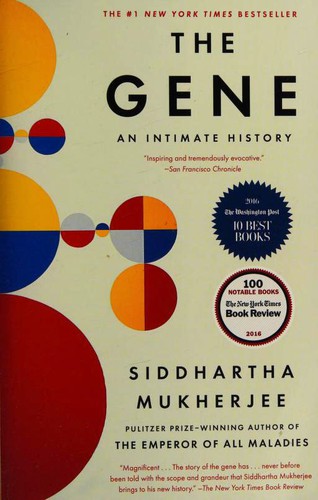
Talk to The Gene: An Intimate History like its author wrote you back.
Get the ideas that fit your life — not generic summaries.
- Chat with the book
- Audiobook-style main ideas
- Adapts to your life and goals
- Helps you take action
What it argues
The Gene is Siddhartha Mukherjee's account of the gene — what it is, how it was discovered, and what humanity has done and might yet do with that knowledge. The book moves chronologically from Gregor Mendel's pea-plant experiments in the 1860s through the double-helix discovery, the Human Genome Project, and into the age of CRISPR and genetic editing. It is a history of science, but Mukherjee keeps returning to something more personal: his family carries a strong history of mental illness, and that thread runs quietly through the entire narrative, giving the science emotional weight it rarely gets in textbooks.
Mukherjee is careful to show how often the science was politically weaponized before it was properly understood. The eugenics movement of the early twentieth century — which drew explicit inspiration from Mendel's work, badly misread — produced laws in the United States and eventually the machinery of Nazi racial policy. The book treats this history at length, not as a detour but as a warning. The same impulse to manage heredity has not gone away; it has just acquired better tools.
What it gets right
- 1.
Mendel's experiments established that traits are inherited in discrete units — what we now call genes — but his work was ignored for decades and later misappropriated to justify eugenics before it was properly understood.
- 2.
The structure of DNA — the double helix discovered by Watson, Crick, and significantly Franklin in 1953 — explained how genetic information is stored and copied, opening molecular biology as a field.
- 3.
Genes do not map cleanly onto traits. Most complex traits (intelligence, personality, height) are polygenic and heavily influenced by environment, making deterministic genetic claims almost always wrong.
What it covers
Who wrote it
Siddhartha Mukherjee is an oncologist, researcher, and writer on the faculty of Columbia University. He won the Pulitzer Prize for General Nonfiction in 2011 for The Emperor of All Maladies, his history of cancer. The Gene, published in 2016, followed a similar model: deep historical research combined with clinical observation and personal family history. His third book, The Song of the Cell, appeared in 2022. Mukherjee's writing is notable for moving between the laboratory, the clinic, and the philosophical implications of both without losing rigor in any register.
