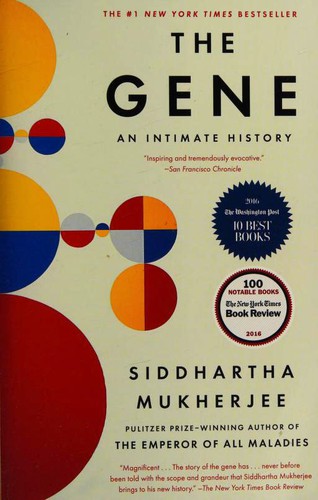
Talk to The Gene: An Intimate History like its author wrote you back.
Get the ideas that fit your life — not generic summaries.
- Chat with the book
- Audiobook-style main ideas
- Adapts to your life and goals
- Helps you take action
The Gene: An Intimate History, in detail
The Gene is Siddhartha Mukherjee's account of the gene — what it is, how it was discovered, and what humanity has done and might yet do with that knowledge. The book moves chronologically from Gregor Mendel's pea-plant experiments in the 1860s through the double-helix discovery, the Human Genome Project, and into the age of CRISPR and genetic editing. It is a history of science, but Mukherjee keeps returning to something more personal: his family carries a strong history of mental illness, and that thread runs quietly through the entire narrative, giving the science emotional weight it rarely gets in textbooks.
Mukherjee is careful to show how often the science was politically weaponized before it was properly understood. The eugenics movement of the early twentieth century — which drew explicit inspiration from Mendel's work, badly misread — produced laws in the United States and eventually the machinery of Nazi racial policy. The book treats this history at length, not as a detour but as a warning. The same impulse to manage heredity has not gone away; it has just acquired better tools.
The middle sections trace the molecular biology revolution of the 1950s through the 1980s: Watson and Crick, Rosalind Franklin's underacknowledged contribution, the cracking of the genetic code, the rise of recombinant DNA, and the early battles over genetic engineering regulation that happened in Asilomar in 1975. Mukherjee is good at making clear why each discovery was genuinely surprising to the people making it, and how much was arrived at by accident, competition, and luck alongside rigorous method.
The final third turns to the present and near future. Gene therapy has moved from promising to disgraced to cautiously promising again. CRISPR allows targeted editing of the genome with a precision previous generations could not have imagined. Mukherjee asks what it will mean to edit heritable traits — not just to cure diseases but eventually, perhaps, to select for intelligence, temperament, height. He does not pretend to answer these questions cleanly. His honest position is that the science is moving faster than the ethical frameworks around it, and that the history of the gene is full of confident decisions that later generations regarded as catastrophic.
The big ideas
- 1.
Mendel's experiments established that traits are inherited in discrete units — what we now call genes — but his work was ignored for decades and later misappropriated to justify eugenics before it was properly understood.
- 2.
The structure of DNA — the double helix discovered by Watson, Crick, and significantly Franklin in 1953 — explained how genetic information is stored and copied, opening molecular biology as a field.
- 3.
Genes do not map cleanly onto traits. Most complex traits (intelligence, personality, height) are polygenic and heavily influenced by environment, making deterministic genetic claims almost always wrong.
