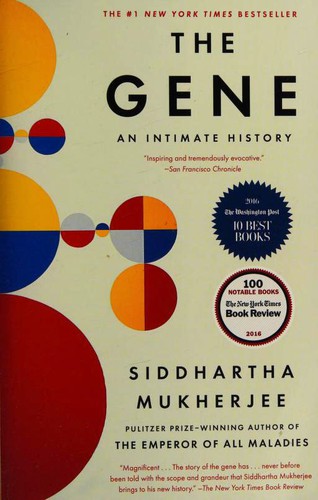
The Gene: An Intimate History by Siddhartha Mukherjee is a 2016 science book about genetics, heredity, medical ethics. Mendel's experiments established that traits are inherited in discrete units — what we now call genes — but his work was ignored for decades and later misappropriated to justify eugenics before it was properly understood.
Summary
The Gene is Siddhartha Mukherjee's account of the gene — what it is, how it was discovered, and what humanity has done and might yet do with that knowledge. The book moves chronologically from Gregor Mendel's pea-plant experiments in the 1860s through the double-helix discovery, the Human Genome Project, and into the age of CRISPR and genetic editing. It is a history of science, but Mukherjee keeps returning to something more personal: his family carries a strong history of mental illness, and that thread runs quietly through the entire narrative, giving the science emotional weight it rarely gets in textbooks.
Mukherjee is careful to show how often the science was politically weaponized before it was properly understood. The eugenics movement of the early twentieth century — which drew explicit inspiration from Mendel's work, badly misread — produced laws in the United States and eventually the machinery of Nazi racial policy. The book treats this history at length, not as a detour but as a warning. The same impulse to manage heredity has not gone away; it has just acquired better tools.
The middle sections trace the molecular biology revolution of the 1950s through the 1980s: Watson and Crick, Rosalind Franklin's underacknowledged contribution, the cracking of the genetic code, the rise of recombinant DNA, and the early battles over genetic engineering regulation that happened in Asilomar in 1975. Mukherjee is good at making clear why each discovery was genuinely surprising to the people making it, and how much was arrived at by accident, competition, and luck alongside rigorous method.
The final third turns to the present and near future. Gene therapy has moved from promising to disgraced to cautiously promising again. CRISPR allows targeted editing of the genome with a precision previous generations could not have imagined. Mukherjee asks what it will mean to edit heritable traits — not just to cure diseases but eventually, perhaps, to select for intelligence, temperament, height. He does not pretend to answer these questions cleanly. His honest position is that the science is moving faster than the ethical frameworks around it, and that the history of the gene is full of confident decisions that later generations regarded as catastrophic.
Talk to The Gene: An Intimate History like its author wrote you back.
Get the ideas that fit your life — not generic summaries.
- Chat with the book
- Audiobook-style main ideas
- Adapts to your life and goals
- Helps you take action
Key takeaways
- 1.
Mendel's experiments established that traits are inherited in discrete units — what we now call genes — but his work was ignored for decades and later misappropriated to justify eugenics before it was properly understood.
- 2.
The structure of DNA — the double helix discovered by Watson, Crick, and significantly Franklin in 1953 — explained how genetic information is stored and copied, opening molecular biology as a field.
- 3.
Genes do not map cleanly onto traits. Most complex traits (intelligence, personality, height) are polygenic and heavily influenced by environment, making deterministic genetic claims almost always wrong.
- 4.
The history of eugenics is a case study in what happens when science outpaces ethics: the same legitimate observations about heredity were used to sterilize hundreds of thousands of people, mostly poor and nonwhite.
- 5.
Gene therapy has oscillated between promise and failure since the 1980s. Early deaths from experimental trials set the field back by years; recent successes with CRISPR have reopened the debate on acceptable risk.
- 6.
CRISPR-Cas9 allows edits to the genome with unprecedented precision. Edits to somatic cells affect only the individual; edits to germline cells pass to every subsequent generation, raising qualitatively different ethical questions.
- 7.
Mukherjee's family history of schizophrenia and bipolar disorder runs through the book as a reminder that the people most affected by genetic science are rarely the ones deciding how it is used.
- 8.
Regulating genetic science requires deciding what counts as disease, what counts as difference, and who gets to draw that line — questions that are political and cultural, not merely biological.
Discussion questions
Use these on your own, with a book club, or as chat starters in Superbook. Book club version, ready to copy or print →
- 1.
Mukherjee describes eugenics as a scientific idea that became a political program. At what point did the science stop and the ideology begin, and is that line always this blurry?
- 2.
The book traces Rosalind Franklin's contribution to the double-helix discovery and how it was used without her consent. How does that history affect how you think about credit in science more broadly?
- 3.
Mukherjee draws a distinction between treating disease and enhancing traits. Where would you draw that line, and do you think it can be held?
- 4.
If genetic testing revealed that you carried a variant strongly associated with early-onset Alzheimer's, would you want to know? Would your answer change if you were planning to have children?
- 5.
The Asilomar conference in 1975 was a rare case of scientists voluntarily pausing their own work to assess risks. What conditions made that possible, and do you think it could happen with CRISPR today?
- 6.
Mukherjee's family history of mental illness shapes his perspective on psychiatric genetics throughout the book. How does a writer's personal stake in a subject change how you read their arguments?
- 7.
The book describes how genes interact with environment to produce traits. What's a belief you held about genetic determinism that the book challenged or confirmed?
- 8.
CRISPR germline editing would affect every future descendant of an edited embryo. What governance structures, if any, do you think could meaningfully regulate that kind of decision?
- 9.
Mukherjee writes that the history of genetics has been one of confident overreach followed by correction. What areas of current genetics research seem most likely, in retrospect, to look like overreach?
- 10.
The book spends considerable time on the political capture of genetics. Are there areas of current science you think are similarly vulnerable to that kind of capture?
- 11.
Mukherjee argues the science is moving faster than the ethical frameworks. What would it actually take to slow the science, and who would bear the cost of that delay?
- 12.
If it became possible to screen embryos for polygenic scores predicting intelligence or mental health risk, who should decide whether that screening is offered, required, or forbidden?
Themes
Frequently asked questions
-
Is The Gene worth reading if I have no science background?
Yes, with the caveat that some sections are dense. Mukherjee builds the concepts carefully from first principles, and the history and ethics sections are accessible to any reader. The molecular biology chapters in the middle require closer attention, but skimming them and staying with the narrative still yields most of the book's value.
-
How long does it take to read The Gene?
Around twelve to thirteen hours at average reading pace for the roughly 600-page book. It's a substantive read and rewards taking it slowly — the historical sections build on each other, and rushing makes the later ethical arguments harder to follow.
-
What is The Gene about?
It's a history of the gene as a scientific concept, from Mendel's 1860s pea experiments through CRISPR. Mukherjee traces the discoveries, the personalities behind them, the political misuses of the science (especially eugenics), and the contemporary questions raised by genetic editing. His family's history of mental illness runs through the book as a personal counterweight to the abstraction.
-
Who should read The Gene?
Anyone interested in where modern medicine and biology are headed, and in the history of how science gets misused as well as applied. It's especially useful for readers who want to think clearly about genetic testing, gene therapy, or reproductive medicine — topics that will affect most people's lives in the next few decades.
-
What's the most important idea in The Gene?
That genes are not destiny, and the history of treating them as destiny has been catastrophic. Complex traits are shaped by many genes interacting with environment over time. That doesn't make genetics unimportant — it makes overconfident genetic determinism, in any form, dangerous.
-
How does The Gene compare to The Emperor of All Maladies?
The structure is similar: a broad history of a scientific concept told through cases, characters, and Mukherjee's own experience as a clinician. The Gene is wider in scope and engages more directly with ethics and policy. Readers who loved Emperor will find the same voice and the same willingness to follow an idea past the comfortable conclusion.
Similar books
The Selfish Gene
Richard Dawkins
Sapiens: A Brief History of Humankind
Yuval Noah Harari
Behave: The Biology of Humans at Our Best and Worst
Robert M. Sapolsky
Why We Sleep
Matthew Walker
