Thriller · Book club
The Girl Who Played with Fire book club questions
Here are 12 book club questions for The Girl Who Played with Fire by Stieg Larsson, ordered to open easily and end somewhere worth arguing about. Copy them, print them, or bring them up one at a time.
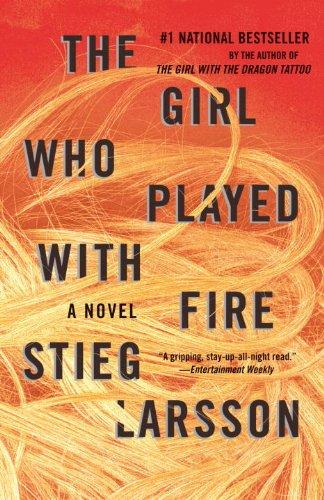
Lisbeth Salander returns to Stockholm after more than a year abroad and is almost immediately the prime suspect in three murders, including two investigators who were about to publish an exposé on the Swedish sex trade.
Stieg Larsson · 2006 · 13h 0m
Full summary and key takeaways →The 12 questions
- 1.
Salander's refusal to defend herself publicly is frustrating as a reader. How does the novel ask us to understand that choice — as trauma response, strategic calculation, or both?
- 2.
The plot requires us to believe that Cold War intelligence bureaucracies could maintain decades-long secrets with real human consequences. How plausible did you find that premise?
- 3.
Blomkvist believes Salander without evidence in the early sections. Is that faith reasonable given what he knows of her, or is it the plot requiring him to act a certain way?
- 4.
The sex trade investigation involves real-world mechanics — trafficking networks, complicit police, client databases. Did that research-heavy approach feel like journalism or procedural?
- 5.
Salander in this book is mostly observed rather than lived with — we see her from outside for long stretches. Does that work for you dramatically, or did you miss the first book's interiority?
- 6.
The revelation about Salander's family is the structural hinge of the trilogy. Does it feel like it recontextualizes everything that came before, or like new information grafted onto an existing character?
- 7.
The villain's protection came from Cold War political logic — he was useful, so he was shielded. Does that feel like a realistic account of how states protect people who serve them?
- 8.
Compare the pace of this novel to the first. Larsson slows down to build the backstory. Was that investment worthwhile by the end of the book?
- 9.
The ending is a cliffhanger that requires reading book three. How do you feel about trilogies that don't give you a resting point between volumes?
- 10.
Salander spends most of the book alone, fugitive, solving problems without allies. What does that isolation tell us about how she has adapted to her history?
- 11.
The Swedish state is the antagonist here in a more abstract sense than any individual. How does Larsson make a bureaucratic system feel as threatening as a human villain?
- 12.
If you've read book one but not book three: what do you think will happen? What does the novel seem to be building toward?
How to run the discussion
- Pick six to eight, not all of them. An hour of real discussion covers fewer questions than anyone expects, and racing the list is what makes a book club feel like homework.
- Open with what people noticed, not what they concluded. Asking for a verdict first hardens opinions before anyone has heard each other.
- Let the disagreement run. The questions below that split a room are the ones worth the time; the ones everyone answers the same way can be skipped.
- Ask the quiet person a specific question. A direct, narrow question is far easier to answer than an open invitation to contribute.
Themes worth steering toward
If the conversation stalls, these are the threads that usually restart it.
Common questions
What are good book club questions for The Girl Who Played with Fire?
Here are 12 book club questions for The Girl Who Played with Fire by Stieg Larsson, ordered to open easily and end somewhere worth arguing about. The strongest openers ask what each reader noticed rather than what they concluded, and the discussion usually turns on origin and identity, state violence against individuals, underground networks.
How long should a book club discussion of The Girl Who Played with Fire last?
Most groups run 60 to 90 minutes of actual discussion. That is roughly six to eight questions, not all of them, so pick the ones that suit your group rather than working down the list in order.
What are the main themes in The Girl Who Played with Fire?
Origin and identity, State violence against individuals, Underground networks, Reputation and evidence, Survival as resistance. Those are the threads most likely to divide a room, which makes them the useful places to steer a discussion that has gone quiet.
Picking the next one? See books like The Girl Who Played with Fire or questions for other book club picks.
