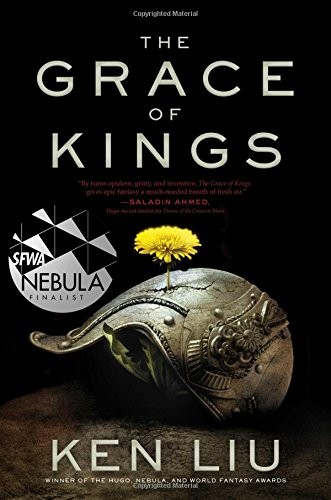
Talk to The Grace of Kings like its author wrote you back.
Get the ideas that fit your life — not generic summaries.
- Chat with the book
- Audiobook-style main ideas
- Adapts to your life and goals
- Helps you take action
The Grace of Kings, in detail
The Grace of Kings is the first volume of Ken Liu's Dandelion Dynasty, an epic fantasy set in an archipelago empire that maps broadly onto the fall of the Qin dynasty and the rise of the Han. Two men drive the story: Kuni Garu, a charismatic and cunning commoner who rises through charm and improvisation; and Mata Zyndu, a giant of a man who believes he is the last champion of a fallen noble house. They meet as rebels against the empire, become close friends and co-conspirators, and then — inevitably, historically — become adversaries as the post-imperial order refuses to accommodate both of them.
The book's central question is not who will win, but what kind of world is actually possible. Liu is interested in competing visions of governance, legitimacy, and change. The gods in this world are actively involved in human affairs — placing their bets on different human leaders — and their arguments among themselves mirror the philosophical disagreements between Kuni and Mata about what justice requires. The "silkpunk" aesthetic (silk-based technology, kite-powered airships, bio-engineered animals, classical engineering) is specific and evocative without becoming the focus.
Liu's style is influenced by classical Chinese narrative — the wide view, the multiple protagonists, the willingness to kill characters the reader has invested in and then move on. Chapters can span years; the novel covers decades. Liu has called the style "silkpunk epic fantasy," but the structural debt is to epics like the Romance of the Three Kingdoms rather than to Tolkien or George R.R. Martin. This is a different kind of long fantasy novel: less focused on intimate interiority, more interested in how history grinds.
Readers expecting the pace and texture of Western epic fantasy will need to adjust. The Grace of Kings rewards patience, attention to the political and philosophical arguments underneath the action, and a willingness to mourn characters who don't survive to the end of their chapters. Readers who enjoy historical fiction with scope — the sweep of empires, the accident of who rises and falls — will find this among the most ambitious fantasy novels of the past decade.
The big ideas
- 1.
The Kuni-Mata relationship is the emotional core: two men whose visions of justice are incompatible, and who cannot sustain their friendship across that gap.
- 2.
Liu's gods are political actors who argue about governance and legitimacy — their interventions are less divine providence than cosmic lobbying.
- 3.
The silkpunk aesthetic grounds the world in a specific cultural imagination (classical East Asian engineering and aesthetics) rather than the default Western medieval fantasy.
