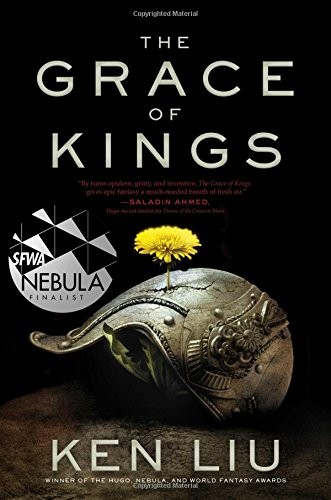
The Grace of Kings by Ken Liu is a 2015 fantasy book about revolution and empire, fate and free will, friendship and betrayal. The Kuni-Mata relationship is the emotional core: two men whose visions of justice are incompatible, and who cannot sustain their friendship across that gap.
Summary
The Grace of Kings is the first volume of Ken Liu's Dandelion Dynasty, an epic fantasy set in an archipelago empire that maps broadly onto the fall of the Qin dynasty and the rise of the Han. Two men drive the story: Kuni Garu, a charismatic and cunning commoner who rises through charm and improvisation; and Mata Zyndu, a giant of a man who believes he is the last champion of a fallen noble house. They meet as rebels against the empire, become close friends and co-conspirators, and then — inevitably, historically — become adversaries as the post-imperial order refuses to accommodate both of them.
The book's central question is not who will win, but what kind of world is actually possible. Liu is interested in competing visions of governance, legitimacy, and change. The gods in this world are actively involved in human affairs — placing their bets on different human leaders — and their arguments among themselves mirror the philosophical disagreements between Kuni and Mata about what justice requires. The "silkpunk" aesthetic (silk-based technology, kite-powered airships, bio-engineered animals, classical engineering) is specific and evocative without becoming the focus.
Liu's style is influenced by classical Chinese narrative — the wide view, the multiple protagonists, the willingness to kill characters the reader has invested in and then move on. Chapters can span years; the novel covers decades. Liu has called the style "silkpunk epic fantasy," but the structural debt is to epics like the Romance of the Three Kingdoms rather than to Tolkien or George R.R. Martin. This is a different kind of long fantasy novel: less focused on intimate interiority, more interested in how history grinds.
Readers expecting the pace and texture of Western epic fantasy will need to adjust. The Grace of Kings rewards patience, attention to the political and philosophical arguments underneath the action, and a willingness to mourn characters who don't survive to the end of their chapters. Readers who enjoy historical fiction with scope — the sweep of empires, the accident of who rises and falls — will find this among the most ambitious fantasy novels of the past decade.
Talk to The Grace of Kings like its author wrote you back.
Get the ideas that fit your life — not generic summaries.
- Chat with the book
- Audiobook-style main ideas
- Adapts to your life and goals
- Helps you take action
Key takeaways
- 1.
The Kuni-Mata relationship is the emotional core: two men whose visions of justice are incompatible, and who cannot sustain their friendship across that gap.
- 2.
Liu's gods are political actors who argue about governance and legitimacy — their interventions are less divine providence than cosmic lobbying.
- 3.
The silkpunk aesthetic grounds the world in a specific cultural imagination (classical East Asian engineering and aesthetics) rather than the default Western medieval fantasy.
- 4.
The novel uses the historical arc of Chinese dynastic change — the pattern of peasant rebellion, coalitional victory, and post-revolutionary fracture — as structural argument.
- 5.
Women are underserved in the first volume (Liu has acknowledged this directly) and the later books in the series correct for it substantially.
- 6.
The novel is willing to kill off characters the reader has been following for hundreds of pages — it operates at epic rather than intimate scale.
- 7.
Political legitimacy — who has the right to rule and on what basis — is the novel's sustained argument, and Liu presents no clean answer.
- 8.
The friendship between Kuni and Mata is treated as genuinely tragic, not just as narrative machinery; their divergence is a real loss.
Discussion questions
Use these on your own, with a book club, or as chat starters in Superbook. Book club version, ready to copy or print →
- 1.
Kuni and Mata represent two incompatible models of leadership — improvisational adaptation versus principled honor. Which does the novel ultimately endorse, if either?
- 2.
The gods in The Grace of Kings are opinionated partisans rather than all-knowing directors. Did you find them effective as narrative devices or too intrusive?
- 3.
Liu kills off significant characters mid-arc without ceremony. Did that pattern feel like epic honesty, or did it create emotional distance for you?
- 4.
The silkpunk aesthetic is specific and carefully imagined. Did it feel like a setting you could inhabit, or more like a costume on a familiar fantasy template?
- 5.
The Kuni-Mata friendship ends in betrayal and war. Was the breach between them inevitable given who they each are, or was there a point where it could have gone differently?
- 6.
The novel covers decades and multiple generations. Did the wide time scale help or hurt your investment in individual characters?
- 7.
Women have limited agency in volume one. Does that register as a realistic depiction of the setting, a narrative limitation, or something else?
- 8.
The gods argue about whether human history is shaped by great individuals or by structural forces. What does Liu himself seem to believe, based on the novel?
- 9.
The Romance of the Three Kingdoms and other classical Chinese narratives are structural influences here. If you've read any of them, where did the resemblance feel clearest?
- 10.
The post-imperial chaos that follows the rebellion is treated as structurally inevitable. Is Liu making a pessimistic argument about revolution?
- 11.
Which character — Kuni, Mata, or one of the supporting figures — did you find most worth following, and why?
- 12.
If you read fantasy primarily in the Western tradition, what adjustments did you find yourself making while reading The Grace of Kings?
Themes
Frequently asked questions
-
Is The Grace of Kings hard to read?
It is long and dense. The novel covers decades, has a very large cast, and operates at epic scale rather than intimate scale. Readers unfamiliar with East Asian historical fiction may find the pacing and structural conventions unfamiliar. It rewards patience and a willingness to sit with complexity rather than momentum.
-
Do I need to know Chinese history?
No, but it helps significantly. The novel maps loosely onto the collapse of the Qin dynasty and the Chu-Han contention. Knowing that history makes the structural argument clearer and adds an additional layer to the reading.
-
Is this a standalone or do I need to read the sequels?
The Grace of Kings has its own arc but is not fully self-contained — it is the first part of an ongoing series. The major storyline of this volume concludes, but the world and its characters continue.
-
Why is it called silkpunk?
Liu coined the term to describe the aesthetic: Asian classical aesthetics and materials (silk, bamboo, natural philosophy) applied to speculative technology, rather than the steam-and-iron of steampunk. It is a world of kite-powered airships and bio-engineered crustaceans rather than gears and steam.
-
Who shouldn't read The Grace of Kings?
Readers who need intimate, character-driven fantasy where they can track a small cast across a contained arc. The novel operates at the scale of historical forces, and if you find yourself needing to care deeply about individuals rather than ideas, this may exhaust you.
Similar books

All Quiet on the Western Front
Erich Maria Remarque
Sapiens: A Brief History of Humankind
Yuval Noah Harari
The Silk Roads: A New History of the World
Peter Frankopan
War and Peace
Leo Tolstoy
