Talk to The Grapes of Wrath like its author wrote you back.
Get the ideas that fit your life — not generic summaries.
- Chat with the book
- Audiobook-style main ideas
- Adapts to your life and goals
- Helps you take action
The Grapes of Wrath, in detail
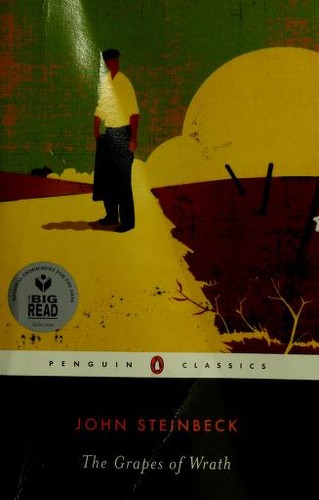
The Grapes of Wrath is Steinbeck's 1939 novel about the Joad family, Oklahoma sharecroppers forced off their land by the Dust Bowl and bank foreclosure, who load everything they own onto a truck and drive Route 66 to California in search of work and a decent life. It is both a specific story about one family and a panoramic account of the 1930s migration of hundreds of thousands of people that Steinbeck researched by living among migrant workers in California.
The novel alternates between chapters following the Joads and "intercalary" chapters that step back to describe the broader forces at work — the banks, the land companies, the California growers who advertise for workers to drive down wages, the social machinery that treats human beings as interchangeable units of cheap labor. Tom Joad, recently paroled from prison, becomes the novel's moral center; Jim Casy, a lapsed preacher who has developed his own rough theology of collective humanity, becomes its philosopher. The family shrinks as the novel progresses; people leave, die, break down. By the end they are in a flooded barn, stripped of almost everything, and the novel ends on one of the most audacious and debated closing images in American fiction.
Steinbeck's prose shifts registers: lyrical and biblical in the intercalary chapters, dialogue-driven and colloquial in the Joad chapters. The structural duality was controversial — many readers find the intercalary chapters slow or didactic — but it is deliberate: Steinbeck wants you to see the Joads as individuals and as symbols simultaneously. The novel won the Pulitzer Prize in 1940 and was central to his Nobel Prize citation. Banned in several counties on its publication (Kern County, California included), it was accused of communist sympathizing and factual inaccuracy — charges Steinbeck anticipated and documented against.
This is a long, demanding, explicitly political novel. It rewards readers willing to engage with its argument, not just its story. Those looking for subtlety about economic systems may find it schematic; those moved by the specific texture of working-class American life, rendered with precision and compassion, will find it devastating. The final image has divided readers for eighty years; it's worth sitting with rather than resolving too quickly.
The big ideas
- 1.
Tom Joad's farewell speech — 'I'll be all around in the dark. I'll be there wherever you can look' — defines the novel's political theology: the individual soul dissolved into collective struggle.
- 2.
The intercalary chapters argue that capitalism's logic — extract, dispose, move on — is applied to human beings exactly as it is applied to land. The novel does not hedge this claim.
- 3.
The family unit disintegrates under economic pressure, but the novel suggests that a larger family — the people — is forming. The migrants who share a camp are a society being born.
