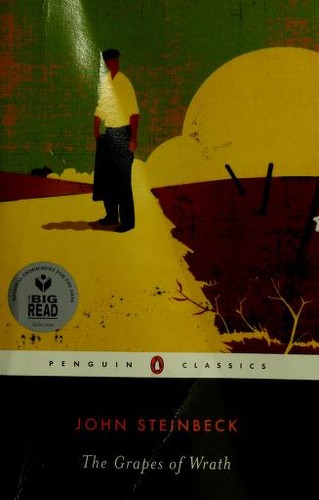
The Grapes of Wrath by John Steinbeck is a 1939 literary fiction book about poverty and migration, human dignity, collective survival. Tom Joad's farewell speech — 'I'll be all around in the dark. I'll be there wherever you can look' — defines the novel's political theology: the individual soul dissolved into collective struggle.
Summary
The Grapes of Wrath is Steinbeck's 1939 novel about the Joad family, Oklahoma sharecroppers forced off their land by the Dust Bowl and bank foreclosure, who load everything they own onto a truck and drive Route 66 to California in search of work and a decent life. It is both a specific story about one family and a panoramic account of the 1930s migration of hundreds of thousands of people that Steinbeck researched by living among migrant workers in California.
The novel alternates between chapters following the Joads and "intercalary" chapters that step back to describe the broader forces at work — the banks, the land companies, the California growers who advertise for workers to drive down wages, the social machinery that treats human beings as interchangeable units of cheap labor. Tom Joad, recently paroled from prison, becomes the novel's moral center; Jim Casy, a lapsed preacher who has developed his own rough theology of collective humanity, becomes its philosopher. The family shrinks as the novel progresses; people leave, die, break down. By the end they are in a flooded barn, stripped of almost everything, and the novel ends on one of the most audacious and debated closing images in American fiction.
Steinbeck's prose shifts registers: lyrical and biblical in the intercalary chapters, dialogue-driven and colloquial in the Joad chapters. The structural duality was controversial — many readers find the intercalary chapters slow or didactic — but it is deliberate: Steinbeck wants you to see the Joads as individuals and as symbols simultaneously. The novel won the Pulitzer Prize in 1940 and was central to his Nobel Prize citation. Banned in several counties on its publication (Kern County, California included), it was accused of communist sympathizing and factual inaccuracy — charges Steinbeck anticipated and documented against.
This is a long, demanding, explicitly political novel. It rewards readers willing to engage with its argument, not just its story. Those looking for subtlety about economic systems may find it schematic; those moved by the specific texture of working-class American life, rendered with precision and compassion, will find it devastating. The final image has divided readers for eighty years; it's worth sitting with rather than resolving too quickly.
Talk to The Grapes of Wrath like its author wrote you back.
Get the ideas that fit your life — not generic summaries.
- Chat with the book
- Audiobook-style main ideas
- Adapts to your life and goals
- Helps you take action
Key takeaways
- 1.
Tom Joad's farewell speech — 'I'll be all around in the dark. I'll be there wherever you can look' — defines the novel's political theology: the individual soul dissolved into collective struggle.
- 2.
The intercalary chapters argue that capitalism's logic — extract, dispose, move on — is applied to human beings exactly as it is applied to land. The novel does not hedge this claim.
- 3.
The family unit disintegrates under economic pressure, but the novel suggests that a larger family — the people — is forming. The migrants who share a camp are a society being born.
- 4.
Jim Casy's secular theology (the Holy Ghost is all people together) is Steinbeck's explicit framework. The novel is religious in structure even though its religion is economic solidarity.
- 5.
Ma Joad is the novel's center of gravity. She holds the family together by will alone, and her willingness to expand 'family' to include strangers is the book's moral claim made flesh.
- 6.
California as broken promise is not accidental. The novel documents how the mythology of the West — opportunity, fresh start, abundance — was weaponized to lure desperate people into exploitable conditions.
- 7.
The turtle chapter that opens the novel is a miniature of everything that follows: a creature moving toward something, knocked aside, persisting. Steinbeck's symbolism is not subtle, but it is well-earned.
- 8.
The ending — Rose of Sharon nursing a starving stranger — is either Steinbeck at his most humanist or at his most sentimental. The argument about that image is the argument about the whole novel.
Discussion questions
Use these on your own, with a book club, or as chat starters in Superbook. Book club version, ready to copy or print →
- 1.
Tom Joad says he'll be present wherever people fight for their rights. Is that speech the novel's climax, or does Steinbeck undercut it by what follows?
- 2.
The intercalary chapters slow the narrative but make a political argument. Do they work? Would the novel be more or less effective as pure story?
- 3.
The novel was accused on publication of being communist propaganda. Eighty years later, how does its economic critique hold up?
- 4.
Ma Joad holds the family together as the men around her break or flee. Is she a fully realized character, or a symbolic figure Steinbeck needs but can't quite write as a person?
- 5.
The Joads are sympathetic partly because Steinbeck ensures they are hard-working, moral, and fundamentally decent. Does their virtue earn our sympathy, or would the novel be stronger if they were more complicated?
- 6.
What does Jim Casy's death accomplish narratively and thematically? Does it earn the weight Steinbeck places on it?
- 7.
The final image — Rose of Sharon nursing a starving man — has been called transcendent, grotesque, heavy-handed, and unforgettable. Which reaction do you have, and why?
- 8.
Compare the California that the Joads imagine to the California they find. How does the novel use the gap between expectation and reality?
- 9.
The novel has been banned repeatedly. On what grounds? Do you find any of those objections worth taking seriously?
- 10.
Between-the-World-and-Me describes a different form of structural American dispossession. What do the two books share about how systems deprive people of dignity?
- 11.
How much of the novel's power depends on its historical specificity? Would a contemporary retelling — set among, say, climate refugees — work the same way?
- 12.
Steinbeck said the novel made him feel sick writing it. Does that emotional investment show on the page? Is it a liability or a strength?
Themes
Frequently asked questions
-
Is The Grapes of Wrath worth reading today?
Yes, particularly if you are interested in American economic history or political fiction. The conditions Steinbeck documented — migrant labor exploitation, corporate agriculture, the weaponization of debt — remain recognizable. The novel is long and explicitly political, but its emotional core holds.
-
Is it a difficult read?
The prose itself is not difficult. The intercalary chapters are denser and more stylized than the Joad chapters. At 500+ pages it requires commitment, and readers who find political fiction didactic may struggle with the argument chapters. Most readers who start it finish it.
-
Why was The Grapes of Wrath banned?
Primarily for its unflattering portrayal of California agricultural interests and for its perceived socialist politics. Kern County, California burned copies. The novel was also criticized for language and for the final scene. Some objections were about content; many were about what the content implied about American capitalism.
-
Who shouldn't read it?
Readers who want morally complex antagonists — the book's villains are systems and abstractions, not fully realized bad actors. And readers who find symbolic endings unsatisfying will likely be frustrated by the final scene.
-
Is there a film?
Yes — John Ford directed a celebrated 1940 adaptation with Henry Fonda as Tom Joad. It softens the ending and the politics somewhat, but is considered one of the finest American films of the era and is worth watching alongside the novel.
Similar books
All Quiet on the Western Front
Erich Maria Remarque
Between the World and Me
Ta-Nehisi Coates
Man's Search for Meaning
Viktor E. Frankl
Born a Crime: Stories from a South African Childhood
Trevor Noah
