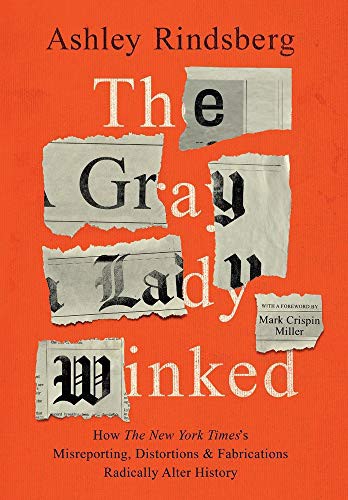
Talk to The Gray Lady Winked like its author wrote you back.
Get the ideas that fit your life — not generic summaries.
- Chat with the book
- Audiobook-style main ideas
- Adapts to your life and goals
- Helps you take action
The Gray Lady Winked, in detail
The Gray Lady Winked is a critical history of the New York Times, focused on cases where the paper's reporting was demonstrably wrong, selectively presented, or actively misleading. Ashley Rindsberg is not arguing that the Times is uniquely dishonest or irredeemably corrupt. His argument is more specific and more interesting: that the paper's institutional character — its belief in its own indispensability, its relationships with powerful sources, and its tendency to align its coverage with the assumptions of its elite readership — has caused it to fail in ways that had serious consequences, and that these failures have rarely been acknowledged proportionately.
The cases Rindsberg examines span decades. Walter Duranty won the Pulitzer Prize for his reporting from the Soviet Union in the 1930s, which systematically denied the Holodomor, the Ukrainian famine engineered by Stalin that killed millions. Herbert Matthews's interviews with Fidel Castro in 1957 produced reporting so sympathetic it arguably influenced the course of the Cuban revolution. Jayson Blair's fabrications in the early 2000s were caught eventually, but Rindsberg documents how editors dismissed warning signs for years. The paper's coverage of the lead-up to the Iraq War — which relied heavily on Judith Miller's reporting on weapons of mass destruction — was credulous in ways that its editors later acknowledged but whose consequences the paper's internal accounting minimized.
The through-line Rindsberg proposes is that the Times, because of its position as the institutional paper of record, has developed blind spots particular to that position. It depends on access to powerful people and institutions; access requires not burning sources; not burning sources produces coverage that protects those sources. It serves a readership that tends to hold certain views; coverage shaped by those views feels like objectivity to both readers and reporters.
The book is polemical in places and its framing occasionally overstates the case. Rindsberg is working against an institution he clearly finds culpable, and that animus shows. But the underlying historical record he documents is well-sourced and the failures he describes are real, documented, and consequential. It is most useful as a corrective to the tendency to treat prestigious journalism as synonymous with reliable journalism.
The big ideas
- 1.
Walter Duranty's Pulitzer Prize-winning Soviet reporting actively denied the Holodomor while millions starved — and the Times has never formally returned the prize.
- 2.
Institutional prestige creates a specific kind of credibility risk: sources, readers, and reporters themselves trust the institution enough to discount evidence that contradicts its coverage.
- 3.
Herbert Matthews's 1957 reporting on Castro was so favorable it shaped American and Cuban perceptions of the revolution at a critical moment, with consequences the paper never adequately reckoned with.
