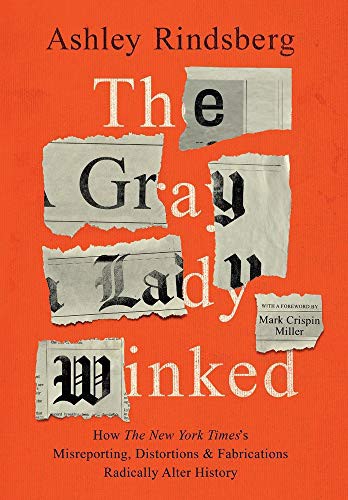
The Gray Lady Winked by Ashley Rindsberg is a 2021 history book about media criticism, journalism ethics, historical accuracy. Walter Duranty's Pulitzer Prize-winning Soviet reporting actively denied the Holodomor while millions starved — and the Times has never formally returned the prize.
Summary
The Gray Lady Winked is a critical history of the New York Times, focused on cases where the paper's reporting was demonstrably wrong, selectively presented, or actively misleading. Ashley Rindsberg is not arguing that the Times is uniquely dishonest or irredeemably corrupt. His argument is more specific and more interesting: that the paper's institutional character — its belief in its own indispensability, its relationships with powerful sources, and its tendency to align its coverage with the assumptions of its elite readership — has caused it to fail in ways that had serious consequences, and that these failures have rarely been acknowledged proportionately.
The cases Rindsberg examines span decades. Walter Duranty won the Pulitzer Prize for his reporting from the Soviet Union in the 1930s, which systematically denied the Holodomor, the Ukrainian famine engineered by Stalin that killed millions. Herbert Matthews's interviews with Fidel Castro in 1957 produced reporting so sympathetic it arguably influenced the course of the Cuban revolution. Jayson Blair's fabrications in the early 2000s were caught eventually, but Rindsberg documents how editors dismissed warning signs for years. The paper's coverage of the lead-up to the Iraq War — which relied heavily on Judith Miller's reporting on weapons of mass destruction — was credulous in ways that its editors later acknowledged but whose consequences the paper's internal accounting minimized.
The through-line Rindsberg proposes is that the Times, because of its position as the institutional paper of record, has developed blind spots particular to that position. It depends on access to powerful people and institutions; access requires not burning sources; not burning sources produces coverage that protects those sources. It serves a readership that tends to hold certain views; coverage shaped by those views feels like objectivity to both readers and reporters.
The book is polemical in places and its framing occasionally overstates the case. Rindsberg is working against an institution he clearly finds culpable, and that animus shows. But the underlying historical record he documents is well-sourced and the failures he describes are real, documented, and consequential. It is most useful as a corrective to the tendency to treat prestigious journalism as synonymous with reliable journalism.
Talk to The Gray Lady Winked like its author wrote you back.
Get the ideas that fit your life — not generic summaries.
- Chat with the book
- Audiobook-style main ideas
- Adapts to your life and goals
- Helps you take action
Key takeaways
- 1.
Walter Duranty's Pulitzer Prize-winning Soviet reporting actively denied the Holodomor while millions starved — and the Times has never formally returned the prize.
- 2.
Institutional prestige creates a specific kind of credibility risk: sources, readers, and reporters themselves trust the institution enough to discount evidence that contradicts its coverage.
- 3.
Herbert Matthews's 1957 reporting on Castro was so favorable it shaped American and Cuban perceptions of the revolution at a critical moment, with consequences the paper never adequately reckoned with.
- 4.
The Judith Miller WMD reporting failure illustrates how access-dependent journalism produces coverage that protects the access rather than the public's interest.
- 5.
Jayson Blair's fabrications survived longer than they should have partly because editors were reluctant to investigate a reporter the institution had promoted and championed.
- 6.
The paper's relationship with its elite readership is not neutral: it shapes which stories get covered, which angles get emphasized, and which failures get minimized.
- 7.
Acknowledging error is structurally difficult for institutions that derive authority from the perception of infallibility. The Times's corrections have typically been proportional to the story's prominence, not to the error's magnitude.
Discussion questions
Use these on your own, with a book club, or as chat starters in Superbook. Book club version, ready to copy or print →
- 1.
Rindsberg argues that the Times's failures cluster around a specific set of institutional pressures: access to power, elite readership alignment, belief in its own indispensability. Do those pressures apply to other prestigious institutions in other fields?
- 2.
Walter Duranty knew what was happening in Ukraine and chose not to report it. Is that kind of omission morally equivalent to fabrication, or is there a meaningful difference?
- 3.
The Jayson Blair case was eventually caught through reporting by Times staffers. What does that internal correction say about the institution's self-correcting capacity?
- 4.
The Iraq War WMD reporting is the most politically contested case in the book. How do you think about assigning responsibility for failures that emerged from a mix of government deception and journalistic credulity?
- 5.
Rindsberg's own perspective in the book is critical and at times openly hostile to the Times. How should readers weigh critique that comes from a position of clear animus versus critique that claims false neutrality?
- 6.
What would a media institution that genuinely corrected errors proportionately — as prominently as the original story — look like, and what structural changes would it require?
- 7.
The Times has enormous influence on what other media cover. Does that amplification effect change the moral weight of its errors compared to a smaller publication?
- 8.
Herbert Matthews's reporting on Castro was sympathetic because he believed in the revolution. How do reporters' personal political sympathies typically shape coverage, and is the solution more explicit disclosure or something else?
- 9.
What's the right standard for evaluating journalism retrospectively? Should we judge based on what reporters could reasonably have known at the time, or based on outcomes?
- 10.
The book focuses exclusively on the Times. Would the same methodology applied to other prestigious outlets — the BBC, the Washington Post, major networks — produce a similar pattern of failure?
- 11.
If you read the Times regularly, has this book changed how you approach its coverage? If not, what would it take to change your reading habits?
Themes
Frequently asked questions
-
Is The Gray Lady Winked a right-wing attack on the Times?
The book has been embraced by conservative critics of the Times, but its historical cases — Duranty, Matthews, Blair, Miller — are not partisan controversies. They are documented failures acknowledged even by Times insiders. The framing is critical rather than ideological, though Rindsberg's animus is visible and readers should weigh it.
-
What is the most important case study in the book?
The Duranty case is the most consequential historically: a Pulitzer Prize-winning reporter who denied a genocide. The WMD coverage is probably the most politically resonant for contemporary readers because its consequences — the Iraq War — are still felt.
-
Does the book argue the Times should be abolished or reformed?
Neither exactly. Rindsberg argues the Times should acknowledge its failures more honestly and that readers should approach its coverage with more critical distance. The critique is about institutional accountability, not institutional existence.
-
How does the book handle the fact that the Times has done excellent journalism?
Rindsberg largely doesn't engage with the positive record, which is the book's most legitimate limitation. It is a case study in failure, not a balanced evaluation. Readers should come to it knowing they are reading a prosecution, not a verdict.
-
Who should read this book?
Anyone who reads the Times as a primary news source and has never seriously interrogated why that choice seems natural. Also useful for journalists and journalism students thinking about institutional culture, access journalism, and the relationship between prestige and accountability.
Similar books
Bad Blood: Secrets and Lies in a Silicon Valley Startup
John Carreyrou
The Looming Tower: Al-Qaeda and the Road to 9/11
Lawrence Wright

Killers of the Flower Moon
David Grann
Empire of Pain: The Secret History of the Sackler Dynasty
Patrick Radden Keefe
