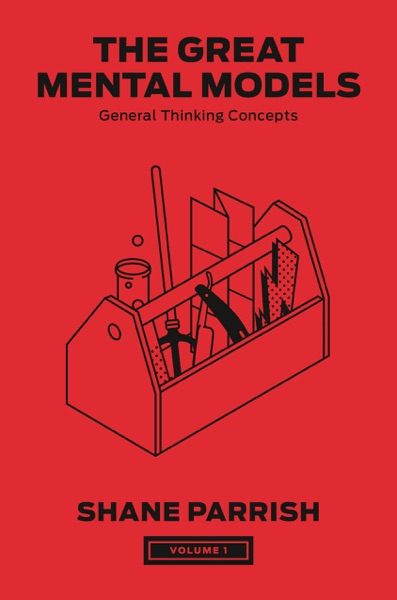
Talk to The Great Mental Models like its author wrote you back.
Get the ideas that fit your life — not generic summaries.
- Chat with the book
- Audiobook-style main ideas
- Adapts to your life and goals
- Helps you take action
The Great Mental Models, in detail
The Great Mental Models is the first volume in Shane Parrish's series drawn from his Farnam Street blog, which he built into one of the most widely read sites on thinking and decision-making. The book's premise is simple: a small number of thinking tools, borrowed from physics, biology, mathematics, and economics, can dramatically improve the quality of decisions across almost any domain. These tools — Parrish calls them mental models — work because reality doesn't care which discipline you're using. The same structural patterns appear in markets, ecosystems, armies, and organizations.
The models Parrish covers in the first volume include the map and the territory (all models are wrong; some are useful), the second-order thinking (what happens after what you think will happen), first-principles reasoning (trace assumptions back to bedrock rather than reasoning by analogy), thought experiments, inversion (think about what you want to avoid as well as what you want to achieve), Occam's Razor, and Hanlon's Razor. Each gets a chapter with a clear explanation, several historical or contemporary examples, and a brief discussion of the model's limits.
The book is explicitly a popularization. Parrish isn't offering original intellectual contributions; he's curating and synthesizing. Readers who have already worked through Charlie Munger's speeches, Richard Feynman's essays, or the behavioral economics literature will find significant overlap. The value is in the organization and accessibility — this is a coherent beginner's toolkit rather than a research-grade treatment of any individual model.
What Parrish does well is make the models feel genuinely useful rather than academic. The examples are well chosen, the writing is clear without being dumbed down, and the recurring emphasis on knowing the limits of each model prevents the book from becoming a collection of intellectual hammers in search of nails. For readers who want a structured introduction to the kind of thinking that shows up in Munger's Poor Charlie's Almanack, Kahneman's work, or Nassim Taleb's essays, this is a reasonable starting point.
The big ideas
- 1.
The map is not the territory. Every model simplifies reality, and the simplifications that make a model useful also create its blind spots.
- 2.
First-principles reasoning — stripping an argument back to its foundational assumptions — is how you escape analogical thinking and inherited received wisdom.
- 3.
Second-order thinking asks: what happens after what I expect to happen? Most decisions fail not because the first-order logic is wrong but because the second-order consequences were ignored.
