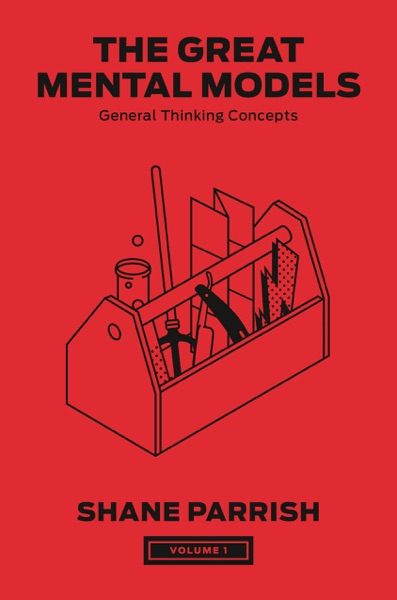
The Great Mental Models by Shane Parrish is a 2019 self-help book about mental models, decision-making, critical thinking. The map is not the territory. Every model simplifies reality, and the simplifications that make a model useful also create its blind spots.
Summary
The Great Mental Models is the first volume in Shane Parrish's series drawn from his Farnam Street blog, which he built into one of the most widely read sites on thinking and decision-making. The book's premise is simple: a small number of thinking tools, borrowed from physics, biology, mathematics, and economics, can dramatically improve the quality of decisions across almost any domain. These tools — Parrish calls them mental models — work because reality doesn't care which discipline you're using. The same structural patterns appear in markets, ecosystems, armies, and organizations.
The models Parrish covers in the first volume include the map and the territory (all models are wrong; some are useful), the second-order thinking (what happens after what you think will happen), first-principles reasoning (trace assumptions back to bedrock rather than reasoning by analogy), thought experiments, inversion (think about what you want to avoid as well as what you want to achieve), Occam's Razor, and Hanlon's Razor. Each gets a chapter with a clear explanation, several historical or contemporary examples, and a brief discussion of the model's limits.
The book is explicitly a popularization. Parrish isn't offering original intellectual contributions; he's curating and synthesizing. Readers who have already worked through Charlie Munger's speeches, Richard Feynman's essays, or the behavioral economics literature will find significant overlap. The value is in the organization and accessibility — this is a coherent beginner's toolkit rather than a research-grade treatment of any individual model.
What Parrish does well is make the models feel genuinely useful rather than academic. The examples are well chosen, the writing is clear without being dumbed down, and the recurring emphasis on knowing the limits of each model prevents the book from becoming a collection of intellectual hammers in search of nails. For readers who want a structured introduction to the kind of thinking that shows up in Munger's Poor Charlie's Almanack, Kahneman's work, or Nassim Taleb's essays, this is a reasonable starting point.
Talk to The Great Mental Models like its author wrote you back.
Get the ideas that fit your life — not generic summaries.
- Chat with the book
- Audiobook-style main ideas
- Adapts to your life and goals
- Helps you take action
Key takeaways
- 1.
The map is not the territory. Every model simplifies reality, and the simplifications that make a model useful also create its blind spots.
- 2.
First-principles reasoning — stripping an argument back to its foundational assumptions — is how you escape analogical thinking and inherited received wisdom.
- 3.
Second-order thinking asks: what happens after what I expect to happen? Most decisions fail not because the first-order logic is wrong but because the second-order consequences were ignored.
- 4.
Inversion is underused. Think about what would guarantee failure and avoid those things as systematically as you pursue success.
- 5.
Circle of competence matters more than breadth of knowledge. Operating inside your competence and knowing where its edges are beats overconfident application of models you only partially understand.
- 6.
Occam's Razor: when multiple explanations fit the data, prefer the simpler one. Complexity is not evidence of depth.
- 7.
Thought experiments — imagining scenarios that can't be physically run — are a legitimate tool for testing reasoning, not a retreat from empiricism.
- 8.
Mental models from different disciplines interact. The best thinkers hold multiple models simultaneously and ask which one applies most usefully to the current situation.
Discussion questions
Use these on your own, with a book club, or as chat starters in Superbook. Book club version, ready to copy or print →
- 1.
Parrish argues that a handful of models from different disciplines can improve reasoning across all domains. Is that claim overstated, or does your experience support it?
- 2.
Which of the models in the book have you actually used — consciously or not — in a real decision? What happened?
- 3.
Think of a recent decision you got wrong. Which mental model, applied earlier, would have changed the outcome?
- 4.
The book emphasizes knowing the edges of your circle of competence. How do you actually know where your competence ends?
- 5.
Parrish draws heavily on Charlie Munger and other investment thinkers. Do mental models that are useful for investing translate cleanly to other domains? Where do they break down?
- 6.
Second-order thinking requires imagining what happens after what you expect. What's a domain in your life where you consistently underestimate second-order effects?
- 7.
Inversion — thinking about how to guarantee failure — is one of the book's recurring tools. Apply it to something you're currently trying to accomplish. What do you find?
- 8.
The book is a curated survey, not original research. Is there value in well-organized curation of ideas that already exist, or does that feel like a shortcut to you?
- 9.
Parrish says good thinkers hold multiple models simultaneously and choose among them. How do you avoid model-shopping — selecting the model that confirms what you already believe?
- 10.
Which mental model from the book do you most frequently see violated in your professional environment? What would change if it were applied more consistently?
- 11.
The series is now multiple volumes. Does the format — one model per chapter, self-contained — suit the subject matter, or would you have preferred a more integrated argument?
- 12.
Munger, Feynman, and other figures Parrish draws on were generalists in a specializing world. Is the multidisciplinary approach they modeled more or less feasible for someone entering a career today?
Themes
Frequently asked questions
-
Is The Great Mental Models worth reading if I've already read Thinking Fast and Slow?
Partially. There is significant overlap on cognitive biases and reasoning errors. Where The Great Mental Models adds value is in the cross-disciplinary framing and the models drawn from physics and engineering rather than behavioral economics. It's a complement, not a substitute.
-
How many volumes are in The Great Mental Models series?
Four as of 2024, covering general thinking tools, physics, chemistry and biology, and military and business strategy. The first volume is the most broadly useful; later volumes go deeper into specific disciplines.
-
Who should read The Great Mental Models?
People early in their thinking-about-thinking journey, or anyone who wants a structured introduction to the models that show up in Munger, Buffett, Feynman, and other polymathic thinkers. It's not a deep treatment of any individual idea, but as an organized overview it works well.
-
What's the single most useful model in the book?
Inversion, by most readers' accounts. The idea that you should systematically think about how to guarantee failure — and avoid those things — is underused relative to its practical value. It applies to investing, project management, parenting, and most other domains where you're trying to achieve a goal.
-
How long is The Great Mental Models?
About 220 pages for the first volume; most readers finish it in three to four hours. The chapters are self-contained, so it works well for reading in short sessions and returning to individual models as they become relevant.
Similar books

Poor Charlie's Almanack
Charlie Munger
Thinking, Fast and Slow
Daniel Kahneman
Thinking in Bets: Making Smarter Decisions When You Don't Have All the Facts
Annie Duke
Algorithms to Live By: The Computer Science of Human Decisions
Brian Christian and Tom Griffiths
