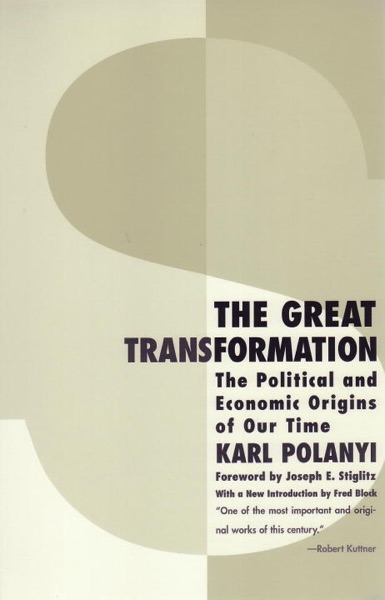
Talk to The Great Transformation like its author wrote you back.
Get the ideas that fit your life — not generic summaries.
- Chat with the book
- Audiobook-style main ideas
- Adapts to your life and goals
- Helps you take action
The Great Transformation, in detail
The Great Transformation is Karl Polanyi's 1944 account of how a self-regulating market economy emerged in nineteenth-century England, what social catastrophe that emergence caused, and why the market society created its own political reaction. Polanyi argues that prior to the Industrial Revolution, markets were embedded in social relations — they served social purposes and were governed by social norms. The great transformation was the attempt, unique in history, to create an autonomous market system that organized society around the price mechanism rather than the other way around.
The core of Polanyi's argument is the concept of fictitious commodities. Land, labor, and money cannot actually be commodities in the strict sense — they were not produced for sale, and treating them as if they were subjects them to the logic of supply and demand in ways that are destructive to the social fabric they support. Labor is human beings; land is nature; money is a purchasing power token whose value depends on social institutions. When the market treats these as ordinary commodities, it generates the pathologies Polanyi documents: the social dislocation of industrialization, the destruction of traditional communities, the degradation of the natural environment.
Polanyi then traces what he calls the double movement: for every extension of market logic, a protective counter-movement arose. Factory acts limiting working hours, Poor Law reform, trade unions, public health legislation — these were not attacks on capitalism from outside but self-protective responses from within society to the damage market expansion caused. The double movement, Polanyi argues, was not ideological but social — conservative and socialist movements alike participated in it because both were responding to the same underlying destructiveness.
The final section links this analysis to the fascism and world wars of the twentieth century. Polanyi argues that the collapse of the liberal economic order and the political catastrophes of the 1930s were not separate events; they were consequences of the same strains that a self-regulating market placed on democratic societies that could not indefinitely absorb its disruptions. The Great Transformation is a demanding book — the historical argument is intricate and the economic concepts require engagement — but its central thesis remains one of the most important frameworks available for understanding why market societies tend to generate political backlash.
The big ideas
- 1.
Markets have historically been embedded in social relations. The nineteenth-century attempt to create a self-regulating, autonomous market system was an unprecedented and in many ways artificial construction.
- 2.
Land, labor, and money are fictitious commodities — they were not produced for sale, and subjecting them to unregulated market mechanisms generates social destruction. This is Polanyi's central empirical claim.
- 3.
The double movement describes the pattern where every extension of market logic generates a counter-movement of social protection. This is not a struggle between capitalism and socialism but between market expansion and societal self-preservation.
