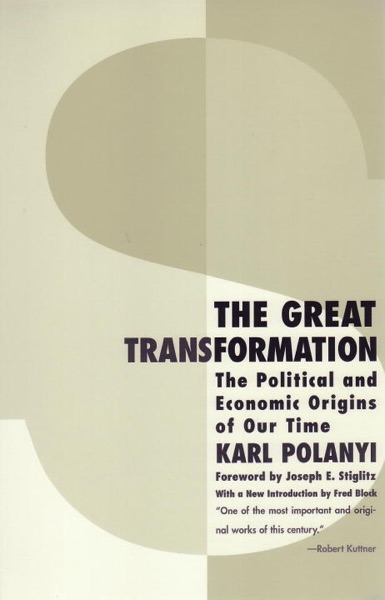
The Great Transformation by Karl Polanyi is a 1944 economics book about markets, society, capitalism. Markets have historically been embedded in social relations. The nineteenth-century attempt to create a self-regulating, autonomous market system was an unprecedented and in many ways artificial construction.
Summary
The Great Transformation is Karl Polanyi's 1944 account of how a self-regulating market economy emerged in nineteenth-century England, what social catastrophe that emergence caused, and why the market society created its own political reaction. Polanyi argues that prior to the Industrial Revolution, markets were embedded in social relations — they served social purposes and were governed by social norms. The great transformation was the attempt, unique in history, to create an autonomous market system that organized society around the price mechanism rather than the other way around.
The core of Polanyi's argument is the concept of fictitious commodities. Land, labor, and money cannot actually be commodities in the strict sense — they were not produced for sale, and treating them as if they were subjects them to the logic of supply and demand in ways that are destructive to the social fabric they support. Labor is human beings; land is nature; money is a purchasing power token whose value depends on social institutions. When the market treats these as ordinary commodities, it generates the pathologies Polanyi documents: the social dislocation of industrialization, the destruction of traditional communities, the degradation of the natural environment.
Polanyi then traces what he calls the double movement: for every extension of market logic, a protective counter-movement arose. Factory acts limiting working hours, Poor Law reform, trade unions, public health legislation — these were not attacks on capitalism from outside but self-protective responses from within society to the damage market expansion caused. The double movement, Polanyi argues, was not ideological but social — conservative and socialist movements alike participated in it because both were responding to the same underlying destructiveness.
The final section links this analysis to the fascism and world wars of the twentieth century. Polanyi argues that the collapse of the liberal economic order and the political catastrophes of the 1930s were not separate events; they were consequences of the same strains that a self-regulating market placed on democratic societies that could not indefinitely absorb its disruptions. The Great Transformation is a demanding book — the historical argument is intricate and the economic concepts require engagement — but its central thesis remains one of the most important frameworks available for understanding why market societies tend to generate political backlash.
Talk to The Great Transformation like its author wrote you back.
Get the ideas that fit your life — not generic summaries.
- Chat with the book
- Audiobook-style main ideas
- Adapts to your life and goals
- Helps you take action
Key takeaways
- 1.
Markets have historically been embedded in social relations. The nineteenth-century attempt to create a self-regulating, autonomous market system was an unprecedented and in many ways artificial construction.
- 2.
Land, labor, and money are fictitious commodities — they were not produced for sale, and subjecting them to unregulated market mechanisms generates social destruction. This is Polanyi's central empirical claim.
- 3.
The double movement describes the pattern where every extension of market logic generates a counter-movement of social protection. This is not a struggle between capitalism and socialism but between market expansion and societal self-preservation.
- 4.
The Speenhamland system — a form of rural income supplement in England — was meant to protect agricultural laborers but instead depressed wages by subsidizing employers. Polanyi uses it to show how social protection and market logic can interact in unexpected ways.
- 5.
The gold standard was a mechanism for subordinating national economic policy to the requirements of international trade. Its rigidity contributed directly to the political crises of the 1920s and 1930s.
- 6.
Fascism emerged partly as a response to the failure of liberal market society to protect populations from economic dislocation. The political catastrophes of the twentieth century were not separate from the economic history Polanyi traces.
- 7.
Freedom in a complex society requires planning and intervention, not its absence. The naive liberal equation of freedom with unregulated markets ignores the social infrastructure that makes markets possible.
- 8.
Polanyi's framework predicts recurring backlash against economic globalization: as market integration advances, protective counter-movements will arise regardless of ideology, because the underlying social damage is real.
Discussion questions
Use these on your own, with a book club, or as chat starters in Superbook. Book club version, ready to copy or print →
- 1.
Polanyi argues that markets were 'embedded' in social relations before the Industrial Revolution and became 'disembedded' by the nineteenth-century transformation. Is that a useful distinction, or does it romanticize pre-industrial economies?
- 2.
The concept of fictitious commodities — treating labor, land, and money as ordinary tradeable goods — is central to Polanyi's argument. Does this concept hold up when you examine contemporary labor markets or financial systems?
- 3.
The double movement suggests that market expansion automatically generates protective counter-movements. Do you see evidence of this dynamic in contemporary politics — in responses to globalization, gig work, or AI displacement?
- 4.
Polanyi is sympathetic to the protective counter-movement but acknowledges it can lead to fascism as well as social democracy. What determines which form the counter-movement takes?
- 5.
He argues that the gold standard contributed to the political crises of the 1920s by preventing countries from using economic policy to respond to downturns. Does this analysis apply to analogous institutions today — the Euro, for example?
- 6.
Polanyi wrote in 1944, when the outcome of the war was still uncertain. How does knowing the subsequent history — the postwar settlement, the Bretton Woods system, the welfare state — change how you read his analysis?
- 7.
He argues that naive liberalism equates freedom with the absence of regulation, but genuine freedom requires social institutions. Is this distinction persuasive, or does it risk justifying unlimited intervention?
- 8.
The book is often invoked by both left and right critics of free markets. What is it about Polanyi's framework that makes it available to critics across the political spectrum?
- 9.
Polanyi's treatment of England in the nineteenth century is detailed; his treatment of other countries is less so. Does the English case generalize, or is there something specific about English industrialization that limits the framework's applicability?
- 10.
The Speenhamland system is Polanyi's key example of how social protection can produce perverse outcomes. Can you think of contemporary equivalents — cases where protective institutions have had unexpected market effects?
- 11.
If Polanyi's double movement thesis is correct, what does it predict about the next decade of political economy in countries most affected by automation and deindustrialization?
Themes
Frequently asked questions
-
Is The Great Transformation difficult to read?
Yes, by popular non-fiction standards. Polanyi's argument is intricate, the historical detail is dense, and several key concepts require careful engagement to follow. It rewards a slow reading rather than a quick one. But the core argument — fictitious commodities, the double movement — is recoverable from the first three chapters, and the rest builds on that foundation.
-
Is the book left-wing?
Polanyi is critical of self-regulating market doctrine, which makes the book available as ammunition for the left. But his analysis is not Marxist, and his concern is the protection of social institutions rather than class struggle. He is skeptical of laissez-faire liberalism; he is not a socialist in the traditional sense.
-
How relevant is a 1944 book to contemporary economics?
Very. The framework Polanyi developed — embedding/disembedding, fictitious commodities, double movement — has been extensively applied to globalization, financial crises, and contemporary inequality. The core analysis became more relevant after the 2008 financial crisis and the political reactions to globalization that followed.
-
What's the most important idea to take away?
The double movement. The idea that market expansion reliably generates protective political counter-movements — regardless of ideology — is a simple and powerful predictive framework that makes sense of a wide range of political developments.
-
Where should I start if this seems too daunting?
Read the first two chapters, which lay out the core argument clearly, and then the final chapter on the political consequences. The middle sections on nineteenth-century England are essential for the full argument but can be read selectively if time is limited.
Similar books
Guns, Germs, and Steel
Jared Diamond
Thinking, Fast and Slow
Daniel Kahneman
Freakonomics
Steven D. Levitt and Stephen J. Dubner
The New Jim Crow: Mass Incarceration in the Age of Colorblindness
Michelle Alexander
