History · Book club
The Gulag Archipelago book club questions
Here are 12 book club questions for The Gulag Archipelago by Aleksandr Solzhenitsyn, ordered to open easily and end somewhere worth arguing about. Copy them, print them, or bring them up one at a time.
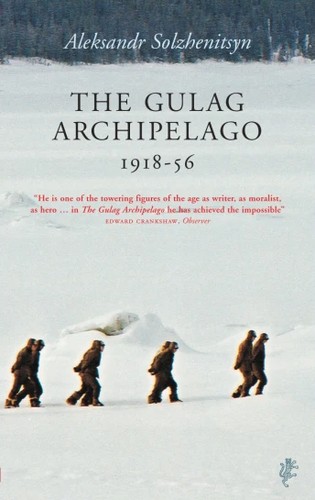
The Gulag Archipelago is Aleksandr Solzhenitsyn's monumental account of the Soviet forced-labor camp system.
Aleksandr Solzhenitsyn · 1973 · 24h 0m
Full summary and key takeaways →The 12 questions
- 1.
Solzhenitsyn argues the Gulag had ideological roots in Leninism, not just Stalinism. Does that argument change how you think about the history of the Soviet Union?
- 2.
He claims the line between good and evil runs through every human heart. Is that a comforting or a disturbing idea? What does it demand of the reader?
- 3.
The book documents widespread collaboration and denunciation among ordinary people. What conditions do you think make ordinary people willing to inform on their neighbors?
- 4.
Solzhenitsyn is critical of Soviet intellectuals who rationalized or ignored the terror. What are the equivalent blind spots among intellectuals today?
- 5.
How does the book's sheer scale — millions of individual stories compressed into one document — affect its emotional and moral impact compared to a single memoir?
- 6.
Solzhenitsyn asks why prisoners didn't resist more. Do you find his answer satisfying? What would resistance have required, and at what cost?
- 7.
The Gulag depended on a legal and bureaucratic apparatus staffed by thousands of ordinary civil servants. What does that say about the relationship between institutions and atrocity?
- 8.
Which passages or individual stories in the book stayed with you most, and why?
- 9.
The book was suppressed for decades in the Soviet Union. What does that tell us about the relationship between historical truth-telling and political power?
- 10.
Solzhenitsyn is a deeply religious thinker who sees the Gulag partly as a spiritual catastrophe. Does that framing help or limit the book's moral analysis?
- 11.
How does reading this book change — if at all — how you think about the institutions and political systems you live inside today?
- 12.
Solzhenitsyn himself survived partly because of specific contingencies and decisions. How does the presence of luck in survival stories affect our moral conclusions about victims and perpetrators?
How to run the discussion
- Pick six to eight, not all of them. An hour of real discussion covers fewer questions than anyone expects, and racing the list is what makes a book club feel like homework.
- Open with what people noticed, not what they concluded. Asking for a verdict first hardens opinions before anyone has heard each other.
- Let the disagreement run. The questions below that split a room are the ones worth the time; the ones everyone answers the same way can be skipped.
- Ask the quiet person a specific question. A direct, narrow question is far easier to answer than an open invitation to contribute.
Themes worth steering toward
If the conversation stalls, these are the threads that usually restart it.
Common questions
What are good book club questions for The Gulag Archipelago?
Here are 12 book club questions for The Gulag Archipelago by Aleksandr Solzhenitsyn, ordered to open easily and end somewhere worth arguing about. The strongest openers ask what each reader noticed rather than what they concluded, and the discussion usually turns on totalitarianism, political repression, survival.
How long should a book club discussion of The Gulag Archipelago last?
Most groups run 60 to 90 minutes of actual discussion. That is roughly six to eight questions, not all of them, so pick the ones that suit your group rather than working down the list in order.
What are the main themes in The Gulag Archipelago?
Totalitarianism, Political repression, Survival, Soviet history, Human dignity. Those are the threads most likely to divide a room, which makes them the useful places to steer a discussion that has gone quiet.
Picking the next one? See books like The Gulag Archipelago or questions for other book club picks.
