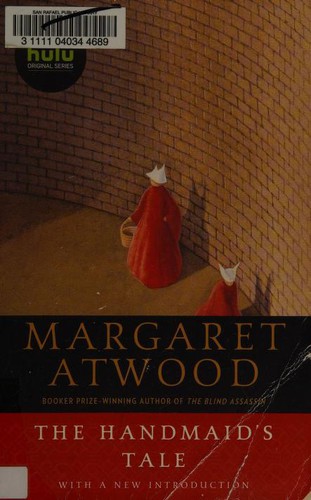
Talk to The Handmaid's Tale like its author wrote you back.
Get the ideas that fit your life — not generic summaries.
- Chat with the book
- Audiobook-style main ideas
- Adapts to your life and goals
- Helps you take action
What it argues
The Handmaid's Tale is set in the near-future theocratic Republic of Gilead, carved out of what was once the northeastern United States after a coup by a fundamentalist Christian movement. The narrator, known only as Offred, is a Handmaid — a woman assigned to a high-ranking Commander and his wife for the sole purpose of bearing children, in a society where most women are infertile from environmental contamination. Offred narrates from memory, reconstructing events she is not entirely certain she has preserved accurately. The frame of the novel — a historical note from scholars centuries later — suggests she survived.
The novel is about many things at once. It is a political satire directed at a particular strand of American religious conservatism, and Atwood has been emphatic that everything in the novel has a historical precedent — she invented nothing, only recombined. It is also a study of how people adapt to degradation incrementally, how institutions of oppression require the participation of the oppressed, and how women in particular can be deployed against each other in the service of male power. Offred's relationship with the Wife, Serena Joy, is one of the book's most chilling dynamics: two women who hate each other trapped in the same system.
What it gets right
- 1.
Atwood's most chilling formal choice is making Offred unreliable not through deception but through trauma — she doesn't know what she remembers accurately, and neither do we.
- 2.
The novel argues that totalitarian systems require participation from those they oppress. The Aunts — women who enforce Gilead's rules on other women — are the most disturbing example.
- 3.
Language is a central weapon in Gilead: Handmaids are named after their Commanders (Offred = Of Fred), and controlling what can be said is how the regime controls what can be thought.
What it covers
Who wrote it
Margaret Atwood is a Canadian poet, novelist, and essayist and one of the most celebrated writers in the English language. Her novels include Cat's Eye, Alias Grace, The Blind Assassin (Booker Prize, 2000), Oryx and Crake, and The Testaments (Booker Prize, 2019), the latter a sequel to The Handmaid's Tale. She has written poetry collections, short fiction, and critical essays. She is a Fellow of the Royal Society of Canada and has received numerous honorary degrees. The Handmaid's Tale, published in 1985, has sold millions of copies and has become a defining work of feminist literature and political dystopia.
