Science fiction · Book club
The Hitchhiker's Guide to the Galaxy book club questions
Here are 11 book club questions for The Hitchhiker's Guide to the Galaxy by Douglas Adams, ordered to open easily and end somewhere worth arguing about. Copy them, print them, or bring them up one at a time.
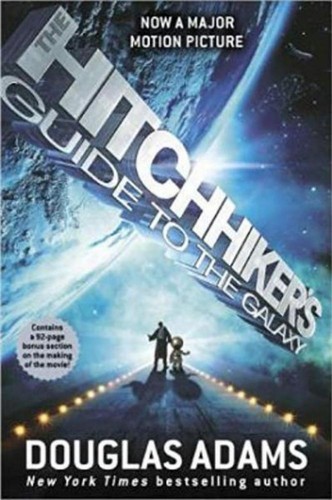
The Hitchhiker's Guide to the Galaxy begins with Earth being demolished to make way for a hyperspace bypass.
Douglas Adams · 1979 · 3h 0m
Full summary and key takeaways →The 11 questions
- 1.
Adams argues, through the 42 joke, that demanding a computational answer to the meaning of existence is a category error. Do you find that argument satisfying or a dodge?
- 2.
Marvin is depressed because he has vast intelligence and nothing adequate to apply it to. Is his depression a critique of intelligence, of purpose, or of the universe itself?
- 3.
The Earth was a computer built by mice to find the Question to the Answer 42. What does Adams do with the reveal that humanity's entire history was an experiment we didn't know we were running?
- 4.
Ford and Arthur's friendship is real despite being based on a fundamental deception about who Ford is. Does the friendship survive that context, and does Adams seem to think it matters?
- 5.
The Vogons are evil through pure bureaucratic compliance. Is that a more or less frightening form of evil than ideological cruelty? Does Adams treat it as comedy, horror, or both?
- 6.
The book is very English in its specific textures: tea, planning offices, the English countryside. Does that particularity make the cosmic comedy work better or limit it?
- 7.
Adams is often read as nihilistic — nothing means anything, the universe is indifferent. Is that the actual argument of the book, or is it more complicated than that?
- 8.
The novel is genuinely funny forty-five years after publication, which is unusual. What has kept the comedy working when most satire from the same period hasn't?
- 9.
The sequels (Restaurant at the End of the Universe through Mostly Harmless) get progressively darker. Is the original's lightness sustainable, or does Adams's eventual bleakness feel like the honest completion of what the first book begins?
- 10.
If you've read the book before, is there anything you took from it differently this time — as an adult, or at this particular moment?
- 11.
Adams said the series is 'essentially about the search for meaning in the universe and the fact that you won't find any.' Is that despair, acceptance, or something else you'd name differently?
How to run the discussion
- Pick six to eight, not all of them. An hour of real discussion covers fewer questions than anyone expects, and racing the list is what makes a book club feel like homework.
- Open with what people noticed, not what they concluded. Asking for a verdict first hardens opinions before anyone has heard each other.
- Let the disagreement run. The questions below that split a room are the ones worth the time; the ones everyone answers the same way can be skipped.
- Ask the quiet person a specific question. A direct, narrow question is far easier to answer than an open invitation to contribute.
Themes worth steering toward
If the conversation stalls, these are the threads that usually restart it.
Common questions
What are good book club questions for The Hitchhiker's Guide to the Galaxy?
Here are 11 book club questions for The Hitchhiker's Guide to the Galaxy by Douglas Adams, ordered to open easily and end somewhere worth arguing about. The strongest openers ask what each reader noticed rather than what they concluded, and the discussion usually turns on absurdism, meaning and meaninglessness, bureaucracy.
How long should a book club discussion of The Hitchhiker's Guide to the Galaxy last?
Most groups run 60 to 90 minutes of actual discussion. That is roughly six to eight questions, not all of them, so pick the ones that suit your group rather than working down the list in order.
What are the main themes in The Hitchhiker's Guide to the Galaxy?
Absurdism, Meaning and meaninglessness, Bureaucracy, Human insignificance, Friendship. Those are the threads most likely to divide a room, which makes them the useful places to steer a discussion that has gone quiet.
Picking the next one? See books like The Hitchhiker's Guide to the Galaxy or questions for other book club picks.
